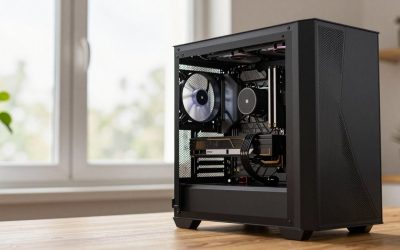
Whether you are buying a prebuilt or planning a build, knowing which components matter most helps you spend wisely and avoid unbalanced systems. Not every part deserves an equal share of your budget.
- The GPU Is the Priority
- A Balanced CPU
- Enough RAM at the Right Speed
- Fast Storage
- Do Not Skimp on the Power Supply
- Cooling and Case Airflow
- Match the PC to Your Monitor
- Leave Room to Upgrade
- Final Thoughts and Quick Recap
- Keeping Your PC in Good Shape
- A Quick Checklist
- Where to Go From Here
- Frequently Asked Questions
- Related Guides
This guide explains what to prioritise in a gaming PC in 2026, from the GPU to the power supply.
As an Amazon Associate we earn from qualifying purchases at no extra cost to you.

The GPU Is the Priority
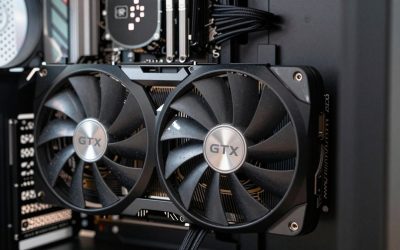
For gaming, the graphics card has the biggest impact on frame rates, so it should take the largest share of your budget. Match the GPU to your target resolution: a mid-range card for 1080p/1440p, a high-end card for 4K.
Avoid pairing a weak GPU with an expensive CPU; the GPU is what drives gaming performance most.
A Balanced CPU
The CPU should be strong enough not to bottleneck your GPU, but you rarely need the most expensive chip for gaming. A good mid-range CPU with strong single-thread performance suits most gamers; high-refresh and CPU-heavy games benefit from more.
Balance is key: a mid-range CPU with a strong GPU beats the reverse for gaming.
Enough RAM at the Right Speed
32GB is the modern sweet spot, with 16GB the workable minimum. Run two sticks in dual-channel and enable XMP/EXPO so the RAM hits its rated speed. Capacity and dual-channel matter more than chasing extreme frequencies.
Skimping to a single stick or leaving XMP off quietly costs gaming performance.
Fast Storage
An NVMe SSD for Windows and games is essential in 2026 for fast loads and to support features like DirectStorage. Aim for 1-2TB given how large modern games are, and add a larger drive for bulk storage if needed.
Do not settle for a hard drive as your main drive; the difference in responsiveness is night and day.
Do Not Skimp on the Power Supply
A quality power supply from a reputable brand with an appropriate wattage and an 80 Plus rating protects your whole system. A cheap PSU is a false economy that can cause instability or, at worst, damage components.
Choose enough wattage for your GPU with headroom for future upgrades.
Cooling and Case Airflow
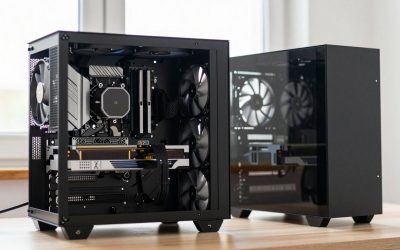
Adequate CPU cooling and a case with good airflow keep components fast and quiet. A balanced set of intake and exhaust fans and a capable CPU cooler prevent thermal throttling.
Airflow is often overlooked but directly affects sustained performance and noise.
Match the PC to Your Monitor
Buy components to suit your display. A 1080p high-refresh monitor pairs with a strong mid-range GPU, while 1440p and 4K need progressively more GPU power. There is little point pairing a 4K card with a 1080p 60Hz screen, or vice versa.
Deciding your target resolution and refresh rate first makes every other component choice clearer.
Leave Room to Upgrade
Choose a power supply with headroom, a case with space for larger coolers and GPUs, and a motherboard on a current platform so future CPU and RAM upgrades are possible. A little foresight extends the useful life of the build.
Standard, non-proprietary parts keep your upgrade options open for years.
Final Thoughts and Quick Recap
What to Look for in a Gaming PC comes down to a few simple habits: use trusted, official sources, change one thing at a time, and confirm the result before moving on. That keeps your PC stable and saves hours of guesswork, whether you are a first-time builder or a seasoned enthusiast.
The guidance above on what to look for in a gaming pc is quick, safe and reversible, so there is little risk in following it. A little care now pays off across every game and task you run, and it keeps the rest of your build healthy too.
Bookmark this guide and revisit it whenever you upgrade a part or hit a new issue, and use the related guides below to keep the whole system in top shape. Consistent small maintenance always beats occasional big fixes.
Keeping Your PC in Good Shape
Whatever brought you to this guide on what to look for in a gaming pc, the same principle applies across your whole system: small, regular attention prevents big problems later. Keep drivers and firmware current on a sensible schedule, watch your temperatures, leave some free space on your drives, and enable your memory profile so the hardware you paid for runs at full speed.
None of this needs deep technical knowledge or costly tools; the free utilities and official software mentioned here are enough to keep a gaming PC fast and reliable for years. Building these habits now means fewer nasty surprises when you are in the middle of a game you love.
A Quick Checklist
Before you finish with what to look for in a gaming pc, run through the essentials one more time: use official software and sources, apply changes one at a time, verify each result, and keep a note of what you changed. This simple discipline turns a fiddly task into a repeatable, low-stress routine.
If something does not work as expected, undo the last change rather than piling on more, and re-check from a known-good state. Most problems around what to look for in a gaming pc come from changing too much at once rather than from the change itself.
Where to Go From Here
With what to look for in a gaming pc handled, it is worth giving the rest of your system the same quick attention: confirm drivers and firmware are current, temperatures are healthy, drives have free space, and your memory profile is enabled. A balanced, well-maintained PC performs better and lasts longer than one where a single part has been over-tuned.
The related guides below cover these neighbouring topics, so you can keep the whole build in good shape rather than fixing one thing while another quietly holds you back.
Frequently Asked Questions
What is the most important part of a gaming PC?
The GPU; it has the biggest impact on frame rates and should get the largest share of a gaming budget.
How much RAM do I need for gaming?
32GB is the sweet spot, 16GB the minimum, in dual-channel with XMP/EXPO enabled.
Do I need an NVMe SSD for gaming?
Yes for fast loads and DirectStorage support; a 1-2TB NVMe drive is ideal as the main drive.
Why does the power supply matter?
A quality PSU protects the whole system; a cheap one risks instability or damage, so never skimp on it.
Related Guides
- Are Prebuilt Gaming PCs Worth It?
- Prebuilt vs Custom Gaming PC: Which Should You Buy?
- How Much RAM Do You Need for Gaming?
- NVMe vs SATA SSD: What’s the Difference?