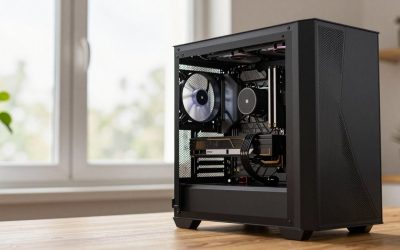
Undertale is one of the least demanding PC games you can install on a modern system. Released in 2015 and built with GameMaker using retro-style 2D pixel graphics, it asks for a 128 MB graphics solution, 2 GB of RAM and 200 MB of disk space — figures that virtually any desktop or laptop sold in the last decade clears without effort. You do not need a dedicated graphics card, a gaming CPU, or more than a few gigabytes of memory to play it. If your PC can browse the web and play video smoothly, it can play Undertale.
- Undertale Official PC System Requirements
- How Demanding Is Undertale Really?
- GPU Recommendations by Resolution: What to Expect
- CPU, RAM and Storage Notes That Actually Matter for Undertale
- Example Builds for Undertale
- Laptop and Handheld Suitability: Steam Deck, ROG Ally and More
- Settings That Actually Raise FPS in Undertale
- Frequently Asked Questions
Undertale Official PC System Requirements
| Component | Minimum (official) | Recommended (official) |
|---|---|---|
| OS | Windows XP, Vista, 7, 8, or 10 | Windows XP, Vista, 7, or 10 |
| Processor | – | 2GHz+ |
| Memory | 2 GB RAM | 3 GB RAM |
| Graphics | 128MB | 512MB |
| Storage | 200 MB available space | 200 MB available space |
Source: the official Undertale Steam store listing (app 391540), checked October 2026. Publishers can update these specs after patches.
The official requirements come in two tiers, and both are modest. The minimum tier lists Windows XP through Windows 10, 2 GB of RAM, a 128 MB graphics solution and 200 MB of available storage. The recommended tier keeps the same operating systems and the same storage figure, but adds a 2 GHz or faster processor, 3 GB of RAM and 512 MB of graphics memory. Nothing in either list calls for a dedicated GPU, a multi-core processor or an SSD. Note that the official OS list stops at Windows 10; Windows 11 machines run the game without issue in practice.
How Demanding Is Undertale Really?
Not demanding at all — and that is the whole story. Undertale does not use complex shaders, high-resolution textures, ray tracing, physics simulation, or a large open world that has to be streamed from storage. It is a 2D sprite-based RPG with simple effects and a small set of hand-drawn assets, designed in 2015 to run on the low-end Windows machines of that era.
In practice the GPU is almost never the limiting factor. The official minimum asks for just 128 MB of graphics memory, a bar that integrated chips and cards from well over a decade ago already clear — Intel HD Graphics 4000, AMD Radeon HD 4000-series integrated graphics, or an NVIDIA GeForce 8000-series card. The recommended tier tops out at 512 MB of graphics memory and a 2 GHz processor, so a basic dual-core chip is sufficient. System memory use is measured in a few hundred megabytes, which is exactly why 2 GB of RAM is all the minimum asks for.
Because the game is so small, it is not a meaningful benchmark for modern hardware. There is nothing to measure between a budget card and a flagship one, and the entire install — assets, music and save files — is smaller than a single texture pack in a modern 3D title. There is no heavy physics simulation, no AI crowd and no procedural world generation to tax the processor either.
Treat Undertale as a game that runs on a class of hardware rather than a specific tier. If a machine meets the official minimum of 2 GB of RAM and 128 MB of graphics memory, it will play the game the way it was meant to be played.
GPU Recommendations by Resolution: What to Expect
You should not buy a graphics card for Undertale. The game renders at a low internal resolution and scales to fit your display, so moving from 1080p to 1440p to 4K barely changes the workload. The guidance below is for people who are already choosing a GPU for other games and simply want confirmation that Undertale will be fine on it.
1080p (Full HD)
At 1080p, any integrated graphics will do. Intel HD Graphics 4000 and newer, Intel UHD Graphics 620, 730 and 770, Intel Iris Xe, AMD Radeon Vega 3, 6 and 8, and AMD Radeon 610M and 780M all clear the official 128 MB graphics minimum by a wide margin and run the game without strain. Dedicated cards are equally effortless: an NVIDIA GeForce GTX 750 Ti, GTX 1050, GTX 1650, RTX 3050 or RTX 5060, or an AMD Radeon RX 460, RX 6600, RX 7600 or RX 9060 XT, are all far beyond what this game can use. On a card like that, Undertale will sit idle while you play.
1440p (QHD)
1440p does not meaningfully change the load for a 2D pixel game, because there is no high-resolution texture set to store, filter or stream. The same integrated graphics listed above remain sufficient, and the official 512 MB graphics recommendation is still comfortably met by anything from the last decade. A dedicated card offers no visible benefit for Undertale at this resolution. If you use a 1440p monitor for work or for other games, Undertale will simply scale up, and how it looks depends on your display’s scaling behaviour rather than on GPU power.
4K (Ultra HD)
Even at 4K, Undertale remains trivial to run. Its native art is low-resolution and is upscaled to fill the screen, so the render cost barely increases. Integrated graphics from the last several years handle it comfortably, and a modern discrete card such as an RTX 5060 or RX 9060 XT is enormous overkill. Stepping up to an RTX 5070 or RX 9070 buys you nothing for this title. The only thing worth adjusting at 4K is integer scaling on your display, which is a display setting rather than a performance one and has no impact on how the game runs.
In short, do not base a GPU purchase on Undertale, and do not base it on resolution. Choose your card for the other games you play; Undertale will run on whatever you choose.
CPU, RAM and Storage Notes That Actually Matter for Undertale
CPU
The official recommended spec asks for a 2 GHz or faster processor, and the minimum tier does not list a processor requirement at all. That means essentially any CPU from the last fifteen years qualifies, including old budget parts such as Intel Celeron, Pentium, Core i3 and Core i5 chips, and AMD A-series, Athlon, Ryzen 3 and Ryzen 5 processors. A modern chip like the Intel Core i3-12100 or Core i5-12400, or an AMD Ryzen 5 5600G or Ryzen 5 7600, will be almost entirely idle while Undertale runs. There is no simulation, pathfinding load or large multiplayer state to process, so a faster CPU does not produce a better experience here — this is not a CPU-bound game, and background tasks such as a browser or a chat client will not change that on a modern system.
RAM
The official minimum is 2 GB of system RAM and the recommended figure is 3 GB. Undertale itself uses only a fraction of that, typically a few hundred megabytes. On a modern machine the practical floor is whatever Windows itself needs, and 8 GB is a sensible amount for comfortable general use with a browser and other apps open — but more than that does not improve Undertale in any way. RAM speed and dual-channel configurations make no measurable difference to a game this small.
Storage
Undertale needs 200 MB of free space, and that figure has not changed since launch. It runs equally well from a mechanical hard drive, a SATA SSD or an NVMe drive. An SSD only shortens the initial launch slightly, because the assets are tiny and there is no world streaming, texture pop-in or shader compilation to wait on. Fan projects built in the same engine, such as Undertale Yellow, are similarly small and do not change the storage picture in any meaningful way.
Example Builds for Undertale
Since almost any PC can run Undertale, these are not Undertale-specific builds. They show what a general-purpose machine looks like at two common levels and confirm that the game is covered at both.
Budget / Office-Level PC
This class is more than enough for Undertale at any resolution. A refurbished office desktop or a budget laptop with an Intel Core i3-10100 or i3-12100, an Intel N100, or an AMD Ryzen 3 3200G or Ryzen 5 5600G, paired with 8 GB of RAM, integrated graphics and a 256 GB SATA or NVMe SSD, meets or exceeds every official figure. No dedicated GPU is needed. The same machine also handles web browsing, office work, indie games and emulation of older consoles without trouble.
Mainstream 1080p Gaming PC
If you also play modern games, a mainstream build — an Intel Core i5-12400 or i5-14400, or an AMD Ryzen 5 5600 or Ryzen 5 7600, with 16 GB of RAM, a 512 GB NVMe SSD and a GPU such as an NVIDIA GeForce RTX 3050, RTX 4060 or RTX 5060, or an AMD Radeon RX 6600, RX 7600 or RX 9060 XT — is a balanced choice for everything else in your library. For Undertale, this hardware is essentially idle, and the game will run with minimal power draw.
You do not need anything stronger than this for Undertale. A high-end card such as an RTX 5070 or RX 9070 offers no advantage for this title at any resolution.
Laptop and Handheld Suitability: Steam Deck, ROG Ally and More
Undertale is an excellent fit for laptops and handhelds, and it suits short portable sessions particularly well.
Laptops: Any Windows laptop from the last decade with integrated graphics meets the official requirements comfortably, with quiet fans and long battery life. Thin-and-light machines, budget school laptops and older ultrabooks all qualify, because the game never pushes the CPU or GPU hard enough to raise power draw significantly.
Steam Deck: Undertale is Steam Deck Verified and runs without any tweaking on both the LCD and OLED models. The built-in gamepad works out of the box, the text is readable on the 7-inch screen, and power draw is low enough for long sessions away from a charger. No settings changes are required.
ROG Ally, Legion Go, MSI Claw and similar: All Windows-based handhelds run Undertale without issue at their native resolutions. Their hardware sits far above the official minimum and recommended specs, so you can comfortably play on battery with a low TDP limit for extended sessions.
Older handhelds and low-power tablets: Because the game is so light, devices such as the GPD Win and older Surface tablets with Intel Atom or Core m3 chips can play it well, provided they meet the 2 GB RAM minimum and run a supported version of Windows.
Settings That Actually Raise FPS in Undertale
Undertale has very few graphics options, and most systems will not need to touch them. If you do notice stutter or uneven motion, the cause is usually vsync behaviour or background software rather than a lack of hardware power. These steps generally help:
- Fullscreen vs. Windowed: Undertale can run fullscreen or in a window. Fullscreen can slightly reduce input lag on some systems, while windowed mode makes alt-tabbing easier. Try both if you see tearing or stutter; the performance difference between them is small on modern Windows.
- VSync on or off: Screen tearing is usually solved by enabling VSync, either in the game or in your GPU control panel. On a high-refresh monitor, forcing VSync off or lowering the display refresh rate while playing can also remove perceived choppiness. This is the single most common fix for uneven motion in a game this light.
- Close unnecessary background apps: On an older PC with only 2-4 GB of RAM, closing a browser with many tabs frees memory and CPU time. Undertale will not max out your system on its own, but Windows needs headroom to stay responsive.
- Integer scaling on high-resolution displays: At 1440p or 4K, enabling integer scaling in the Intel, NVIDIA or AMD graphics control panel keeps the pixel art sharp. It does not raise frame rate, but it is the best visual tweak available for a low-resolution 2D game and costs nothing in performance.
There are no texture quality, shadow or anti-aliasing settings to lower in Undertale. If the game still feels uneven on a modern PC, check your graphics drivers and any forced frame-rate limits in your GPU software before considering a hardware upgrade — for this game, one is almost certainly not needed.
Frequently Asked Questions
Can I run Undertale without a graphics card?
Yes. The official minimum asks for a 128 MB graphics solution, which integrated graphics clear easily, and the recommended tier asks for 512 MB. You do not need a dedicated NVIDIA or AMD card. Intel HD and UHD Graphics, Intel Iris Xe and AMD Radeon integrated graphics are all sufficient at 1080p, 1440p and 4K.
How much RAM do I really need for Undertale?
The official minimum is 2 GB and the recommended figure is 3 GB, though on a modern Windows install 8 GB is a sensible amount for general use alongside a browser and other apps. Undertale itself uses only a few hundred megabytes, so adding more memory will not change how it runs.
Does Undertale run on Steam Deck and at what frame rate?
Yes, it is Steam Deck Verified and runs without configuration on both the LCD and OLED models, and equally well on Windows handhelds such as the ROG Ally and Legion Go. The official requirements sit far below what these devices offer, so there is no frame-rate concern on any of them.
Do I need an SSD for Undertale?
No. Any storage type works — hard drive, SATA SSD or NVMe — and the game only needs 200 MB of free space. An SSD shortens the initial launch slightly, but it does not change how the game runs.