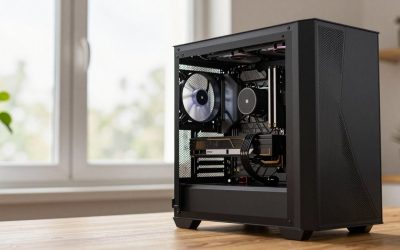
The classic question for any new gaming PC buyer is whether to buy a prebuilt or build a custom rig. Both are valid in 2026, and the best choice depends on your budget, skills and goals.
- Value for Money
- Convenience and Time
- Component Quality and Control
- Upgradeability
- Warranty and Support
- Which Should You Choose?
- The Learning Curve of Building
- Total Cost of Ownership
- Final Thoughts and Quick Recap
- Keeping Your PC in Good Shape
- A Quick Checklist
- Where to Go From Here
- Frequently Asked Questions
- Related Guides
This guide directly compares prebuilt and custom gaming PCs across value, convenience, upgradeability and support.
As an Amazon Associate we earn from qualifying purchases at no extra cost to you.

Value for Money
A custom build typically gives more performance per dollar because you choose each component and avoid markup on assembly. Prebuilts add a convenience premium, though bulk buying can narrow the gap, especially on GPUs during shortages.
If squeezing maximum performance from your budget matters most, building wins.
Convenience and Time
Prebuilts win on convenience: they arrive assembled, tested and ready to play, with no time spent researching compatibility or building. For busy people or first-timers, that is a major advantage.
Building takes a few hours plus research time, which some enjoy and others would rather skip.
Component Quality and Control
Building lets you pick a quality PSU, the exact GPU model, dual-channel RAM and the case you want, avoiding the corners some prebuilts cut. With a prebuilt, you must scrutinise the spec sheet for weak parts.
Control over every component is a core reason enthusiasts build their own.
Upgradeability
Custom builds use standard parts that are easy to upgrade later. Some budget prebuilts use proprietary motherboards, power supplies or cases that limit future upgrades, so check before buying.
If you plan to upgrade over time, a standard-parts build or a prebuilt using standard components is important.
Warranty and Support
Prebuilts offer single-source warranty and support for the whole system, which is reassuring for a first PC. With a custom build, each part is warrantied separately and troubleshooting is your responsibility.
Weigh the peace of mind of unified support against the value and control of building.
Which Should You Choose?
Build your own for the best value, control and upgradeability if you are willing to learn. Buy a prebuilt for convenience, a single warranty, and when a well-specced model is fairly priced. Either way, prioritise a strong GPU, dual-channel RAM, a quality PSU and good cooling.
There is no wrong answer; match the choice to your comfort level and priorities.
The Learning Curve of Building
Modern PC building is largely plug-and-play, with clear guides and keyed connectors that are hard to install wrong. The main hurdles are patience and confirming compatibility, which tools and checklists handle. Many first-timers succeed with a weekend and a video guide.
If the learning appeals to you, building is rewarding; if it feels like a chore, a prebuilt is a perfectly good choice.
Total Cost of Ownership
Consider the full picture: a build’s value in performance per dollar, versus a prebuilt’s bundled warranty and time saved. Factor in a monitor and peripherals either way. During GPU shortages the maths can favour prebuilts; when parts are plentiful, building usually wins.
Weigh your time, comfort and budget rather than treating one route as always superior.
Final Thoughts and Quick Recap
Prebuilt vs Custom Gaming PC comes down to a few simple habits: use trusted, official sources, change one thing at a time, and confirm the result before moving on. That keeps your PC stable and saves hours of guesswork, whether you are a first-time builder or a seasoned enthusiast.
The guidance above on prebuilt vs custom gaming pc is quick, safe and reversible, so there is little risk in following it. A little care now pays off across every game and task you run, and it keeps the rest of your build healthy too.
Bookmark this guide and revisit it whenever you upgrade a part or hit a new issue, and use the related guides below to keep the whole system in top shape. Consistent small maintenance always beats occasional big fixes.
Keeping Your PC in Good Shape
Whatever brought you to this guide on prebuilt vs custom gaming pc, the same principle applies across your whole system: small, regular attention prevents big problems later. Keep drivers and firmware current on a sensible schedule, watch your temperatures, leave some free space on your drives, and enable your memory profile so the hardware you paid for runs at full speed.
None of this needs deep technical knowledge or costly tools; the free utilities and official software mentioned here are enough to keep a gaming PC fast and reliable for years. Building these habits now means fewer nasty surprises when you are in the middle of a game you love.
A Quick Checklist
Before you finish with prebuilt vs custom gaming pc, run through the essentials one more time: use official software and sources, apply changes one at a time, verify each result, and keep a note of what you changed. This simple discipline turns a fiddly task into a repeatable, low-stress routine.
If something does not work as expected, undo the last change rather than piling on more, and re-check from a known-good state. Most problems around prebuilt vs custom gaming pc come from changing too much at once rather than from the change itself.
Where to Go From Here
With prebuilt vs custom gaming pc handled, it is worth giving the rest of your system the same quick attention: confirm drivers and firmware are current, temperatures are healthy, drives have free space, and your memory profile is enabled. A balanced, well-maintained PC performs better and lasts longer than one where a single part has been over-tuned.
The related guides below cover these neighbouring topics, so you can keep the whole build in good shape rather than fixing one thing while another quietly holds you back.
Frequently Asked Questions
Is it cheaper to build or buy a gaming PC?
Building is usually cheaper for the same performance, though prebuilts can be competitive during GPU shortages due to bulk pricing.
Is building a PC worth it?
Yes for value, control and upgradeability if you are willing to learn; a prebuilt is better if you want convenience and unified support.
Can I upgrade a prebuilt gaming PC?
Often yes, but check for proprietary parts in budget models that can limit upgrades; standard components are best.
Which is more reliable, prebuilt or custom?
Both are reliable with quality parts; prebuilts add single-source warranty, while custom builds let you choose reliable components yourself.
Related Guides
- Are Prebuilt Gaming PCs Worth It?
- What to Look for in a Gaming PC
- Best Gaming PC Under $500
- Gaming Laptop vs Desktop: Which Should You Buy?