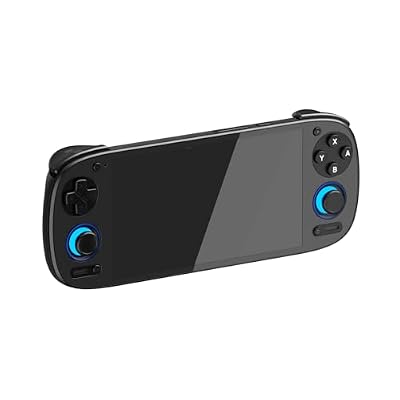
- Top Pick: Lenovo Legion Go 2 (Ryzen Z2 Extreme, 32GB, 2TB)
- Runner-up: SanDisk 1TB Extreme microSDXC Card
- Also consider: Samsung T7 Portable SSD 1TB
Lenovo and ASUS both sell a flagship Windows handheld built on AMD’s current Zen 5 generation, and on a spec sheet they look like the same machine twice: eight cores, fast soldered memory, a high-refresh screen. For emulation that similarity misleads in both directions. The chips are close enough that neither unlocks a system the other cannot run, yet the machines feel different in the hand and on the desk.
As an Amazon Associate, we earn from qualifying purchases.
This comparison judges the two only on the axes emulators use: the panel, the chip, the memory layout, storage and ports, the software front door, controls, weight and battery. Every figure comes from Lenovo’s PSREF sheet for the Legion Go 2 (8AHP2) or ASUS’s published specifications for the ROG Xbox Ally X (RC73XA), and capability is read against the tiers the emulator projects publish. Games and BIOS files here mean dumps from your own discs and consoles.
This article contains affiliate links, and we may earn a commission when you buy through them at no extra cost to you.
Quick Answer
Pick the Legion Go 2 if the screen leads your decision: its 8.8-inch OLED at 1920×1200 integer-scales retro systems cleanly and adds variable refresh. Pick the ROG Xbox Ally X if portability and the console-style Xbox interface matter more. The chips are peers, so neither machine unlocks a tier of emulation the other cannot reach.
Start With the Screens, Not the Chips
The panel is the largest real difference here, and it favours Lenovo. The Legion Go 2 carries an 8.8-inch OLED at 1920×1200, up to 144Hz, with variable refresh support, so the screen can follow the odd refresh rates emulated systems produce instead of forcing them into a fixed grid. The 1200-line height is also the friendlier integer-scaling target: a PlayStation game with 240 visible lines scales at exactly five times to fill the panel height with no fractional step, and DS and 3DS layouts get more height and more physical size.
The Xbox Ally X answers with a 7-inch IPS touchscreen at 1920×1080 and 120Hz with FreeSync Premium, so variable refresh is shared ground, not a Lenovo exclusive. Its 1080 lines ask 240-line systems for a four-times scale plus borders, or a fractional scale, and the smaller panel tightens text-heavy frontends and stacked layouts. What the ASUS screen buys instead is the device around it: smaller, lighter, easier to hold. As a pure emulation display the Go 2 panel wins; as part of a portable, the Ally X makes the more balanced trade.
The Chips Are Peers, and That Is the Story
Both machines run Zen 5 silicon with eight cores and sixteen threads boosting to around 5GHz. ASUS names its part the Ryzen AI Z2 Extreme, with RDNA 3.5 graphics of 16 compute units; Lenovo’s PSREF documents a Ryzen Z2 in the same core and boost configuration, with a Z2 Extreme configuration also sold. Read against the tiers emulators publish, the two land in the same place. PCSX2’s requirement ladder describes moderate and heavy tiers built on single-thread ratings and graphics scores written for desktop parts, and both chips clear the recommended ground for PS2 and GameCube emulation with margin to spare.
That margin buys the same things on both devices: higher internal resolutions before the integrated graphics become the limit, and steadier behaviour in the heaviest titles. It does not buy a different catalogue: the emulators’ own documentation treats this class of processor as one tier, and both handhelds sit inside it.
System by System: Where Each Machine Stands
The cartridge era, PlayStation, Nintendo 64, Dreamcast and PSP sit far below what either chip offers, and both machines run those systems with power to spare for shaders, fast-forward and rewind. PlayStation 2, GameCube and Wii are the comfortable middle: native resolution is a given on both, upscaling headroom is present on both, and the visible result is then decided by the panel.
PlayStation 3 through RPCS3 stays a per-title check on both machines. The project’s documentation recommends desktop-class processors, and its compatibility list rates a large share of the library below full playability regardless of hardware, so neither badge changes which PS3 games work. Xbox 360 through Xenia is the same shape of answer: an experimental emulator with per-title compatibility, on both equally. Wii U through Cemu runs well on this chip class, its resolution set per game through graphics packs. The one edge in the whole rundown belongs to the Go 2’s panel, which gives DS and 3DS layouts room the 7-inch screen cannot.
Memory, Storage and Ports
Memory is where the Go 2 asks its buyer a question the Ally X does not. Lenovo solders in either 16GB or 32GB of LPDDR5X, and the choice is permanent. Because the integrated graphics share that pool with Windows, the 32GB configuration is the emulation-relevant one: HD texture packs, shader caches and the operating system all draw from the same memory, and 32GB removes the squeeze entirely. ASUS fits 24GB to every Xbox Ally X, between Lenovo’s two options, and removes the decision.
Storage and ports are close to level. Both machines use standard M.2 2280 drives, Lenovo’s configurations reaching 2TB against the ASUS machine’s 1TB, and both carry a microSD reader. The Go 2 offers two USB4 ports; the Ally X pairs one USB4 port with a second USB 3.2 Gen 2 Type-C port.
Software, Controls and the Weight of the Thing
The Ally X owns the software axis. It boots straight into the Xbox full screen experience, a controller-driven interface with the full Windows installation underneath, so daily launching feels like a console, while setup still happens in desktop mode. Armoury Crate SE remains the device layer for operating modes and control settings. The Go 2 boots to plain Windows with Legion Space as its organiser: setup is more direct, daily launching less polished, and a frontend such as ES-DE or Playnite narrows the gap on either machine without closing it.
Controls split by philosophy. Lenovo’s TrueStrike controllers detach, enabling tabletop play on the built-in kickstand and a mouse-style FPS mode with the right controller. ASUS keeps a fixed unit with grips contoured after Xbox controllers, impulse triggers and a dedicated Xbox button. Both present to Windows as an Xbox-style pad, the layout emulators map by default.
Then there is the scale. The Go 2 weighs around 920g with controllers attached; the Ally X weighs 715g, a gap hands notice across an evening. It runs opposite to the battery figures: the heavier machine carries a 74Wh pack, the lighter one 80Wh. In words rather than runtime figures, light systems on a quiet mode stretch across a long day of broken-up play on both, PS2-class loads shorten sessions considerably, and the heaviest tiers belong near a charger.
The Gear in This Comparison
Lenovo Legion Go 2 (Ryzen Z2 Extreme, 32GB, 2TB)

The Lenovo flagship in its fullest configuration: the Z2 Extreme chip, the 32GB memory tier and the largest storage offered.
Specs:
- Processor: AMD Ryzen Z2 Extreme
- Memory: 32GB LPDDR5X, soldered
- Storage: 2TB SSD
- Display: 8.8-inch OLED, 1920×1200, up to 144Hz
- Battery: 74Wh
- Operating system: Windows 11 Home
- Item model number: 83N0000AUS
SanDisk 1TB Extreme microSDXC Card

Both machines keep a microSD reader, so one card carries a cartridge library between handheld and desk.
Specs:
- Capacity: 1TB
- Model: SDSQXAV-1T00-GN6MA
- Read speed: up to 190MB/s
- Write speed: up to 130MB/s
- Speed classes: C10, U3, V30, A2
- Includes: SD adapter
Samsung T7 Portable SSD 1TB

A fast shuttle drive for moving disc-image libraries between handhelds or from a desktop.
Specs:
- Capacity: 1TB
- Model: MU-PC1T0T/AM
- Interface: USB 3.2 Gen 2, up to 10Gbps
- Read speed: up to 1,050MB/s
- Write speed: up to 1,000MB/s
- Security: AES 256-bit hardware encryption
JSAUX 6-in-1 Docking Station HB0609

For TV play from either machine. Two honest caveats: this dock does not pass through variable refresh rate, so the VRR advantage stays on the handheld screens, and the maker’s compatibility list names the Legion Go and Go S rather than the Go 2, so check the listing before ordering.
Specs:
- Model: HB0609
- Video: HDMI output up to 4K at 120Hz
- Charging: USB-C pass-through up to 100W
- Network: Gigabit Ethernet
- Data ports: USB-A and USB-C, USB 3.2 Gen 1
8BitDo Pro 2 Bluetooth Controller
A second pad for docked multiplayer on either machine, with a symmetrical layout that suits older systems and back buttons that map well to emulator hotkeys.
Specs:
- Connectivity: Bluetooth, USB-C wired
- Sticks: Hall Effect
- Extras: two programmable back buttons, profile switching
- Compatibility: Windows, Switch, Android and Apple devices, as maker-stated
- Model: not stated
How to Choose
Decide by the axis you care about most, because the chip axis will not decide for you. If you play at home, favour big-screen handheld sessions, run DS and 3DS layouts, or upscale PS2 and GameCube titles onto the best panel, take the Legion Go 2, in the 32GB configuration, since that choice cannot be revisited. If you travel with your handheld, play in shorter sessions away from a table, or want the console-style front door and the larger battery in the lighter body, take the ROG Xbox Ally X. If most play is docked to a TV, the Go 2’s panel advantage leaves with the handheld screen, and the Ally X becomes the easier daily machine.
Who Should Skip
Skip both if your library ends with the cartridge era and PSP, because a dedicated retro handheld covers those systems more simply and lasts longer. Skip both if PlayStation 3 or Xbox 360 emulation is the whole point, since no handheld changes what those projects document about their own requirements, and a desktop serves that library honestly. Skip the Legion Go 2 if you play long handheld sessions and know your wrists complain, and skip the ROG Xbox Ally X if the biggest screen or detachable controllers are what you are actually shopping for.
FAQ
Which one runs PS2 and GameCube games better?
At native resolution, neither: both chips clear the recommended tiers PCSX2 and Dolphin publish, so both run the systems. The difference is presentation. The Go 2 shows upscaled output on a larger OLED panel with an exact integer fit for 240-line systems; the Ally X does the same work on a smaller 1080p screen in a lighter body.
Is the ROG Xbox Ally X a portable Xbox console?
No. It is a Windows 11 PC handheld with an Xbox-designed interface layered on top. It runs the same PC emulators as the Legion Go 2, and does not play Xbox console discs or console-format downloads natively.
Does the Legion Go 2 memory choice really matter for emulation?
Yes, because it is permanent and shared. The integrated graphics draw from the same pool as Windows and the emulator, so the 32GB configuration gives HD texture packs and shader caches room the 16GB configuration does not. The Xbox Ally X sidesteps the question with 24GB in every unit.
Can I move my emulator library between the two machines?
Yes. Both run Windows 11, so emulator folders, game libraries, saves and memory-card files copy across by microSD card, external drive or network. Expect to re-pair controllers and re-check library entries, but nothing needs converting.
Final Verdict
The split rule is this: buy the screen and the memory ceiling, or buy the portability and the front door. The Legion Go 2 is the better emulation display and the better tabletop machine, and its 32GB configuration holds the larger memory headroom. The ROG Xbox Ally X is the better travel handheld, with the bigger battery, the lighter body and a couch-friendly interface. What neither purchase buys is a higher tier of emulation, because the emulators’ own requirement tiers place these chips side by side, and every system either runs on both or stays per-title on both.