

The JBL Endurance Run 2 Wired is JBL’s mainstream wired sports in-ear monitor, built around a single dynamic driver, an IPX5 sweat- and water-resistance rating and the company’s FlexSoft enhancers that keep the buds locked into the ear during exercise. At around $15 it competes directly with the MEE Audio M6 Sport as the gym buyer’s no-thought-required wired option. This JBL Endurance Run 2 review covers the driver, fit, sound signature and realistic use cases.
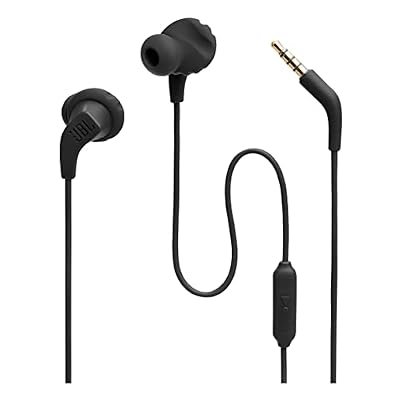
JBL Endurance Run 2 Wired - Waterproof Wired Sports in-Ear Headphones, JBL Pure Bass Sound, Hands-Free Calls, Never Hurt. Never Fall Out. (Black) (Renewed)


As an Amazon Associate we earn from qualifying purchases. Product prices and availability are accurate as of the date/time indicated.
🛒 Best Price Today on Amazon
Prime members get fast, free shipping on everything above, plus member-only deals. New members get a 30-day free trial — cancel anytime.
As an Amazon Associate we earn from qualifying purchases.





JBL Endurance Run 2 Wired at a Glance
| Feature | Specification |
|---|---|
| Driver configuration | Single 8.7mm dynamic driver (1DD) |
| Impedance | 16 ohm |
| Sensitivity | approx 100 dB/mW |
| Frequency response | 20 Hz to 20,000 Hz |
| Cable type | Fixed (non-detachable), tangle-free flat cable |
| Microphone | Yes (in-line, 1-button remote) |
| Connector | 3.5mm TRRS |
| Sound signature | V-shaped with JBL Pure Bass bias |
| Approx price | around $15 |
Sound Quality & Driver Configuration
Before getting into the specifics of this set it is worth a short refresher on the technical realities that shape every wired in-ear monitor. The most important is driver topology. An IEM with a single dynamic driver (DD) moves air with a small cone-and-magnet motor, much like a miniature loudspeaker, and tends to produce a warmer, fuller and more physical bass response with smooth midrange. An IEM with one or more balanced armature (BA) drivers uses a tiny electromagnetic reed inside a sealed enclosure that vibrates with very low mass — this gives BA drivers their characteristic strengths of fine treble detail, fast transient response and excellent separation of instruments, at the cost of slightly thinner low-end weight on bass-only BA designs. A hybrid configuration combines both: a DD handles the bass for warmth and impact, and one or more BAs handle the mids and treble for detail and clarity, which is why hybrids dominate the budget Chi-Fi market.
Impedance and sensitivity govern how easy an IEM is to drive. Most modern IEMs sit in the 16 to 32 ohm range with sensitivity ratings of 100 to 110 dB/mW, which means a phone, a laptop headphone jack or a Nintendo Switch can drive them to comfortable listening volumes without a separate amplifier. Higher impedance (50 ohm and above) or low sensitivity may benefit from a portable DAC/amp, but the IEMs in this guide are all designed to be plug-and-play from a 3.5mm jack. The frequency response figure quoted on the spec sheet is usually 20 Hz to 20 kHz or wider, but it is a marketing number — the actual tuning is what matters, and is described in plain language in each review.
Finally, cables, connectors and the wired-audio advantage. The two universal detachable connectors on modern IEMs are the 2-pin (0.78mm) standard, used across virtually every KZ, CCA, Moondrop and 7Hz model, and the MMCX coaxial connector, used by Shure, MEE Audio’s PRO series and a number of premium models. Both let you swap a stock cable for a better one, an upgrade with a microphone, or a balanced 4.4mm cable for a portable DAC/amp. Cheaper IEMs ship with fixed, non-detachable cables — usually fine, but a failure point if the cable develops a crackle. The headline advantage of every IEM in this guide over a wireless equivalent is zero added latency and no codec compression: a 3.5mm cable carries the analog signal directly to the driver, which is exactly why competitive musicians, sound engineers and serious gamers still choose wired IEMs over Bluetooth earbuds.
The Endurance Run 2 uses a single 8.7mm dynamic driver per side, tuned to JBL’s familiar Pure Bass house signature — a clear mid-bass lift for impact, a recessed midrange and a polite upper treble. This is the same broad tuning philosophy used across JBL’s wider consumer lineup and works well with the up-tempo electronic, hip hop and pop most commonly played during exercise. There is no balanced-armature detail retrieval and no hybrid topology — the Endurance Run 2 is a purpose-built sports IEM, not an analytical music monitor.
Within the single-DD class the tuning is competent: bass has presence without being overwhelmingly one-note, vocals carry through workout playlists and the treble does not turn sibilant at gym-appropriate volumes. Buyers who want a flatter, more neutral wired IEM at a similar price should look at the SoundMAGIC E10; buyers who want hybrid driver detail should look at the KZ ZST or KZ ZS10 PRO covered later in this guide.
Build Quality & Cables
JBL builds the Endurance Run 2 around a lightweight plastic shell with the company’s FlexSoft enhancer — a soft silicone wing that tucks into the upper ear ridge to lock the bud in place during running, lifting and HIIT work. The IPX5 rating means the earbud is rated to withstand sweat and brief water splashes, which is the practical requirement for a gym IEM. The cable is fixed (non-detachable), tangle-resistant and flat to reduce knotting in a gym bag. The in-line single-button remote handles play / pause and call answer.
Comfort & Fit — Tips Included
The headline comfort feature is the FlexSoft enhancer wing, which combines with the silicone eartip to give the Endurance Run 2 a notably stable fit during movement. Multiple sizes of both tips and wings are included to fine-tune the fit — taking the time to swap them is worth the effort, because a secure fit is what separates a usable sports IEM from a frustrating one. The earpiece is light enough to wear for an hour-plus workout without ear fatigue. A magnetic catch on the back of each bud lets the two buds clip together around the neck when not in use, which is a small but practical touch.
Sound Signature — Neutral / V-Shape / Bass
This is unambiguously JBL Pure Bass V-shape territory — the mid-bass is lifted to give kick drums and EDM drops the energy a gym playlist demands, the midrange is gently recessed and the treble has a presence lift that keeps vocals and hi-hats from disappearing behind the bass. It is the right tuning for the intended use case and would be inappropriate for stage monitoring or critical music. Buyers who want a more neutral, less bass-forward sound at this price should look at the SoundMAGIC E10 in this guide.
Use Cases — Gaming / Music / Stage
The Endurance Run 2 is purpose-built for workouts and is the right tool for that job — IPX5, FlexSoft fit and a high-energy V-shape are exactly what a runner or gym-goer needs. For everyday music outside the gym it is fine, though the bass-lift can be tiring on acoustic and classical material at higher volumes. For casual gaming on a Switch or phone the wired 3.5mm connection delivers zero-latency audio. It is not a stage monitor or a serious music IEM — Shure SE215 and Moondrop CHU II occupy those roles in this guide. See our best IEMs for gaming roundup for gaming-focused options.
Pros and Cons
Pros: Genuinely secure sports fit with FlexSoft enhancers; IPX5 sweat and water resistance; JBL house-tuned bass-forward sound for workouts; flat tangle-resistant cable; magnetic bud catch for storage.
Cons: Fixed non-detachable cable; bass-heavy tuning is not for all music; not for stage monitoring or critical listening; single-button remote lacks native volume control.
Verdict
At around $15 the JBL Endurance Run 2 Wired is the right pick for the buyer who wants a no-fuss wired sports IEM from a recognised brand. The fit is genuinely secure, the IPX5 rating handles sweat and splashes, and the Pure Bass tuning is matched to workout playlists. Its main rival in this guide is the MEE Audio M6 Sport — that set offers a memory-wire over-ear hook for an even more secure fit and is worth comparison. Buyers who want a non-sport wired IEM at this price should look at the Panasonic ErgoFit or the LUDOS Clamor instead. See our best wired earbuds roundup for wider options.
Frequently Asked Questions
Is the JBL Endurance Run 2 Wired waterproof?
It is rated IPX5 for sweat and water-splash resistance, which is appropriate for gym use and running in light rain. It is not rated for full submersion or showering.
Does the JBL Endurance Run 2 have a microphone?
Yes. It includes a single-button in-line remote and microphone for calls and chat from any 3.5mm TRRS source.
What is the driver configuration of the JBL Endurance Run 2?
A single 8.7mm dynamic driver per side, tuned to JBL’s Pure Bass house signature.
Can the JBL Endurance Run 2 cable be replaced?
No. The cable is fixed and non-detachable, which is normal at this price and acceptable in a sports IEM that prioritises durability of seal at the earpiece.
More IEM Reviews
- KZ ZS10 Pro Review: 4BA+1DD 5-Driver Hybrid IEM
- Shure SE215 PRO Review: Legendary Stage Monitor IEM
- MEE Audio M6 Sport Review: Noise-Isolating Wired Sports IEM
- KZ ZST Colorful Hybrid Review: Budget 1BA+1DD IEM
- SoundMAGIC E10 Review: HiFi Bass-Forward Wired Earbuds
- MEE Audio M6 PRO 2nd Gen Review: Detachable Cable Stage IEM
- Moondrop CHU II Review: Budget Audiophile Pivot Point IEM
- KZ ZST PRO X Review: Budget 1BA+1DD Hybrid Gaming IEM
Affiliate Disclosure: As an Amazon Associate, we earn from qualifying purchases. If you click a link and make a purchase, we may earn a small commission at no extra cost to you. Prices and availability are accurate as of publication and may change.
Ready to decide? Our #1 pick for 2026 is the Driver configuration.
Live price & availability on Amazon.


