Yes. The Ryzen 7 7700X is a genuinely good gaming processor: an eight-core Zen 4 chip with high clock speeds that, at its launch, was the fastest gaming CPU in AMD’s own Zen 4 lineup at 1080p according to TechPowerUp’s review testing. It will not hold back a modern graphics card at 1440p or 4K, and it keeps up well even in CPU-bound 1080p play. The honest caveats are threefold. AMD’s X3D chips are measurably faster for pure gaming, especially at 1080p. The 7700X sits on the AM5 platform, which means a new motherboard and DDR5 memory if you are coming from AM4. And the box contains no cooler, so cooling is an extra cost you have to plan for. This guide works through the benchmark evidence by resolution, the X3D comparison, the cheaper alternatives and the platform realities, so you can judge whether those caveats matter for your build.
As an Amazon Associate we earn from qualifying purchases.
The chip at a glance
The Ryzen 7 7700X is the eight-core model from AMD’s first Zen 4 wave. All eight cores live on a single core complex die (CCD), which is part of why it games so well: there is no cross-die traffic of the kind that can cost the dual-CCD Ryzen 9 models a few frames. It is unlocked for overclocking, supports PCIe 5.0, and carries a basic integrated GPU intended for display output and troubleshooting rather than play — AMD itself is clear that the integrated graphics are not for gaming.
AMD Ryzen 7 7700X
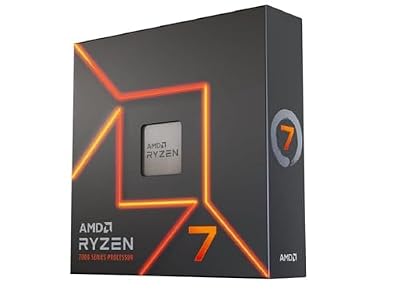
Specs
- Architecture: Zen 4 (TSMC 5 nm)
- Cores / threads: 8 / 16
- Base clock: 4.5 GHz
- Max boost clock: up to 5.4 GHz
- Cache: 8 MB L2 + 32 MB L3 (40 MB total)
- Default TDP: 105 W (socket power up to 142 W PPT)
- Socket: AM5
- Memory support: DDR5 only (DDR5-5200 native)
- Integrated graphics: AMD Radeon Graphics (RDNA 2, basic display output)
- Cooler included: No
- Max operating temperature (TjMax): 95 °C
Gaming performance by resolution
How good the 7700X looks depends heavily on resolution, because resolution decides whether the CPU or the graphics card is the limiting factor.
1080p is where CPUs are separated. With a fast GPU and lowered settings, the processor feeds frames as quickly as it can, and differences show up directly in frame rates. This is the 7700X’s strongest territory relative to its own family: TechPowerUp’s launch review found it the fastest Zen 4 processor for gaming at 1080p, edging out even the Ryzen 9 7950X, because its single-CCD layout avoids inter-CCD latency. In the same review, averaged across a 12-game mix, the 7700X pulled slightly ahead of the older Ryzen 7 5800X3D overall, although the 5800X3D kept an edge in specific cache-sensitive titles.
1440p is the resolution most 7700X systems are built for, and it splits the difference. The GPU takes on more of the load, CPU gaps compress, and the 7700X has no trouble sustaining high-refresh frame rates in the large majority of games when paired with a suitable graphics card.
4K is GPU-bound in almost every title. In The FPS Review’s three-resolution testing of the 7800X3D against the 7700X, the reviewer noted that at 4K there are no large differences between the two chips, because the graphics card decides the frame rate. If you play at 4K, the 7700X is effectively as good as any gaming CPU you can buy, and money is better directed at the GPU.
The X3D question: how far behind is it, honestly?
The Ryzen 7 7800X3D uses the same Zen 4 cores but stacks an extra 64 MB of L3 cache on the die, for 96 MB in total against the 7700X’s 32 MB. Games that constantly stream assets and run heavy simulation logic benefit from that cache, and the benchmarks reflect it — unevenly.
The FPS Review’s head-to-head testing gives a clear picture at 1080p. The 7800X3D was faster than the 7700X by small margins in most titles: about 3 percent in Returnal, 2 percent in Forspoken, 6 percent in F1 2022, 4 percent in Chernobylite Enhanced Edition and 6 percent in Dying Light 2. In cache-hungry games the gap widened sharply — 14 percent in Cyberpunk 2077 and 25 percent in Far Cry 6. At 1440p those margins mostly shrank to low single digits, Far Cry 6 (18 percent) excepted, and at 4K they largely disappeared.
So the honest summary is: for pure gaming, the X3D chip is better, sometimes by a little and sometimes by a lot, and the newer Zen 5-based 9800X3D sits above both. What the 7700X offers in return is balance. It boosts to 5.4 GHz against the 7800X3D’s 5.0 GHz, which helps clock-sensitive applications, and it is the stronger all-rounder for mixed use — gaming plus streaming, encoding or productivity work on the same machine. If gaming is the only job, X3D wins. If the PC does more than game, the contest is much closer than the gaming charts alone suggest.
Cheaper and newer alternatives worth weighing
Ryzen 5 7600X. The six-core sibling is the value challenge. In The FPS Review’s testing of the 7700X, the two chips performed the same in Microsoft Flight Simulator across all three resolutions, and in many GPU-bound games the difference between six and eight Zen 4 cores is small. The 7700X earns its keep in CPU-heavy strategy and simulation titles, when streaming or recording while playing, and as longer-term headroom as games use more threads.
Ryzen 7 7700 (non-X). Same core count at a 65 W TDP, with slightly lower clocks (up to 5.3 GHz boost) — and, unlike the 7700X, AMD includes a Wraith Prism cooler in the box. Once you price in the cooler the X model requires, the non-X chip is a serious alternative for a quieter, simpler build.
Ryzen 7 9700X. The Zen 5 successor is the newer option on the same socket. Launch testing by TechPowerUp and Tom’s Hardware put it a few percent ahead of the 7700X in 1080p gaming — roughly 4 to 8 percent — while drawing notably less power under its 65 W TDP. Which of the two makes sense comes down to current pricing and how much you value the efficiency gain.
Platform reality: AM5 and DDR5 only
The 7700X cannot be dropped into an older system. It requires an AM5 motherboard (600-series boards such as B650 and X670, or the newer 800-series) and DDR5 memory; DDR4 is not supported at all. Anyone upgrading from AM4 faces a platform swap — CPU, board and RAM together — and that combined cost, not the processor alone, is the real buying decision.
The compensation is longevity. AM5 is AMD’s current desktop socket, Zen 5 processors drop into the same boards with a BIOS update, and AMD has committed to supporting the platform for years beyond the 7700X’s launch. A 7700X build bought today has an in-socket upgrade path to a faster chip, including X3D models, without replacing the motherboard or memory again. If you are speccing a complete new system around this processor, our Ryzen 7 7700X gaming PC build guide lays out full configurations matched to different resolutions.
Power, heat and the missing cooler
AMD rates the 7700X at 105 W TDP, with socket power allowed up to 142 W (PPT) under sustained all-core load. TweakTown’s review measured a peak of 150 W in CPU-only power testing under heavy load, while gaming loads sit well below the maximum because games rarely saturate all eight cores. In practical terms the chip is easy on a gaming PC’s power supply but works hard when rendering, compiling or encoding.
Heat is the other planning item. Zen 4 is designed to boost until it reaches its limits, and AMD sets the 7700X’s maximum operating temperature at 95 °C, which the chip will approach under sustained all-core loads with modest cooling. That behaviour is by design rather than a fault, but it surprises builders used to cooler-running processors. There is no stock cooler in the box: AMD recommends liquid cooling for maximum performance, and while a capable tower air cooler is entirely adequate for gaming duty, a cooler is a mandatory extra purchase either way. Factor it in before comparing the 7700X against the cooler-included Ryzen 7 7700.
Verdict: who should buy it, who should skip it
Buy the 7700X if you are building an AM5 system for 1440p or 4K gaming, you also stream, record or create on the same machine, or you want a balanced processor with a clear in-socket upgrade path. At those resolutions it performs within a few percent of far more expensive gaming chips, and its eight high-clocked cores cover far more than games.
Look elsewhere if you play competitively at 1080p with a top-end GPU and chase every frame — the 7800X3D and 9800X3D are measurably ahead in exactly that scenario. Strict-budget builders should weigh the Ryzen 5 7600-class chips and put the savings into the graphics card, and AM4 owners who are not ready to replace their motherboard and memory should stay on their current platform for now.
The short answer stands: yes, the Ryzen 7 7700X is good for gaming — not the outright gaming champion of its socket, but a fast, flexible eight-core chip whose weaknesses only show in the specific corners where X3D silicon was purpose-built to win.