- Top Pick: APC Back-UPS Pro Gaming 1500VA
- Runner-up: Specs
- Also consider: CyberPower CP1500AVRLCD3 Intelligent LCD UPS
Cloud gaming moves the heavy work to a remote server, but your side of the connection still runs on wall power. When the lights flicker, your router, TV, and console all drop at once, and the session you were in is gone. A UPS battery backup sits between the wall and your gear and switches to battery in milliseconds, giving your setup minutes of clean power instead of an instant blackout.
That is the whole job of a UPS for cloud gaming: bridge the gap. It keeps a short outage from becoming a lost match or a corrupted save, and it gives you time to pause and quit gracefully if the outage lasts. It cannot keep you online if your internet provider goes down, and no home UPS runs a living room for hours, so size it to your actual load.
As an Amazon Associate, we earn from qualifying purchases.
Quick answer
For most cloud gaming setups, the APC Back-UPS Pro Gaming 1500VA is the strongest pick: it carries a console, TV, and router on pure sine wave power with room to spare. On a tighter budget, the APC Back-UPS 600VA covers a router and streaming stick. Size any UPS by watts, not VA, and keep the total load below its watt rating.
What a UPS can and cannot do for cloud gaming
A UPS protects the gear plugged into it. If the power blinks for a few seconds, your router stays up, your TV stays on, and your console never notices, so the stream keeps flowing. If the outage lasts a few minutes, the battery gives you time to finish the round, save, and shut down cleanly.
What a UPS cannot do is fix the internet itself. If the outage takes your broadband provider down with it, your session drops no matter how much battery you own. Published runtimes are measured in minutes at half and full load, not hours, and a heavy gaming PC drains a battery far faster than a router does.
1. APC Back-UPS Pro Gaming 1500VA

The APC Back-UPS Pro Gaming is the only pick here built with a gaming setup in mind. It delivers pure sine wave output, the cleanest waveform a UPS can produce, and the one modern PC and console power supplies are designed to accept. Capacity is 1500VA and 900 watts across ten outlets, six on battery backup and surge protection and four surge only, enough for a console, a TV, and a router with power to spare. APC publishes about 12 minutes of runtime at half load and about 3 minutes at full load, enough to ride out a flicker or quit cleanly. The front panel carries a multifunction LCD, status lighting, and one USB-C and two USB-A charging ports, and the lead-acid battery is user replaceable.
Specs
| Spec | Detail |
|---|---|
| Capacity | 1500VA and 900W |
| Waveform | Pure sine wave |
| Outlets | 10 total, 6 with battery backup and surge protection and 4 surge only |
| Runtime | 12 minutes at half load, 3 minutes at full load |
| Surge protection | 1080 joules |
| USB charging | 1 USB-C port and 2 USB-A ports |

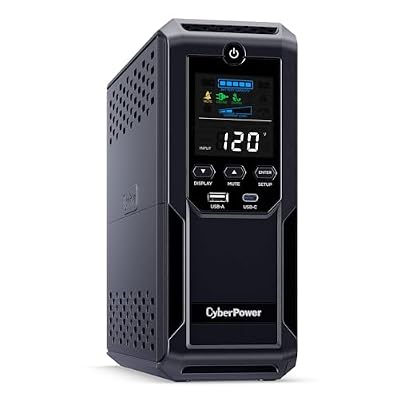
2. CyberPower CP1500AVRLCD3
The CyberPower CP1500AVRLCD3 matches the gaming pick on capacity at 1500VA and 900 watts, but takes a different approach: more outlets and a simulated sine wave output. Twelve outlets give you room for the whole living room, six with battery backup and six surge only, so the router, TV, console, and soundbar can all live on one unit. Automatic voltage regulation corrects minor fluctuations without switching to battery, and the LCD shows load and battery status. CyberPower publishes 12 minutes at half load and 3 minutes at full load, with a typical recharge time of eight hours. The simulated sine wave output is the main trade-off: fine for consoles, TVs, and routers, but some high-end PC power supplies prefer pure sine wave.
Specs
| Spec | Detail |
|---|---|
| Capacity | 1500VA and 900W |
| Waveform | Simulated sine wave |
| Outlets | 12 total, 6 with battery backup and surge protection and 6 surge only |
| Runtime | 12 minutes at half load, 3 minutes at full load |
| Surge protection | 1500 joules |
| USB charging | 1 USB-A port and 1 USB-C port |
3. APC Back-UPS Pro BX1500M

The APC Back-UPS Pro BX1500M is the quiet workhorse of this list. It offers the same 1500VA and 900-watt capacity as the two picks above, with automatic voltage regulation, an LCD status display, and ten outlets for a home office or living room setup. It has no gaming styling or extra flourishes, which is what many buyers want from a box that sits under a desk and is forgotten until the lights go out. The BX1500M uses a stepped approximation to a sine wave rather than pure sine wave, so it is best matched to consoles, TVs, routers, monitors, and office PCs. Runtime is not stated in the published specifications, so judge it by its capacity class: minutes of backup at a moderate load. The battery is user replaceable.
Specs
| Spec | Detail |
|---|---|
| Capacity | 1500VA and 900W |
| Waveform | Stepped approximation to a sine wave |
| Outlets | 10 total, 5 with battery backup and surge protection and 5 surge only |
| Runtime | Not stated |
| Automatic voltage regulation | Yes |
| Battery | Lead-acid, user replaceable |
4. CyberPower CP1000AVRLCD
The CyberPower CP1000AVRLCD is the mid-size option, right for a living room where the load is a console, a TV, and a router rather than a full gaming PC. At 1000VA and 600 watts it takes up less space than the 1500VA models while still covering the three devices that matter most for a cloud session. Nine outlets split into five with battery backup and four surge only, so the essentials go on battery and extras go on surge-only outlets. Automatic voltage regulation handles brownouts without touching the battery, and the multifunction LCD shows load and battery status. The important thing with a 600-watt unit is to add up your load honestly: a console and a modern TV can draw 300 watts or more while gaming, but if your honest total is close to 600 watts, step up to a 900-watt model.
Specs
| Spec | Detail |
|---|---|
| Capacity | 1000VA and 600W |
| Waveform | Simulated sine wave |
| Outlets | 9 total, 5 with battery backup and surge protection and 4 surge only |
| Runtime | Not stated |
| Automatic voltage regulation | Yes |
| Battery | Lead-acid, user replaceable |
5. APC Back-UPS BE600M1
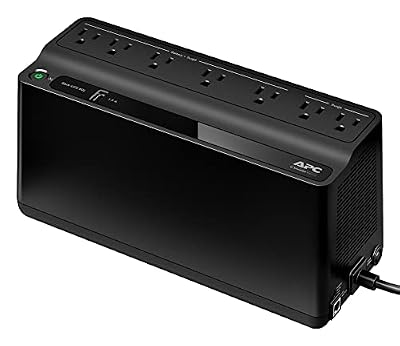
The APC Back-UPS BE600M1 is the budget pick, and it earns its place by solving the most common cloud gaming problem at the lowest cost: keeping the network alive. At 600VA and 330 watts it is not meant to run a TV and a console, but it is more than enough for a router, a modem, and a streaming stick, which together draw only a small fraction of its capacity. Because the load is so light, the battery lasts far longer in practice than heavy-load figures suggest. Seven outlets split into five with battery backup and surge protection and two surge only, plus a USB charging port on the front. The standby topology switches to battery when the power fails, and a typical recharge time of ten hours means it is ready again by the next evening.
Specs
| Spec | Detail |
|---|---|
| Capacity | 600VA and 330W |
| Waveform | Stepped approximation to a sine wave |
| Outlets | 7 total, 5 with battery backup and surge protection and 2 surge only |
| Runtime | Not stated |
| USB charging | 1 USB charging port |
| Recharge time | 10 hours |
How to choose
Start by adding up the watts of everything you want on battery. A router draws roughly 10 to 20 watts, a streaming stick a few watts, a modern TV roughly 100 to 200 watts, a console roughly 150 to 200 watts while gaming, and a gaming PC anywhere from 300 watts upward. Add the numbers for your own gear, then choose a UPS rated at least a quarter above that total. Only the router, the display, and the device running the game need battery backup; everything else can sit on surge-only outlets, which every pick here provides. Then consider waveform: pure sine wave is the safest match for high-end PC power supplies, while simulated or stepped sine wave is fine for consoles, TVs, and networking gear.
Who should skip
A UPS is not for everyone. If you play exclusively on a phone or tablet with its own battery, and your router is the only thing that needs power, a small router-only unit is enough and a large UPS is wasted money and weight. If your internet connection drops whenever the power goes out because your provider’s local equipment has no backup, a UPS will not save your session, so check whether your connection survives a short outage before buying. If slow internet, not power cuts, is your main problem, spend the money on a better connection or wired Ethernet first. A UPS fixes power, not bandwidth.
FAQ
How long will a UPS keep my cloud gaming session running?
It depends on the load. Published runtimes for the 1500VA models here are 12 minutes at half load and 3 minutes at full load. A light load, such as a router and a streaming stick drawing well under 100 watts, runs far longer, while a heavy gaming PC drains the same battery in minutes.
Do I need a pure sine wave UPS for cloud gaming?
Only if you run a gaming PC with a high-end power supply using active power factor correction. Consoles, TVs, routers, and streaming devices run fine on simulated or stepped sine wave output. If your setup is console based, choose by capacity instead.
Can a UPS keep me online during a power outage?
Only if your internet connection itself stays up. A UPS keeps your router powered, but if your broadband provider loses power at the street cabinet, the connection drops anyway. A UPS protects you from flickers and brief local outages, not from a provider-wide blackout.
How do I size a UPS for a console, a TV, and a router?
Add the watt ratings of the three devices, then pick a UPS rated at least a quarter above that total. A console at about 180 watts, a TV at about 150 watts, and a router at about 15 watts total roughly 345 watts, so a 600-watt unit covers it with headroom and a 900-watt unit leaves room to grow.
Final verdict
For most cloud gaming setups, the APC Back-UPS Pro Gaming 1500VA is the pick to buy first. Its pure sine wave output, 900-watt capacity, and six battery-backed outlets cover a console, a TV, and a router with room to spare. If the budget is tighter, the CyberPower CP1500AVRLCD3 gives you the same capacity and more outlets at a lower tier. If your setup is smaller, do not overspend: the CyberPower CP1000AVRLCD suits a single console and TV, and the APC Back-UPS BE600M1 keeps the network alive for phone and tablet players.