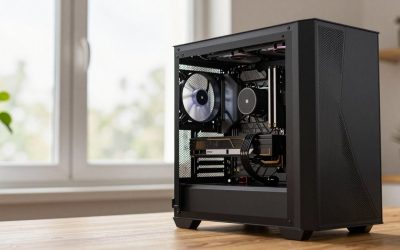
- Top Pick: ASUS ROG G700 (2025) Gaming Desktop PC, Intel® Core™ Ultra 7 265F Processor, NVIDIA® GeForce RTX™ 5070, 1TB M.2 NVMe™ PCIe® 4 SSD, 16GB DDR5 RAM, Windows 11 Home, G700TF-DS774
- Best Value: ASUS ROG GM700 (2025) Gaming Desktop PC, AMD Ryzen™ 7 9800X3D Processor, AMD® Radeon™ RX 9070 XT Prime OC, 2TB M.2 NVMe™ PCIe® 4 SSD, 32GB DDR5 RAM, Windows 11 Home, GM700TZ-MS777
- Premium Choice: ASUS ROG GM700 (2026) Gaming Desktop PC, AMD Ryzen™ 7 8700F Processor, NVIDIA® GeForce RTX™ 5070, 1TB M.2 NVMe™ PCIe® 4 SSD, 32GB DDR5 RAM, Windows 11 Home, GM700TZ-PS776
Five Nights at Freddy’s: Security Breach arrived on December 16, 2021, and it is still the biggest technical step the series has taken: a first-person survival horror game set in the open, multi-zone Mega Pizzaplex rather than the small single rooms of the earlier entries. That scale is why its requirements sit above those of Five Nights at Freddy’s: Help Wanted, but measured against modern releases the game is light. The official minimum is a GeForce GTX 1050 Ti with 8GB of RAM and a Ryzen 5 3600 or Core i5 6600K, and the recommended spec asks only for 16GB of RAM and a Ryzen 7 2700X or Core i7 4790. Any entry-level gaming desktop or laptop with a dedicated GPU can run it, an SSD is worth having for the 80GB install and the constant asset streaming, and you do not need a flagship graphics card or a high-core-count CPU to play it comfortably.
- Five Nights at Freddy’s: Security Breach Official PC System Requirements
- How Demanding Is Security Breach?
- GPU Recommendations by Resolution
- CPU, RAM and Storage Notes for Security Breach
- Example PC Builds for Security Breach
- Laptop and Handheld Suitability
- Best Settings to Raise FPS in Security Breach
- FAQ
As an Amazon Associate we earn from qualifying purchases at no extra cost to you.


Five Nights at Freddy’s: Security Breach Official PC System Requirements
| Component | Minimum (official) | Recommended (official) |
|---|---|---|
| OS | Windows 10 (64 bit) | Windows 10 (64 bit) |
| Processor | AMD Ryzen 5 3600, Core i5 6600K | AMD Ryzen 7 2700X, Intel Core i7 4790 |
| Memory | 8 GB RAM | 16 GB RAM |
| Graphics | Nvidia GeForce GTX 1050 Ti | Not published |
| DirectX | Version 12 | Version 12 |
| Storage | 80 GB available space | 80 GB available space |
Source: the official Five Nights at Freddy's: Security Breach Steam store listing (app 747660), checked October 2026. Publishers can update these specs after patches.
Those are the official figures from the game’s Steam store page, and they are the only hardware numbers Steel Wool Studios publishes. Note what the recommended column does and does not specify: it raises the CPU and memory targets to a Ryzen 7 2700X or Core i7 4790 and 16GB of RAM, but it names no graphics card at all, so the GTX 1050 Ti in the minimum column is the official floor and anything above it is headroom for higher resolutions, higher settings and higher refresh rates rather than a requirement. Both columns call for 64-bit Windows 10 and DirectX 12, and both list the same 80GB of storage, so it is worth leaving some room on your drive for patches and the Ruin DLC on top of that figure.
How Demanding Is Security Breach?
Not very. Security Breach runs on Unreal Engine 4, uses no ray tracing, and lists a budget graphics card from several generations ago as its official minimum, so any PC built or bought in the last several years with a dedicated GPU should handle it. The reason it is not quite as trivial as Help Wanted is the environment rather than the rendering technology: the Pizzaplex is one large, continuously loaded location with real-time lighting, reflective floors and a lot of animatronics, staff bots and props active at once, so the game leans on the GPU for shading and on memory and storage for streaming assets as you move between areas such as the Atrium, Monty Golf and Roxy Raceway.
In practice the GTX 1050 Ti minimum is the entry point: the game runs, at 1080p with settings reduced. The recommended spec is more about smoothness than raw power, since 16GB of RAM and a six-core CPU remove the hitches that come from a busy map competing with background system tasks. Storage speed matters more than most people expect — install the game on an SSD if you can, because the 80GB of assets load and stream constantly, and a mechanical drive makes both the initial load and the transitions between zones noticeably slower. Nothing about this title requires 32GB of RAM, a 12GB-plus graphics card, or an upscaling feature to be playable.
GPU Recommendations by Resolution
The official minimum names a GeForce GTX 1050 Ti, so that card is the reference point for the bottom tier: it runs the game at 1080p with settings turned down. Everything above it buys higher settings, higher resolution or a higher refresh rate rather than basic playability. The tiers below are grouped by what each class of card realistically handles, and they scale upward from that official floor rather than from a hypothetical “demanding” baseline.
1080p (Full HD) – The Sweet Spot
1080p is where the game is at its most forgiving, and even quite old mid-range cards are comfortable here.
- Meeting the official minimum: GeForce GTX 1050 Ti, GTX 1650, GTX 1060 6GB, Radeon RX 570 / RX 6400. These are the entry point and will run the game at 1080p with reduced settings.
- Comfortable 1080p: GeForce GTX 1660 Super, RTX 2060, RTX 3050, Radeon RX 5600 XT / RX 6600, Intel Arc A750. Plenty of headroom for high settings and a stable 60 FPS cap.
- Modern 1080p, high refresh: GeForce RTX 5060 or Radeon RX 9060 XT, and the previous-generation RTX 4060 / RX 7600. These are well beyond what the game needs at 1080p and make sense if you also play heavier titles or want to feed a 120Hz-plus monitor.
1440p (QHD)
1440p is easy for any current mid-range card, and older cards from recent generations can still manage it if you accept high rather than maximum settings.
- Entry 1440p: GeForce RTX 3060 12GB, RTX 4060, Radeon RX 6700 XT / RX 7600. Comfortable at 1440p with settings in the high range.
- Comfortable 1440p: GeForce RTX 5060 Ti / RTX 5070, Radeon RX 9060 XT / RX 9070. These hold high settings at 1440p with headroom to spare and will drive a high refresh 1440p panel.
4K (UHD)
4K is well within reach for this game because there is no ray tracing to pay for, and the art style means you can drop a setting or two without losing much.
- Native 4K, high settings: GeForce RTX 5070 / RTX 5070 Ti, Radeon RX 9070 / RX 9070 XT, and older cards of a similar class such as the RTX 4070 Super, RTX 4080 or RX 7900 XT.
- Budget 4K: A GeForce RTX 4060 Ti or RTX 5060 Ti, or a Radeon RX 7700 XT / RX 9060 XT, can handle 4K if you keep settings around high and stay away from the most expensive shadow and effect options.
If the game exposes a resolution scale or upscaling option in its menu, enabling it is the cheapest way to gain performance at 4K, and it is rarely needed at 1080p or 1440p on a modern card. As always, update your GPU driver before you start tuning.
CPU, RAM and Storage Notes for Security Breach
CPU: A Modest Six-Core Is Plenty
The official pairings are a Ryzen 5 3600 or Core i5 6600K at minimum and a Ryzen 7 2700X or Core i7 4790 at recommended, which tells you the game is not CPU-hungry. It is a linear, first-person horror game rather than a simulation, strategy or large-scale multiplayer title, so it does not scale with core count and does not need a high-end chip. Any modern quad-core or six-core processor — an Intel Core i3-12100F, Core i5-12400F or newer, or an AMD Ryzen 5 5600 or Ryzen 5 7600 — will feed a mid-range graphics card without holding it back.
What does matter is avoiding genuinely old two-core and early four-core chips, and pairing whatever CPU you have with enough memory. The fact that the recommended Intel part is itself an older generation shows how little CPU headroom this game actually asks for.
RAM: 8GB Meets the Minimum, 16GB Matches the Recommended Spec
The official minimum is 8GB and the recommended figure is 16GB. For a modern Windows system, 16GB is the sensible target: it leaves room for the operating system, a browser and other background tasks alongside the game, and it is the configuration the developer lists for the recommended experience. A 16GB kit in dual-channel (2x8GB) is the sweet spot. 32GB is not necessary for this game alone, though it is a reasonable choice if you play heavier titles or keep a lot of applications open.
Storage: 80GB, and an SSD Is Strongly Recommended
The official storage requirement is 80GB of available space, with no drive type specified. In practice an SSD is the single most noticeable upgrade you can make for this game: the Pizzaplex streams assets continuously, so a solid-state drive shortens the initial load and keeps transitions between areas smooth, while a mechanical hard drive is the most common cause of long loads and stutter during fast movement. Any SATA SSD is a big improvement and an NVMe drive is better still. Because the game occupies around 80GB before patches and the Ruin DLC, plan on a 500GB or 1TB SSD with room to spare rather than filling a small drive to capacity.
Example PC Builds for Security Breach
These are parts categories rather than specific models, so they can be adapted to whatever is available where you are. Both builds clear the recommended specification comfortably.
Budget Build – 1080p High
Built around the official minimum and just above it, this is the most cost-effective sensible way to play.
- CPU: Intel Core i3-12100F or AMD Ryzen 5 5500 / Ryzen 5 5600
- GPU: GeForce GTX 1660 Super, RTX 3050 or Radeon RX 6600 (a GTX 1050 Ti meets the official minimum but leaves no headroom)
- RAM: 16GB (2x8GB) DDR4 3200
- Storage: 1TB SATA or NVMe SSD
This class of system runs the game at 1080p on high settings without difficulty and has enough spare capacity for the Ruin DLC.
Mid-Range Build – 1440p or 1080p High Refresh
A step up for people who also play current AAA releases or want to make the most of a high refresh monitor.
- CPU: Intel Core i5-14400F or AMD Ryzen 5 7600
- GPU: GeForce RTX 5060 / RTX 5060 Ti or Radeon RX 9060 XT / RX 9070
- RAM: 16GB (2x8GB) DDR5 5600-6000, or 16GB DDR4 3200 on a DDR4 platform
- Storage: 1TB NVMe PCIe 4.0 SSD
This configuration sits comfortably above the recommended spec and will run Security Breach at 1440p on high settings, or at 1080p on a high refresh display, while leaving plenty in reserve for other games. Moving to 32GB of RAM is optional and only worth it if you multitask heavily.
Laptop and Handheld Suitability
Gaming Laptops
The official requirements list desktop parts, but the mobile equivalents translate well. A laptop with a GeForce GTX 1050 Ti-class GPU or newer — an RTX 3050, RTX 4050 or RTX 5060 Laptop, or an equivalent Radeon part — plus 16GB of RAM will run the game without trouble. Older or thinner machines with a GTX 1650 or RTX 2050-class GPU can still play it at 1080p with settings reduced. Two things matter more on laptops than desktops: make sure the memory is running in dual-channel, and keep the machine plugged in on its performance profile so the GPU is not power-limited.
Steam Deck, ROG Ally and Other Handhelds
Security Breach can be played on PC handhelds, but it is not a title that flatters them, and compatibility ratings change over time, so check the current store listing before you buy. Because this is an Unreal Engine 4 game with a large streaming world, the main limits on a handheld are the integrated graphics and the settings you are willing to accept.
- Steam Deck and Deck OLED: Expect to run at the device’s native resolution with settings lowered and a frame-rate cap for consistency. Locking the refresh rate to a lower value and capping the frame rate to match gives a much steadier experience than chasing the maximum, and it helps battery life.
- ROG Ally / Ally X, Legion Go and similar: These have stronger integrated graphics than the Deck and can push higher settings and resolution, though you will still want to cap the frame rate rather than let it fluctuate.
- General handheld advice: Lower shadows and effects first, keep textures at a reasonable level, cap the frame rate to something the device holds consistently, and remember the game needs 80GB of storage, which is a meaningful chunk of a handheld’s internal drive.
Best Settings to Raise FPS in Security Breach
Security Breach uses a standard Unreal Engine 4 options menu. If you need more performance, these are the changes that usually give the best return for the smallest visual cost, and the same advice applies whether you are on a desktop, a laptop or a handheld:
- Shadows: Usually the most expensive option in a UE4 game, and the Pizzaplex is full of dynamic light sources, so dropping shadows a notch or two is the first thing to try.
- Effects and volumetric fog: Lowering these reduces the cost of the game’s atmospheric lighting and fog in areas such as the Daycare, with a fairly small visual difference in motion.
- Post-processing: Bloom and ambient occlusion quality scale with this setting, so dropping it one notch is a cheap way to gain a little performance.
- View distance: Keep this high if you can. Lowering it helps weaker CPUs but causes obvious pop-in across the open Pizzaplex.
- Textures: A small performance cost provided you have enough VRAM, so leave them high on a card with 4GB or more and lower them only if you are hitting a VRAM limit.
- Resolution and upscaling: If the game exposes a resolution scale or upscaling option, use it before dropping multiple quality settings; it is usually the most efficient way to reach a stable frame rate.
On the official minimum GTX 1050 Ti, expect to combine a lower shadow setting with a reduced resolution scale to hold a steady frame rate. On anything from a GTX 1660 Super upward you should be able to leave most options high at 1080p. Whichever card you have, install the latest driver and run the game from an SSD.
FAQ
Does Security Breach need a good PC?
No. Its official minimum is a GeForce GTX 1050 Ti with 8GB of RAM and a Ryzen 5 3600 or Core i5 6600K, which is modest for a 2021 release and very modest by current standards. Any entry-level gaming PC with a dedicated graphics card will run it, and the recommended spec asks only for 16GB of RAM and a Ryzen 7 2700X or Core i7 4790.
Is 8GB RAM enough?
It meets the official minimum, so the game will run. The developer’s recommended figure is 16GB, and that is the better target for a modern Windows system, because background applications and the game’s asset streaming compete for the same memory.
Do I need an SSD?
The official requirement is 80GB of available space and does not specify a drive type, so an SSD is not strictly mandatory. It is strongly recommended, though: the game streams a large open environment constantly, and an SSD noticeably reduces load times and the hitching that comes with asset streaming.
Can I run it without a graphics card?
The official minimum is a dedicated GeForce GTX 1050 Ti, so integrated graphics sit below the supported specification. Modern integrated GPUs may manage the game at a low resolution with settings reduced, but a discrete card that meets or exceeds the minimum is the only reliable way to get a playable experience.