Cutting the cable used to mean paying a premium for a low-latency dongle, a decent microphone and a battery that survived a weekend. That is no longer true. The entry tier of wireless gaming headsets now covers the features that actually decide a purchase: a proper 2.4 GHz USB connection instead of Bluetooth alone, published battery life in the high teens of hours, drivers between 40 mm and 50 mm, and microphones that range from detachable booms to built-in beamforming arrays. What this tier does not give you is everything at once. Each model below trades something away, and the right pick depends on which trade you can live with.
As an Amazon Associate, we earn from qualifying purchases.
The Short Answer
For most PC and PlayStation players, the Logitech G435 is the easiest recommendation in this tier because it pairs a low-latency LIGHTSPEED dongle with Bluetooth in a headset light enough to forget you are wearing. PC players who want the biggest drivers and a proper boom microphone should look at the HyperX Cloud Stinger 2 Wireless. PlayStation owners who want a simple dongle headset tuned for console play are served by the HyperX Cloud Stinger Core Wireless, and anyone who plays across PC, PlayStation and Switch and wants a detachable microphone should pick the SteelSeries Arctis 1 Wireless. None of the four connects wirelessly to an Xbox, for reasons explained in the platform section below.
How to Choose in This Tier
Connection: dongle first, Bluetooth second
The single most important spec on an entry wireless headset is the connection type. A 2.4 GHz USB dongle gives you a dedicated low-latency link designed for gaming, and all four headsets here include one. Bluetooth is convenient for phones and handhelds, but standard Bluetooth audio carries noticeably more delay and forces a lower-quality voice profile when the microphone is active. Treat Bluetooth as a bonus for a second device, never as the main gaming connection. The G435 is the only pick here that offers both, which is why it suits players who split time between a PC and a phone or Switch.
Battery life as published
Manufacturers in this tier publish battery figures between roughly 17 and 22 hours of use per charge. Those numbers are measured at moderate volume, so real sessions with the volume up will land lower. The practical difference between the picks is small: every model here lasts through several long evenings before it needs a cable, and all of them charge over USB. If you routinely play marathon sessions, the models rated at 20 hours give you a little more headroom than the 17-hour model.
Microphones: boom, swivel or built-in
There are three microphone designs in this tier. A detachable boom, as on the Arctis 1 Wireless, gives the clearest voice pickup and can be removed for listening on the go. A fixed boom that mutes when you swivel it up, as on both HyperX models, is harder to lose and faster to mute mid-game. Built-in beamforming microphones, as on the G435, remove the boom entirely; the published design uses dual microphones to focus on your voice, but reviewers consistently note that a headset without a boom sounds thinner in chat than one with the microphone near your mouth. That is published-spec versus reviewer commentary, and it is the G435 trade-off in one line: the cleanest look and the lightest frame, in exchange for the weakest voice pickup of the four.
Platform support, and the Xbox limit
Xbox consoles use a proprietary wireless protocol, and only headsets built and licensed for that protocol connect to an Xbox without a cable. None of these four headsets is an Xbox wireless model, and no USB dongle fixes that, because the console simply does not accept standard dongle audio. The fallback is a wired connection to the controller’s 3.5 mm jack, which only the Arctis 1 Wireless supports among these picks, thanks to its included cable. If wireless Xbox play is a requirement, skip this entire tier list and shop the Xbox-specific models instead; readers weighing a slightly larger budget against a wider field can also work through our guide to the best wireless gaming headset under 100 for the step-up options. PlayStation and PC accept all four headsets here over their dongles, and the Switch works with the G435 over Bluetooth and with the Arctis 1 Wireless through its USB-C dongle in handheld mode.
The Picks
Logitech G435 LIGHTSPEED
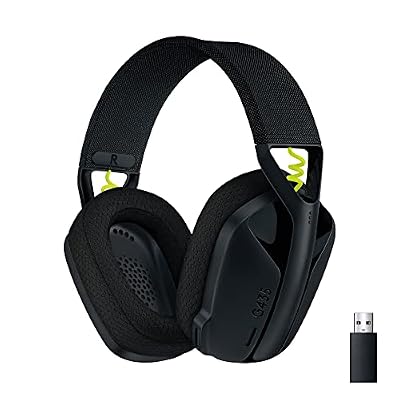
The G435 is the lightest headset in this roundup by a wide margin, and that shapes everything about it. Logitech publishes a weight of 165 grams, 40 mm drivers and up to 18 hours of battery life. You get two wireless modes: LIGHTSPEED over the included USB receiver for PC and PlayStation, and a low-latency Bluetooth mode for Switch, phones and tablets. There is no boom microphone; instead, dual beamforming microphones are built into the ear cup, which keeps the silhouette clean but is the design reviewers flag most often, since voice chat sounds less full than a boom design. The G435 also supports Dolby Atmos and Tempest 3D AudioTech on compatible systems, according to Logitech. It has no wired mode at all, so it cannot fall back to a cable on an Xbox controller or a flat battery.
Specs
- Connection: LIGHTSPEED 2.4 GHz USB receiver plus Bluetooth
- Battery life: up to 18 hours (published)
- Drivers: 40 mm
- Microphone: dual built-in beamforming microphones, not detachable
- Weight: 165 g (published)
- Platforms: PC, PlayStation 5, PlayStation 4, Nintendo Switch, mobile
- Tier: budget
HyperX Cloud Stinger 2 Wireless

The Stinger 2 Wireless is the PC specialist of the group. It connects over a 2.4 GHz USB dongle, runs for up to 20 hours per charge according to HyperX, and uses the largest drivers here at 50 mm. The microphone is a fixed boom with a noise-cancelling capsule, and muting it is a physical gesture: swivel the boom up and the mic cuts out, which is faster and more reliable than hunting for a button. HyperX also publishes DTS Headphone:X spatial audio support on PC. The limits are platform breadth and flexibility: this is a PC-only headset, there is no Bluetooth, and the microphone does not detach. Within those limits, it is the most conventional, game-first design in the tier.
Specs
- Connection: 2.4 GHz USB dongle
- Battery life: up to 20 hours (published)
- Drivers: 50 mm
- Microphone: fixed boom, noise-cancelling, swivel-to-mute
- Platforms: PC
- Extras: DTS Headphone:X spatial audio on PC, memory foam ear cushions
- Tier: mid-range
HyperX Cloud Stinger Core Wireless

The Stinger Core Wireless is the console-leaning sibling. Its 2.4 GHz dongle works with PlayStation 5, PlayStation 4 and PC, and HyperX publishes up to 17 hours of battery life and 40 mm drivers. The microphone is a fixed noise-cancelling boom, and the frame uses steel sliders, which is a durability detail worth having at this end of the market where all-plastic hinges are the usual failure point. You give up the bigger drivers and the spatial-audio software of the Stinger 2 Wireless, and there is still no Bluetooth or detachable mic. In return you get the simplest path to wireless audio on a PlayStation in this tier, in a lightweight frame that suits long sessions.
Specs
- Connection: 2.4 GHz USB dongle
- Battery life: up to 17 hours (published)
- Drivers: 40 mm
- Microphone: fixed boom, noise-cancelling
- Platforms: PlayStation 5, PlayStation 4, PC
- Build: steel sliders, lightweight frame
- Tier: budget
SteelSeries Arctis 1 Wireless

The Arctis 1 Wireless is the multi-platform pick. Its compact USB-C dongle carries a lossless 2.4 GHz connection to PC, PlayStation and Switch, including the Switch in handheld mode, with a USB-A adapter cable in the box for machines without a free USB-C port. SteelSeries publishes up to 20 hours of battery life and 40 mm drivers. The microphone is the differentiator: a detachable ClearCast boom with a bidirectional noise-cancelling capsule, which SteelSeries publishes as Discord certified, and it is the strongest voice setup here on paper. Reviewer commentary lines up with the spec sheet on this one; Trusted Reviews, for example, praised the clarity of both the game audio and the microphone. The included 3.5 mm cable also makes this the only pick that can plug into an Xbox controller for wired play.
Specs
- Connection: 2.4 GHz USB-C dongle, USB-A adapter included, 3.5 mm wired fallback
- Battery life: up to 20 hours (published)
- Drivers: 40 mm
- Microphone: detachable ClearCast boom, bidirectional noise-cancelling
- Platforms: PC, PlayStation 5, PlayStation 4, Nintendo Switch, Android
- Tier: mid-range
Which One Fits Your Setup
Pick the G435 if you move between a PC or PlayStation and a phone or Switch and value low weight over microphone quality. Pick the Stinger 2 Wireless if you play only on PC and want the biggest drivers and a swivel-to-mute boom. Pick the Stinger Core Wireless if your main machine is a PlayStation and you want the simplest dongle setup with a sturdier frame. Pick the Arctis 1 Wireless if you own several platforms, want the detachable microphone, or need the wired fallback for an Xbox controller. The pattern across the tier is consistent: you are always choosing which two of connection flexibility, microphone quality and platform breadth matter most, because no model in this segment maximises all three.
Frequently Asked Questions
Is a 2.4 GHz dongle really better than Bluetooth for gaming?
Yes, for games. A dedicated 2.4 GHz dongle is built for low-latency audio, so dialogue, footsteps and on-screen action stay in sync. Standard Bluetooth adds delay and drops to a lower-quality voice mode when the microphone is active. Bluetooth is still useful for phones, handhelds and video, which is why the G435 pairing of both connections is handy, but the dongle should be your gaming connection whenever one is included.
Why does none of these headsets work wirelessly on Xbox?
Xbox consoles use a proprietary wireless protocol rather than standard USB dongle audio. Only headsets designed and licensed for that protocol connect wirelessly, and none of the four models here is one of them. Plugging a dongle into an Xbox does not change this. The wired fallback is the controller’s 3.5 mm jack, which only the Arctis 1 Wireless can use among these picks, thanks to its included cable.
How long do these headsets actually take to charge and last?
The published ratings run from 17 to 20 hours per charge, measured at moderate listening levels, so expect somewhat less at high volume with the microphone active through long sessions. In practice, every model here covers several evenings of play between charges, and all four recharge over USB. If you play daily for long stretches, the 20-hour models give you a little more margin before the cable comes out.
Is a detachable microphone worth prioritising?
It depends on how you use the headset. A detachable boom, like the ClearCast microphone on the Arctis 1 Wireless, gives the clearest chat audio and comes off when you just want to listen. A fixed swivel-to-mute boom, as on both HyperX models, cannot be lost and mutes with a flick. Built-in beamforming microphones, as on the G435, are the most convenient and the least clear in chat, according to both the published designs and reviewer consensus.
Final Verdict
The entry wireless tier is genuinely competitive now, and the deciding factors are connection type, microphone design and platform support rather than raw sound. The Logitech G435 is the best all-rounder for PC, PlayStation and handheld players who want dongle and Bluetooth in one light frame. The HyperX Cloud Stinger 2 Wireless is the PC purist’s pick, the Stinger Core Wireless is the straightforward PlayStation option, and the SteelSeries Arctis 1 Wireless is the one to buy for multi-platform use and the strongest microphone. Just do not buy any of them expecting wireless Xbox support, because that requires a different class of headset entirely.
Product and ASIN Reference
| Product | ASIN |
|---|---|
| Logitech G435 LIGHTSPEED Wireless Gaming Headset (Black) | B08R8DT7X6 |
| HyperX Cloud Stinger 2 Wireless Gaming Headset | B0BJDQ5VHD |
| HyperX Cloud Stinger Core Wireless Gaming Headset (White) | B08BTHXJFN |
| SteelSeries Arctis 1 Wireless Gaming Headset | B07X64MTGL |