A time-lapse sequence lives or dies on consistency. The camera has to creep along the rail at a perfectly even pace, stop dead for every exposure, and repeat that cycle for hundreds of frames without drifting, juddering or running out of power halfway through a sunset. A motorized slider built for time-lapse work gives you exactly that: programmable start and end points, a shutter trigger link to the camera, and a drive slow enough that a full traverse can stretch past half an hour. This guide compares five motorized sliders currently sold on Amazon US that are suited to time-lapse shooting, from a pocket-size 20 cm travel mini rail to a full 120 cm carbon fiber track, using manufacturer specifications only.
As an Amazon Associate, we earn from qualifying purchases.
What Makes a Slider Good for Time Lapse?
Four things matter more for time lapse than for ordinary video moves. First, the drive has to move slowly and evenly at its lowest settings, ideally with a dedicated time-lapse mode that separates travel time from the frame interval. Second, the slider needs a shutter release connection, because the camera must fire in step with the carriage rather than on its own internal timer alone. Third, battery life decides whether a long sequence finishes at all, so swappable NP-F plates and USB power inputs are worth more than a sealed internal cell. Fourth, the payload rating has to cover your camera and lens at the angle you plan to shoot, since ratings drop sharply on inclines. Parallax or panoramic capability is a bonus: a carriage that angles the camera as it travels keeps a foreground subject framed while the background shifts, which is the move that makes slider time lapses look cinematic.
The Picks at a Glance
Long sequences over landscapes call for the longest rail and the biggest battery you can carry. Studio and product work favors short, precise rails with fine minimum step distances. The five sliders below are ordered from the longest travel to the shortest, and each one is a different answer to the same question.
1. GVM SLIDER-120 Wireless Motorized Slider (Premium)

The GVM SLIDER-120 is the long-travel option in this lineup. Its carbon fiber rail measures 48 inches (122 cm) and delivers about 47 inches (119 cm) of usable travel, the most of any slider here. Control is entirely wireless: a Bluetooth app for iOS and Android sets the A and B travel points, the sliding speed from 1 to 100 percent, and keyframed time-lapse sessions. In time-lapse mode the slowest full traverse runs from 171 seconds out to 33 minutes and 45 seconds, which is the range that matters for cloud, crowd and light-change sequences. A panoramic mode swings the camera through 120 degrees during the move for a simple parallax effect.
Specs
- Rail length: 48 in / 122 cm carbon fiber
- Travel distance: 47 in / 119 cm
- Payload: 11 lb / 5 kg horizontal (manufacturer rating)
- Control: Bluetooth app (iOS and Android), manual and automatic modes
- Time-lapse: keyframed sessions, A/B points, slowest full traverse 33 min 45 s
- Power: NP-F750 battery included, up to 10 hours per the manufacturer
- Weight: 10.1 lb / 4.6 kg
- In the box: ball head, battery and charger, six camera shutter cables, carry bag
The trade-off is size. At 4.6 kg before a tripod goes under it, this is a car-to-location slider rather than a hiking tool, and the app-only control means there is no physical remote if your phone dies. For static landscape work where the rail stays put for an hour, neither drawback matters much.
2. Zeapon Micro 2 Plus Motorized Slider (Premium)

The Zeapon Micro 2 Plus takes the opposite approach: a double-distance design that folds a long move into a short body. The motorized version is 43 cm long yet travels 54 cm, because the rail extends as the carriage moves. Zeapon rates the payload at 4.5 kg at any angle, including vertical, and 8 kg in flat desktop mode, which is the strongest all-angle rating in this guide. The app offers waypoint programming and named presets for time-lapse, night-lapse and city-lapse work, and a 2.5 mm port links the motor to your camera shutter with an optional cable.
Specs
- Rail length: 43 cm motorized (34.7 cm slider body)
- Travel distance: 54 cm
- Payload: 4.5 kg at all angles, 8 kg horizontal desktop mode
- Control: Zeapon app (iOS and Android) plus on-motor controls, three speed settings
- Time-lapse: app presets including time-lapse and night-lapse, waypoint paths
- Power: NP-F550, NP-F750 or NP-F970 battery (sold separately); about 4, 7 or 14 hours of video-mode runtime by battery size; USB-C charging with power delivery support
- Weight: 2 kg with motor module
- Motor noise: 39 dB per the manufacturer
Because the battery is sold separately, factor an NP-F pack into the setup. The payoff is a slider that fits in a camera bag, works vertically for rising reveal shots, and keeps its payload rating on an incline where most rivals derate hard.
3. Neewer ER1-120 Motorized Camera Slider (Mid-Range)

Neewer’s ER1-120 matches the GVM on rail length, a full 120 cm of carbon fiber, but adds a second control path: alongside the Neewer app there is a 2.4G wireless remote, so basic moves do not depend on a phone. The app exposes manual, video and time-lapse modes, with frames, interval and exposure settings adjustable for time-lapse sequences. Side knobs on the carriage set the tracking angle, which gives straight runs, angled tracking shots and a 120 degree panoramic sweep from the same hardware.
Specs
- Rail length: 47.2 in / 120 cm carbon fiber
- Payload: 11 lb / 5 kg horizontal, 5.5 lb / 2.5 kg at a 45 degree tilt (manufacturer ratings)
- Control: Neewer app and 2.4G remote control
- Time-lapse: dedicated mode with frame count, interval and exposure settings in the app
- Power: NP-F550 battery included; USB Type-C 5V input for a power bank
- Shooting modes: manual, video, time lapse, tracking and 120 degree panoramic
- In the box: slider, remote, battery, USB battery charger, ball head, six shutter release cables
The ER1-120 is the flexible middle ground of this list: full-length travel, two ways to control it, and a battery in the box. It is a sensible pick if you split time between location time lapse and ordinary interview or product moves and only want to own one rail.
4. Zeapon Micro 2 E600 Motorized Slider (Mid-Range)
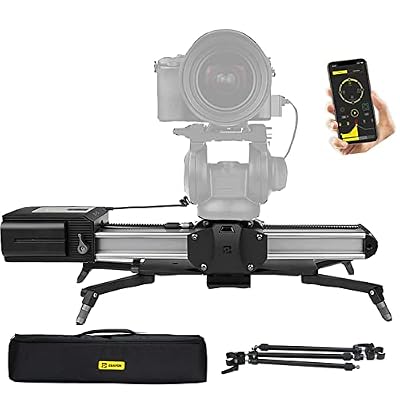
The earlier Micro 2 E600 uses the same double-distance idea in a longer body. Zeapon rates its travel at 74 cm (29 in) with a maximum payload of 8 kg (18 lb), and the motor includes power-off protection so a cut in power does not send the carriage sliding. App control covers the motion programming, and the E600 remains a strong option for heavier mirrorless or compact cinema rigs that would overwhelm the mini sliders.
Specs
- Travel distance: 74 cm / 29 in
- Payload: up to 8 kg / 18 lb (manufacturer rating)
- Control: Zeapon app over Bluetooth
- Time-lapse: app-programmed moves with power-off protection
- Power: NP-F series battery plate (battery sold separately)
- Design: double-distance rail, travel longer than the folded body
Choose the E600 over the Micro 2 Plus if your camera package is heavy and your moves are mostly horizontal; choose the Plus if you need vertical work or the smaller packed size.
5. YC Onion Chocolate SE Motorized Slider (Budget)

The Chocolate SE is the travel and tabletop pick. The whole unit is 26.8 cm long, weighs 818 g, and travels 20 cm, which sounds tiny until you remember that close-range product and food time lapses only need a short, precise move. YC Onion quotes a minimum step distance of 0.001 cm, the finest quoted figure here, and rates the payload at 20 kg sitting on a surface, 3.5 kg inclined and 2.5 kg vertical. A Bluetooth app drives video and time-lapse modes, and a shutter release connection keeps exposures in step.
Specs
- Rail length: 26.8 cm
- Travel distance: 20 cm
- Payload: 20 kg surface-mounted, 3.5 kg inclined, 2.5 kg vertical (manufacturer ratings)
- Control: Bluetooth app (iOS and Android), video and time-lapse modes
- Minimum step: 0.001 cm per the manufacturer
- Power: NP-F550 battery (sold separately) for about 6 hours, or a USB power bank for longer runs
- Weight: 818 g
- Mounting: silicone base pad for tabletops, tripod thread for angled work
This is the slider to keep in a desk drawer or a small camera bag. Anyone shooting tabletop sequences, macro subjects or travel scenes where a full rail is impractical will get more use from it than from a 120 cm track. It is also the natural companion to a compact streaming or creator desk setup; if you are laying out that workspace, a height-adjustable surface such as the ones in our guide to the best motorized gaming desks pairs well with a tabletop rail.
How to Choose Between Them
Start with travel distance, because it cannot be changed later. A 20 cm move reads clearly on a tabletop subject but barely registers across a landscape, while a 119 cm traverse is wasted on a product shot. Next, check the payload at your shooting angle rather than the headline horizontal figure: the Micro 2 Plus holds its 4.5 kg rating vertically, while the long rails derate on inclines. Then look at power. Every slider here runs on NP-F batteries or USB power, so long sequences are a matter of carrying a bigger pack rather than a different charger. Finally, decide how you want to program the move. App-only sliders are fine when the phone is part of your kit anyway; the Neewer earns its place for anyone who wants a physical remote as a backup.
Frequently Asked Questions
How slow does a time-lapse slider need to move?
Slow enough that the full traverse takes at least as long as the sequence you are recording. For a 30 minute capture window, the GVM SLIDER-120 reaches that pace in its time-lapse mode, while shorter rails cover shorter windows. What matters is that the slowest setting is even, with no visible stepping between frames.
Do I need a shutter release cable for slider time lapse?
For most setups, yes. The cable lets the slider trigger each exposure in step with the carriage movement, which keeps frames evenly spaced. All five sliders here support a shutter connection, and the GVM and Neewer models include camera cables in the box.
Can these sliders shoot vertical time-lapse moves?
Two of them are rated for it. The Zeapon Micro 2 Plus carries 4.5 kg at any angle including vertical, and the YC Onion Chocolate SE is rated at 2.5 kg vertical. The long carbon rails are horizontal and mild-incline tools, so check the derated figure before tilting them.
How long will one battery run a time-lapse slider?
It depends on the pack size and the move. Manufacturer figures in this guide range from about 6 hours on an NP-F550 in the Chocolate SE to about 10 hours on the NP-F750 supplied with the GVM SLIDER-120, and up to 14 hours of video-mode runtime for the Micro 2 Plus on an NP-F970. Every model here also accepts USB power, so a power bank removes the ceiling entirely.
Final Verdict
For long outdoor sequences, the GVM SLIDER-120 pairs the longest travel in this guide with a big included battery and proper keyframed time-lapse control. For travel and vertical work, the Zeapon Micro 2 Plus is the most capable compact rail, with the E600 covering heavier rigs. The Neewer ER1-120 is the all-rounder with a physical remote, and the YC Onion Chocolate SE owns the tabletop niche. Match the rail length to your subject distance and the payload to your steepest angle, and any of the five will produce clean, repeatable time-lapse moves.
Product and ASIN Reference
| Product | ASIN |
|---|---|
| GVM SLIDER-120 Wireless Motorized Camera Slider (48 in / 120 cm) | B09CL2XWY1 |
| Zeapon Micro 2 Plus Motorized Slider | B0953DFY97 |
| Neewer ER1-120 Motorized Camera Slider (47.2 in / 120 cm) | B0B7BJM85B |
| Zeapon Micro 2 E600 Motorized Slider | B08P4JWJ6S |
| YC Onion Chocolate SE Motorized Slider | B09JLRK4W7 |