A large home exposes the limits of a single router quickly: bedrooms sit far from the modem, floors and walls weaken the signal, and a gaming PC, laptops, phones, televisions, and smart-home devices compete for the same airtime. A Wi-Fi 7 mesh system uses several nodes sharing one network name, so devices connect to a nearer node as they move through the house.
As an Amazon Associate we earn from qualifying purchases.
This guide compares Wi-Fi 7 mesh packs for larger properties on connection standard, band design, compatible devices, rated coverage, node placement, backhaul options, and usage limits stated by each maker. Coverage figures are manufacturer ratings for favourable layouts, so treat them as a planning starting point, not a guarantee.
What Wi-Fi 7 Adds
Wi-Fi 7, also called 802.11be, builds on Wi-Fi 6 and Wi-Fi 6E. It adds wider channels on the 6 GHz band, 4K-QAM, and Multi-Link Operation (MLO), which lets a compatible device use more than one band at once. That can help supported phones, laptops, and gaming PCs stay connected when one band becomes busy.
Older devices still work: these systems are backwards compatible with the earlier standards on their product pages, so phones, consoles, printers, and smart plugs join at their own maximum standard. The clearest gains appear when the plan is fast, several people are active at once, and key devices support Wi-Fi 6E or Wi-Fi 7.
Band design matters too. Tri-band systems have 2.4 GHz, 5 GHz, and 6 GHz radios, giving nodes an extra path for talking to each other. Dual-band systems have only 2.4 GHz and 5 GHz, so node traffic shares bands with client traffic. Dual-band kits can still suit large homes, especially with wired backhaul, but tri-band designs give busy households more flexibility.
How to Check Fit Before You Buy
These systems replace your router but still need a modem or optical terminal from your provider, so check the WAN port speed against your plan: a 2.5 Gbps port covers multi-gigabit plans, while a faster port leaves more headroom. If your provider supplies a combined modem-router, confirm it can be put into bridge mode.
Count devices realistically. Stated capacity figures here range from around 100 devices to more than 200, and cameras, bulbs, plugs, and sensors add up quickly, so choose a limit comfortably above your current count.
All of the systems below support wireless backhaul. Wired backhaul, where nodes connect by Ethernet, is usually more stable in a large home because it frees the wireless bands for devices. If your house has Ethernet runs, favour multiple multi-gigabit ports per node; if not, position each node with a clear wireless path back toward the main unit.
For broader sizing guidance before narrowing down to Wi-Fi 7, see our guide to the best mesh Wi-Fi system for large homes.
The Systems Compared
TP-Link Deco BE63 (3-Pack)
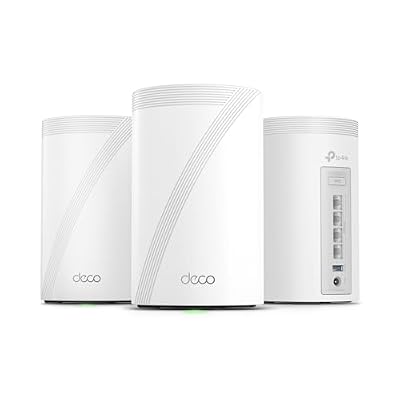
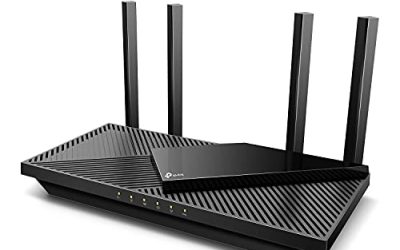
A tri-band Wi-Fi 7 system with a BE10000 rating. Its Amazon listing gives up to 5,188 Mbps on 6 GHz, 4,324 Mbps on 5 GHz, and 574 Mbps on 2.4 GHz, with MLO, Multi-RU, 4K-QAM, and 320 MHz channels named. The 3-pack is rated for up to 7,600 square feet and over 200 devices. Each unit has four 2.5G WAN/LAN ports and a USB 3.0 port, making wired backhaul and wired PC or console connections straightforward. Setup runs through the Deco app; the listing notes Alexa and Google Assistant compatibility, plus Matter support.
- Amazon: https://www.amazon.com/dp/B0CN8QLS4K
Amazon eero Pro 7 (3-Pack)

A tri-band mesh Wi-Fi 7 router in a 3-pack rated for up to 6,000 square feet. Its listing describes support for internet plans up to 5 Gbps, suiting fast cable or fibre tiers that a gigabit WAN port would limit. Each unit has two auto-sensing 5 GbE ports, so one can feed the internet connection while the other supports a wired device or wired backhaul. Setup and management are app-guided and largely automatic. Check the listing for any subscription-based features you want and confirm regional availability.
- Amazon: https://www.amazon.com/dp/B0C6R9P664
NETGEAR Orbi 770 Series, RBE773 (3-Pack)

One router and two satellites, rated by NETGEAR for up to 8,000 square feet, the largest figure here, with Wi-Fi 7 speeds of up to 11 Gbps across its tri-band design and support for up to 100 devices. The router has a 2.5-gigabit internet port and three 2.5-gigabit LAN ports; each satellite has two 2.5-gigabit LAN ports. That supports wired backhaul to both satellites, plus wired links for a gaming PC or console. Setup runs through the Orbi app. Count your devices against the 100-device limit carefully.
- Amazon: https://www.amazon.com/dp/B0D4JB6QJD
TP-Link Deco BE25 (3-Pack)

A dual-band Wi-Fi 7 system with a BE5000 rating: up to 4,324 Mbps on 5 GHz and 688 Mbps on 2.4 GHz, with 240 MHz channel width, MLO, and AI-Roaming named on its listing. The 3-pack covers up to 6,600 square feet; a single unit is rated at up to 2,600 square feet and a 2-pack at up to 4,600 square feet, which helps when judging whether a smaller pack is enough. Each unit has two 2.5G WAN/LAN ports, so wired backhaul is available despite the lack of a 6 GHz band. The listing names compatible devices including gaming consoles, personal computers, smart televisions, smartphones, and tablets. Because node traffic shares the 5 GHz band when backhaul is wireless, it fits best where Ethernet wiring exists.
- Amazon: https://www.amazon.com/dp/B0DKVDZXSN
Side-by-Side Comparison Points
| System | Bands | Rated coverage (3-pack) | Stated device focus | Ports per node |
|---|---|---|---|---|
| TP-Link Deco BE63 | Tri-band, Wi-Fi 7 | Up to 7,600 sq. ft. | Over 200 devices | Four 2.5G ports, plus USB 3.0 |
| Amazon eero Pro 7 | Tri-band, Wi-Fi 7 | Up to 6,000 sq. ft. | Plans up to 5 Gbps | Two 5 GbE ports |
| NETGEAR Orbi 770 (RBE773) | Tri-band, Wi-Fi 7 | Up to 8,000 sq. ft. | Up to 100 devices | Router: 2.5G internet plus three 2.5G LAN; satellites: two 2.5G LAN |
| TP-Link Deco BE25 | Dual-band, Wi-Fi 7 | Up to 6,600 sq. ft. | Moderate counts, wired backhaul helps | Two 2.5G ports |
Installation Configurations by Home Size and Need
Homes around 3,000 to 4,500 square feet, one or two floors. Start with two nodes: the main node beside the modem in a central, raised position, and the second halfway toward the far bedrooms, in an open hallway rather than a cupboard. A 2-pack of the Deco BE25, rated at up to 4,600 square feet as a pair, matches this layout on paper. Add a third node only if a room still struggles.
Homes around 4,500 to 6,500 square feet, or L-shaped layouts. Use the full 3-pack, with the main node central and one node toward each wing. Avoid putting a node in the dead zone itself, since it needs a decent signal from its neighbour to pass on. In a two-storey home, stagger nodes between floors instead of stacking them. The Deco BE25 and eero Pro 7 3-packs fit this band by stated coverage.
Homes above 6,500 square feet, three floors, or thick internal walls. Choose a tri-band 3-pack such as the Deco BE63 or Orbi 770, with wired backhaul wherever possible. Put one node on each floor, offset horizontally, and wire the gaming PC or office into the nearest node. For a detached office or garage, plan an extra compatible node rather than stretching the main set beyond its rated area.
Gaming priority. Wire delay-sensitive devices: connect the gaming PC or console to a node by Ethernet, keep that node within one wireless hop of the main unit, and place nodes away from metal objects and dense brickwork.
Who Each System Is For
- Choose the Deco BE63 for tri-band Wi-Fi 7, the highest stated device capacity here, and plenty of 2.5G ports.
- Choose the eero Pro 7 if your plan runs above gigabit speed, you prefer app-led setup, and your home fits its stated 6,000 square foot coverage.
- Choose the Orbi 770 Series if coverage is your first priority and your device count stays within the stated limit.
- Choose the Deco BE25 for Wi-Fi 7 and 2.5G ports in a dual-band system, especially with Ethernet wiring for backhaul.
Limits to Keep in Mind
Coverage ratings assume favourable conditions. Reinforced concrete, foil-backed insulation, and long distances between nodes reduce real coverage, so a home near the top of a rating may still need an extra node. Wi-Fi 7 features such as MLO and 320 MHz channels apply only to compatible devices. Subscription and smart-home functions vary by brand and region, so check the listing for the exact pack, and confirm the pack size in the title: several systems come in multiple pack sizes under similar names.