Buying a TV box under the Linux label forces one decision before anything else: which kind of Linux system do you actually want in the living room? Embedded Linux boxes such as the MAG and TVIP lines boot straight into a provider portal and do nothing else, while Android TV boxes sit on the Linux kernel yet behave like app platforms with a store, sign-ins and updates. The two families share a name and almost nothing else, so picking the wrong family is the mistake that matters.


This guide serves three groups: subscribers who already pay for a portal-based TV service, households torn between a portal service and everyday apps, and media-library owners who want Kodi or Plex on the big screen. Every pick below was chosen from its Amazon listing name and published specs, with the operating system each box really runs stated plainly rather than hidden behind the Linux label.
Quick Picks
As an Amazon Associate we earn from qualifying purchases
| Product | Best for | Key spec from title |
|---|---|---|
| Raxxio MAG544w3 | Putting an existing portal subscription on the TV with zero fuss | Linux 4.9 with 4K HDR, HEVC and AV1 decoding |
| Meentek TVIP 605 SE | Households split between a portal service and Android apps | Dual Linux and Android system with 4K HDR output |
| Formuler Z11 Pro Max | Portal TV through a polished app on modern networking | Android 11, 4 GB DDR4 memory and Wi-Fi 6 |
| NVIDIA SHIELD TV Pro | Serving and playing a home media library from one box | Tegra X1+ with 4K HDR, Dolby Vision and AI upscaling |
How to Choose
Start With the System the Box Actually Runs
Read the operating system line on the listing before anything else, because it decides everything the box can do. An embedded Linux build, like the Linux 4.9 system on the MAG544w3, boots into one fixed portal interface: no store, no extra apps, no desktop hiding underneath. Android TV models, including the Formuler and the SHIELD, are Linux-based underneath but present an app platform instead. Neither is a PC-style Linux distribution, so choose by behaviour, not by the word Linux in the product name.
Portal Service or Open App Store
A portal box is only half a product until a service feeds it. The MAG544w3 and the TVIP in Linux mode load the channel interface from a portal address your provider gives you, and no subscription is included in the box. Before ordering, confirm your provider supports the exact model and middleware. Android TV picks work the other way: the Play Store supplies Kodi, Plex and mainstream streaming apps directly, and Formuler’s MYTVOnline 3 adds a portal front end on top for households that want both worlds in one unit.
Ports, Storage and Network Speed
Match the hardware to the job instead of chasing the longest spec list. Portal boxes store almost nothing locally, so the MAG544w3 manages fine with 4 GB of flash and a 100 Mbps Ethernet port. App boxes need more: the Formuler pairs 32 GB of storage with Wi-Fi 6 and Gigabit Ethernet, while the SHIELD adds two USB 3.0 ports so a large external drive can hold a Plex library. Check your router’s Wi-Fi band too, since a dual-band box placed far from the router still buffers.
Setup Path and the Way Back
Setup follows the same order on every pick: HDMI to a free TV input, Ethernet if you wired the room, power last, then language, network and any pending system update before changing other settings. Portal users then enter the provider’s portal address and reload; app users sign in and install their players. Once the box sits in place, a cable management box keeps the HDMI and power leads tidy behind the stand. If anything goes wrong, the factory reset inside Settings wipes accounts, apps and portal entries, so keep that path in mind before you buy.
The 4 Best Options
Raxxio MAG544w3
This is the purist’s pick: a set-top box in the classic Infomir mould, sold under the Raxxio brand, running Linux 4.9 with no Android layer at all. It suits a household that already subscribes to a portal-based service and wants the TV to open on the same channel interface every single time. The Amlogic S905Y4-B chipset handles 4K HDR streams with modern HEVC and AV1 decoding, so the modest memory is matched to the job rather than a weakness. Nothing extra is installed, nothing updates in the background, and there is nothing to tidy up.
Specs
- OS: Linux 4.9
- Chipset: Amlogic S905Y4-B, quad-core ARM Cortex-A35
- Memory: 1 GB DDR4 RAM, 4 GB eMMC flash
- Video: 4K HDR with HEVC and AV1 decoding, HDMI 2.1
- Audio: Dolby Digital Plus
- Connectivity: dual-band Wi-Fi, 100 Mbps Ethernet, USB 2.0
Best for: A subscriber who wants a dedicated portal box that boots straight into their existing TV service.
Watch out for: No service is included, and your provider must support this exact model, so confirm compatibility before ordering.
Meentek TVIP 605 SE
The TVIP 605 SE hedges the family bet by carrying both systems on one unit: a Linux mode that behaves like a classic portal mediacenter, and an Android side for app-based playback. That split makes it the natural choice for a household mid-migration, or one where different viewers want different things from the same TV. The Amlogic S905X2 processor drives 4K output with HDR, connections include AV out for an older set, and USB recording lets the box capture from its tuner-style inputs. Middleware support spans TVIP, IPTVPORTAL and HTML5/JS portals.
Specs
- OS: Linux and Android dual system
- Processor: Amlogic S905X2 quad-core, 1.8 GHz
- Memory: 1 GB RAM, 8 GB flash storage
- Video: 3840×2160 (4K) with HDR
- Connectivity: dual-band Wi-Fi 802.11ac, Ethernet
- Interfaces: HDMI, AV, 2x USB, MicroSD, USB recording
Best for: A household that uses a portal service today but still wants Android apps on the same box.
Watch out for: With 1 GB of memory and 8 GB of storage, the Android side is a light-duty extra, not a full app platform.
Formuler Z11 Pro Max
Formuler builds Android boxes specifically for portal and playlist viewing, and the Z11 Pro Max is its current flagship take on that idea. It runs Android 11, which is Linux-based under the interface, and centres everything on the MYTVOnline 3 app, a TV-first front end that makes portal services feel like a native cable box. Around that sit 4 GB of DDR4 memory, 32 GB of storage, Wi-Fi 6 and Gigabit Ethernet, a clear step up from basic portal hardware. Widevine L1 support keeps protected streaming services playing at full quality.
Specs
- OS: Android 11 (Linux-based)
- Processor: Realtek RTD1319C, Mali-G57 MC1 GPU
- Memory: 4 GB DDR4 RAM, 32 GB eMMC storage
- Video: 4K at 60fps, AV1 and H.265 decoding, Widevine L1
- Networking: Wi-Fi 6 AX 2×2, Bluetooth 5.0, Gigabit Ethernet
- Ports: USB 3.0, USB 2.0, HDMI, MicroSD slot
Best for: A portal or playlist viewer who wants a polished, fast interface plus mainstream apps in reserve.
Watch out for: MYTVOnline 3 still needs your own service credentials or playlist, and this is an app box, not a desktop Linux machine.
NVIDIA SHIELD TV Pro
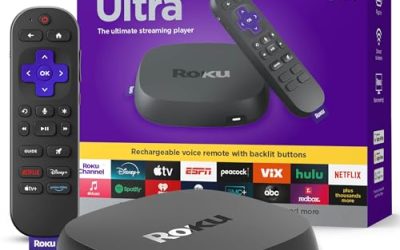
The SHIELD TV Pro is the heavy lifter of this group and the longest-supported Android TV box on the market. Its listing ships Android TV 11 on the Tegra X1+ processor, with AI-enhanced upscaling that lifts HD streams toward 4K and full Dolby Vision and Atmos support for a main living-room setup. What really separates it is the built-in Plex Media Server: attach a drive to one of the two USB 3.0 ports and the same box that plays your library also serves it to the rest of the house.
Specs
- OS: Android TV 11 (Linux-based)
- Processor: NVIDIA Tegra X1+
- Memory: 3 GB RAM, 16 GB storage
- Video: 4K HDR, Dolby Vision, AI-enhanced upscaling
- Audio: Dolby Atmos
- Connectivity: Gigabit Ethernet, dual-band Wi-Fi, 2x USB 3.0
Best for: A home media library owner who wants one box that both serves Plex and plays everything back.
Watch out for: The 16 GB of internal storage fills quickly with apps and cached data, so plan on USB storage from the start.
Which One Fits Your Situation
You Already Pay for a Portal-Based TV Service
Order the Raxxio MAG544w3 and skip everything else. Your subscription does the heavy lifting; the box only has to boot reliably into the portal, decode modern streams efficiently and stay out of the way. Embedded Linux does exactly that, with no app clutter, no store accounts and nothing for family members to rearrange by accident.
Your Household Is Split Between Portal TV and Apps
The Meentek TVIP 605 SE exists for this exact standoff. One viewer keeps the familiar portal interface in Linux mode while another switches to the Android side for app playback, all on a single unit connected to a single TV. You give up the polish of a dedicated Android box, but nobody has to change services or habits.
You Want Portal Viewing With a Modern Interface
Choose the Formuler Z11 Pro Max when the service stays portal-based but the experience should feel current. MYTVOnline 3 organises channels and playlists properly, the remote-first interface suits the sofa, and Wi-Fi 6 with Gigabit Ethernet keeps 4K streams steady. The Play Store sits behind it for the mainstream apps a plain portal box cannot offer.
You Run a Media Library on Your Home Network
The NVIDIA SHIELD TV Pro is the only pick here built for library owners. Plex Media Server is integrated rather than bolted on, external drives connect over USB 3.0, and the Tegra X1+ handles playback and upscaling in the same unit. The Formuler works as a Kodi client for network shares, but the SHIELD is the complete package.
Common Mistakes
- Buying a MAG or TVIP box without already having a provider subscription and its portal address.
- Expecting a desktop environment, terminal or app store on an embedded Linux portal box.
- Assuming an Android TV box gives you full Linux, when the system is Linux-based but locked to apps.
- Ignoring network hardware, then blaming the box for buffering over a weak Wi-Fi signal or a 100 Mbps bottleneck.
- Skipping the model check and discovering after delivery that your provider does not support that exact box.
Frequently Asked Questions
Do these boxes run a full desktop Linux?
No. The MAG544w3 and TVIP 605 SE run embedded Linux builds designed only for TV portals, while the Formuler and the SHIELD run Android TV, which is built on the Linux kernel but presents an app interface. None of the four offers a desktop, a terminal or general-purpose Linux software out of the box.
Can I install Kodi on a Linux portal box?
Not on the MAG544w3, which has no app installation of any kind. Kodi installs normally from the Play Store on the Formuler Z11 Pro Max and the SHIELD TV Pro. The TVIP 605 SE sits between them: its Android side can run apps while Linux mode stays reserved for portal services.
Do I need a subscription for the MAG or TVIP boxes?
Yes. Both are hardware for portal-based services, so you need an account with a compatible provider and the portal address it issues; the box alone shows nothing. The Formuler’s MYTVOnline 3 also needs your own service or playlist, while the SHIELD works with mainstream apps and your own media files instead.
Which pick suits a home media library best?
The SHIELD TV Pro, because Plex Media Server is built in and its USB 3.0 ports accept large external drives, letting one box store, serve and play the library. The Formuler makes a strong Kodi client for network shares. The portal boxes are happiest fed by a provider service rather than local files.