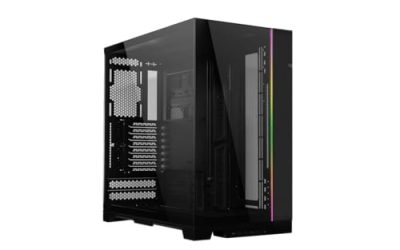
A mini ATX case, more accurately called a Micro-ATX case, is the middle ground of PC building: it takes a Micro-ATX or Mini-ITX motherboard, so the finished system is far smaller than a full ATX tower, yet it still accepts full-size graphics cards, standard power supplies and real cooling hardware — a balance that is hard to beat for a crowded desk, a living room PC, or a first build in a small room.
The catch is that every millimeter matters in a compact chassis: a graphics card that fits one case may foul the front panel of another, and a thick radiator may leave no room for the power supply. This guide compares five Micro-ATX cases still sold on Amazon US, judged on motherboard support, component clearances, cooling options and ease of building.
As an Amazon Associate we earn from qualifying purchases.
Quick Answer
For most builders, the Cooler Master MasterBox Q300L is the best mini ATX PC case: a compact Micro-ATX tower with magnetic dust filters, a movable front I/O panel and room for a 360mm graphics card. The ASUS Prime AP201 is the pick for stronger airflow, the JONSBO Z20 for a system that moves between rooms, the Thermaltake S100 TG for a clean glass showcase, and the Lian Li A3-mATX for the most capable compact chassis, with room for a 415mm graphics card and a 360mm radiator.
Best Mini ATX PC Cases at a Glance

| Case | Best For | Board Support | GPU Clearance | Radiator Support | ASIN |
|---|---|---|---|---|---|
| Cooler Master MasterBox Q300L | Budget builds | Micro-ATX, Mini-ITX | Up to 360mm | Up to 240mm | B0785GRMPG |
| ASUS Prime AP201 | Airflow | Micro-ATX, Mini-ITX | Up to 338mm | Up to 360mm | B0B99HTD3B |
| JONSBO Z20 | Portability | Micro-ATX, Mini-ITX | Up to 363mm | Up to 240mm | B0CWQK3LMB |
| Thermaltake S100 TG | Glass showcase | Micro-ATX, Mini-ITX | Up to 330mm | Up to 280mm | B087CBP34Q |
| Lian Li A3-mATX | Maximum hardware | Micro-ATX, Mini-ITX | Up to 415mm | Up to 360mm | B0D5HCYZXR |
1. Cooler Master MasterBox Q300L: Best Budget Mini ATX Case
The MasterBox Q300L has been a budget staple for years, earning that place with flexibility rather than flash. The chassis measures 387 x 230 x 381mm, so it sits comfortably on a desk or under a monitor shelf, and its most useful trick is the modular I/O panel, which mounts in six positions, putting the front ports and power button wherever your desk layout makes sense.
Cooling is honest for the size: the case ships with one 120mm fan pre-installed and supports up to five fans in total, plus a radiator up to 240mm. Magnetic dust filters on the perforated panels keep intake air clean and lift off for cleaning without tools, and the acrylic side panel shows off the build without the weight of glass.
Specs
- Motherboard support: Micro-ATX, Mini-ITX
- CPU cooler clearance: up to 159mm
- Graphics card clearance: up to 360mm
- Radiator support: up to 240mm
Who It Is For
The Q300L suits first-time builders and budget gaming rigs, and the movable I/O panel solves more desk-layout problems than any other feature here.
Who Should Skip It
Skip the Q300L if you need a full ATX motherboard, plan to run a very hot graphics card with little airflow headroom, or want a tempered glass side panel, since the acrylic window scratches more easily than glass.
2. ASUS Prime AP201: Best Airflow Mini ATX Case
The ASUS Prime AP201 is a 33-liter Micro-ATX case built around mesh: quasi-filter mesh panels cover the sides and front, giving intake air a short, direct path to the components, which matters in a compact build where a solid front panel traps heat. Tool-free side panels make the AP201 easy to open for upgrades and cleaning.
Despite the small volume, the AP201 accepts a standard ATX power supply, which widens the choice of units and avoids the extra cost of a small-form-factor model. It also supports a radiator up to 360mm and a graphics card up to 338mm long, so a serious gaming build fits without resorting to short-card variants.
Specs
- Motherboard support: Micro-ATX, Mini-ITX
- Graphics card clearance: up to 338mm
- Radiator support: up to 360mm
- Power supply support: standard ATX
Who It Is For
The AP201 suits builders who prioritize cool running temperatures in a compact footprint: air-cooled builds benefit most, since the mesh panels let the CPU cooler and graphics card breathe, and ATX power supply support keeps part choices simple.
Who Should Skip It
Skip the AP201 if your graphics card is longer than 338mm, since the case will not take the longest triple-fan cards, and builders who want a glass showcase look may prefer a tempered glass panel rather than mesh.
3. JONSBO Z20: Best Portable Mini ATX Case
The JONSBO Z20 packs a full Micro-ATX build into about 20 liters, and its defining feature is a detachable carrying handle, making it the natural pick for a system that travels to LAN events, moves between rooms, or gets carried to a friend’s house. The steel chassis feels solid in the hand, and the handle removes when the case sits on a desk.
Inside, the Z20 is more capable than its volume suggests, accepting graphics cards up to 363mm long, a 240mm all-in-one liquid cooler, and air coolers up to 160mm tall. Power supply support covers ATX, SFX and SFX-L units, so builders can choose a full-size or compact unit to free up cable room.
Specs
- Motherboard support: Micro-ATX, Mini-ITX
- Graphics card clearance: up to 363mm
- CPU cooler clearance: up to 160mm
- Radiator support: up to 240mm
- Power supply support: ATX, SFX, SFX-L
Who It Is For
The Z20 suits builders who move their PC: the handle, the small footprint and the full-size component support make it a genuine portable gaming rig rather than a compromise.
Who Should Skip It
Skip the Z20 if you need a full ATX motherboard, since the case is sized for Micro-ATX and Mini-ITX only, and it has less room for extra drives than the larger cases on this list.
4. Thermaltake S100 TG: Best Glass Mini ATX Case
The Thermaltake S100 TG is a compact Micro-ATX chassis with a tempered glass side panel, built for builders who want to see their components. The slim case measures 441 x 220 x 411mm and keeps a clean, understated shape, with a built-in power supply cover that hides cables and a dust filter that keeps the interior clean.
Specs
- Motherboard support: Micro-ATX, Mini-ITX
- CPU cooler clearance: up to 165mm
- Graphics card clearance: up to 330mm
- Radiator support: up to 280mm
- Side panel: tempered glass
Who It Is For
The S100 TG suits builders who want a compact glass showcase: it looks clean on a desk, hides its cables behind the power supply cover, and fits the air coolers most gaming builds use.
Who Should Skip It
Skip the S100 TG if you plan a 360mm radiator, since the case tops out at 280mm.
5. Lian Li A3-mATX: Best High-End Mini ATX Case
The Lian Li A3-mATX is the most capable compact chassis in this guide: at 26.3 liters it is still a small case, but it accepts a graphics card up to 415mm long and a radiator up to 360mm, covering the longest current graphics cards and serious liquid cooling. Perforated mesh panels on the top and sides are designed for airflow, and the interior can be arranged in several layouts, with the power supply mounted at the side or the front.
Specs
- Motherboard support: Micro-ATX, Mini-ITX
- Graphics card clearance: up to 415mm
- Radiator support: up to 360mm
- Power supply support: ATX, SFX
Who It Is For
The A3-mATX suits builders who want a small case without giving up high-end parts: it is the pick for a compact rig with a long graphics card, a 360mm radiator, or both.
Who Should Skip It
Skip the A3-mATX if you want the simplest possible build, since the flexible interior takes more planning than a fixed-layout case, and it is the most premium option here, so budget builders get better value from the Q300L or S100 TG.
How to Choose a Mini ATX PC Case
Start with the motherboard: a Micro-ATX case will not take a full ATX board, whatever the photos suggest, so confirm the board size first. All five cases here take Micro-ATX and Mini-ITX boards, and none takes a full ATX board.
Next, measure the graphics card. Manufacturer clearance figures are the starting point, not a guarantee, since a card’s listed length may not include a thick backplate or a protruding power connector. Compare the card’s full dimensions against the case clearance and leave a small margin for cables.
CPU cooler height is the next check: air coolers are measured from the motherboard surface to the top of the cooler, and the case clearance must exceed that figure. The cases here range from 159mm to 165mm of cooler clearance, which covers most tower coolers but not the tallest dual-tower models.
Radiator support decides the cooling plan: a 240mm radiator fits all five cases here, while the AP201 and A3-mATX also take a 360mm radiator. Note that radiator and fan thickness add up, so a thick radiator can collide with memory modules or the power supply shroud even when the length fits.
Power supply size and connectors matter more in a small case: check the maximum power supply length, confirm the unit has the connectors the graphics card needs, and remember that a modular power supply makes cable routing far easier in a tight chassis.
Finally, think about airflow against looks: mesh panels cool better than solid glass, while glass shows off the build, and dust filters help in both cases. Front I/O is a small detail that matters daily, so check for the USB ports and audio jacks you actually use, and whether the panel sits where your desk allows easy reach.
Frequently Asked Questions
Is a mini ATX case the same as a Micro-ATX case?
Yes. Mini ATX is a casual name for the Micro-ATX form factor: a case sold as a mini ATX case takes Micro-ATX and usually Mini-ITX motherboards, but not full ATX boards. Confirm the supported board sizes in the manufacturer specifications before ordering.
Can a mini ATX case fit a full-size graphics card?
Most of the cases in this guide can: clearances here run from 330mm to 415mm, which covers the majority of current graphics cards. Measure the card, including any backplate and power connectors, and compare it with the case clearance before buying.
Do mini ATX cases run hotter than full towers?
A smaller case has less air volume and tighter component spacing, so temperatures depend more on layout and fan setup, and mesh-front cases with a clear intake-to-exhaust path run cooler than sealed glass boxes of the same size. Plan the fan layout and keep cables out of the airflow path.
What power supply do I need for a mini ATX build?
It depends on the case: some mini ATX cases take a standard ATX power supply, while others need an SFX or SFX-L unit. Check the case specifications for the maximum power supply length and the mounting type, then choose a unit with enough wattage and the right connectors for the graphics card.
Final Verdict
The best mini ATX PC case for most builders is the Cooler Master MasterBox Q300L, covering the essentials at a friendly size: Micro-ATX support, a 360mm graphics card, a 240mm radiator and a movable I/O panel. The ASUS Prime AP201 is the pick for the coolest running compact system, the JONSBO Z20 is the right choice when the PC needs to travel, the Thermaltake S100 TG is the cleanest glass showcase, and the Lian Li A3-mATX holds the longest graphics card and the biggest radiator in a small volume.
Before ordering, measure the graphics card, cooler and power supply against the manufacturer clearances. If the parts list outgrows a compact chassis, our guide to the best ATX PC cases covers full-size options with more room for cooling and upgrades.
Product and ASIN Reference
| Product | ASIN |
|---|---|
| Cooler Master MasterBox Q300L Micro-ATX PC Case | B0785GRMPG |
| ASUS Prime AP201 Micro-ATX PC Case | B0B99HTD3B |
| JONSBO Z20 Micro-ATX Mini Tower PC Case | B0CWQK3LMB |
| Thermaltake S100 TG Micro-ATX PC Case | B087CBP34Q |
| Lian Li A3-mATX Micro-ATX PC Case | B0D5HCYZXR |