As an Amazon Associate we earn from qualifying purchases.

A portable EKG monitor, also called an ECG monitor, records the electrical activity of the heart and shows the result in a smartphone app. For home use, the appeal is simple: a short recording, a clear trace on the phone, and a record that can be saved or shared with a clinician. The choice depends on lead count, app support, battery type, recording length and how the device connects to the phone.
This guide compares portable EKG monitors that work with a smartphone app. It explains the checks that matter before buying, then looks at four devices listed on Amazon US. These devices are for personal rhythm spot checks and record keeping. They are not a substitute for medical care, and they do not check for a heart attack. If symptoms are severe or ongoing, seek medical help promptly.
What to Check Before You Choose
Lead count is the first difference. A single-lead device records one view of the heart, usually Lead I, from two fingers. A six-lead device records six views, including Lead I, II, III, aVR, aVL and aVF, when used with fingers and a leg or ankle contact. More leads give a clinician more context, but they also need correct placement and a steady recording.
App support is the second check. Confirm the device app works with the phone operating system and version in use, and check whether the app needs Bluetooth, an ultrasonic signal, or a wired connection. Some devices use Bluetooth, some use the phone microphone, and some use a direct connection. Check the listing for iOS and Android support, and for any subscription needed for extra detections or unlimited storage.
Recording time and battery matter for regular use. Most devices in this guide record in about 30 seconds. Some allow longer recordings, up to five minutes or more, which can help when a rhythm event is intermittent. Battery type also varies: some use a replaceable coin cell, some use a rechargeable battery, and some use a charging dock.
Sharing options are important if the record will go to a clinician. Check whether the app can export a PDF, share by email, or store recordings in a cloud account. Also check whether the device is listed as FDA-cleared, and what rhythms it is cleared to detect, such as atrial fibrillation, bradycardia, tachycardia and normal sinus rhythm. Clearance does not mean the device can diagnose every heart condition.
1. KardiaMobile 6L
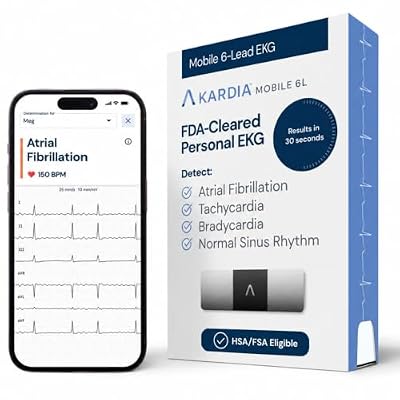
The KardiaMobile 6L by AliveCor is a six-lead personal EKG monitor, FDA-cleared, that gives results in 30 seconds and works with smartphones. The Amazon listing states it provides six views of the heart, unlimited recordings, and HSA and FSA eligibility. It is pocket-size and uses a CR2016 battery, with a listed battery life of about 200 hours in the product details.
Six leads give more context than a single-lead device, which can help a clinician review the trace. The device is designed for finger and leg placement to capture the six leads, and the app shows the trace and determination on the phone. The compact size makes it easy to carry in a bag or keep beside a desk.
- View on Amazon: https://www.amazon.com/dp/B07RQW6SD5
2. KardiaMobile 1-Lead EKG Monitor
The KardiaMobile 1-Lead EKG Monitor by AliveCor is a single-lead, FDA-cleared personal heart monitor that records a medical-grade EKG in 30 seconds. The listing states it detects normal sinus rhythm, atrial fibrillation and arrhythmias, offers unlimited recordings, and works with most smartphones. It weighs 18 grams, uses a CR2016 battery with a listed battery life of about 12 months, and is pocket-size.
This is the simplest device in the guide. Two fingers on the electrodes, a 30 second recording, and a result in the app. No wires, no Bluetooth pairing step in the same way as other devices, and no charging cable to keep track of. That simplicity suits users who want a quick spot check without extra setup.
- View on Amazon: https://www.amazon.com/dp/B01A4W8AUK
3. KardiaMobile Card

The KardiaMobile Card is a wallet-size, single-lead personal EKG device by AliveCor. The listing describes it as thin and light, like a credit card, fitting in a wallet, and recording a medical-grade EKG in seconds. It uses Bluetooth to connect to the phone, needs no Wi-Fi, and is FDA-cleared to detect atrial fibrillation and irregular arrhythmias, with up to six arrhythmia detections listed in the product details.
The card form factor is the main difference here. It suits users who want a device always in a wallet, without carrying a separate pocket device. Bluetooth connection avoids the ultrasonic method used by the original KardiaMobile, which can help in noisy settings.
- View on Amazon: https://www.amazon.com/dp/B09TQ3ZN8V
4. Wellue DuoEK-S
The Wellue DuoEK-S is a personal EKG monitor with Bluetooth, a free app for iOS and Android, and a 0.96 inch OLED screen. The listing states it can record ECG and heart rate, detect irregular heartbeat, and analyse rhythm in 30 seconds from the fingers, or from the chest for a deeper trace. It is USB rechargeable, with auto on and off, and connects to a smartphone with Bluetooth.
The DuoEK-S offers more placement options than a finger-only device. Hand to hand, hand to leg, chest and chest wear are listed as measurement methods in the product details, and recording can run from 30 seconds to five minutes. The built-in screen shows heart rate without opening the app, which can help for a quick check.
- View on Amazon: https://www.amazon.com/dp/B098XQQVB6
Comparison at a Glance
| Device | Leads | Connection | Recording time |
|---|---|---|---|
| KardiaMobile 6L | 6 leads | Smartphone app | 30 seconds |
| KardiaMobile 1-Lead | 1 lead | Smartphone app, ultrasonic | 30 seconds to 5 minutes |
| KardiaMobile Card | 1 lead | Bluetooth | Seconds, per listing |
| Wellue DuoEK-S | Single-lead, multiple placements | Bluetooth | 30 seconds to 5 minutes |
Lead count and placement flexibility are the main trade-offs. Six leads give more context, while a card or single-lead device gives more portability.
Choosing for Different Needs
For a first home EKG monitor, a single-lead device is often the simplest starting point. It is easy to use, easy to carry, and gives a clear trace for atrial fibrillation spot checks. The KardiaMobile 1-Lead fits that role, with a long coin-cell battery life and a pocket-size design.
For more context in each recording, the KardiaMobile 6L is the upgrade pick in this guide. Six leads need more careful placement, but they give a clinician more to review. That can matter when a rhythm event is hard to classify from one lead alone.
For always-with-you use, the KardiaMobile Card fits a wallet and uses Bluetooth. It suits users who travel often or who want a device that is always at hand without a separate case.
For longer or chest-based recording, the Wellue DuoEK-S offers a screen, Bluetooth, and multiple placement methods. It suits users who want a longer recording window or a chest-worn option, subject to the strap included in the listing.
For more on portable screens and phone accessories that pair with a health setup, see our guide to best portable monitors for a larger view of app data at a desk.
Conclusion
The best portable EKG monitor with smartphone integration depends on how much context is needed in each recording and how the device will be carried. The KardiaMobile 6L gives six leads for a fuller trace, the KardiaMobile 1-Lead gives simple single-lead spot checks, the KardiaMobile Card gives wallet-size Bluetooth convenience, and the Wellue DuoEK-S gives multiple placements and a built-in screen. Check lead count, app support, battery type and sharing options first, then choose the device that fits the phone, the routine and the clinician workflow.