Logitech G has supplied more mice to professional FPS rosters than any other brand, and the reason is boring in the best way: its HERO sensors track without smoothing or acceleration, its LIGHTSPEED wireless reports at 1 ms, and its shapes are conservative designs refined over years rather than experiments. If you have already decided on Logitech and play shooters, the real question is not whether the sensor is good enough — every mouse below uses a flawless HERO variant — but which shell, switch type and connection fits your hand and grip.
This guide compares five current Logitech G mice that suit FPS play, deliberately skipping the G502 family (too heavy and button-dense for pure aim work) and the models covered in our other Logitech roundups. Each pick is matched to a user group: ultralight symmetrical, ergonomic flagship, palm-grip wireless, battery-endurance hybrid and a wired option for players who never want to think about charging. If you want the cross-brand picture before committing to one maker, our roundup of the best FPS gaming mouse picks covers the rival shapes from Razer, Pulsar and others.
As an Amazon Associate we earn from qualifying purchases.
The HERO generations, briefly
Three sensor generations appear below. The original HERO launched at 16,000 DPI and was later raised to a 25,600 DPI ceiling (HERO 25K) through G HUB firmware updates, with tracking above 400 IPS and zero smoothing, filtering or acceleration. HERO 2, found in the current PRO X SUPERLIGHT 2 line, pushes the ceiling to 44,000 DPI and 888 IPS and supports wireless polling rates up to 8,000 Hz on compatible models. For FPS play at realistic sensitivities (400–1,600 DPI), all three generations are effectively perfect; the newer sensor mainly buys higher polling options and efficiency, not visibly better aim.
1. Logitech G PRO X SUPERLIGHT — the ultralight benchmark
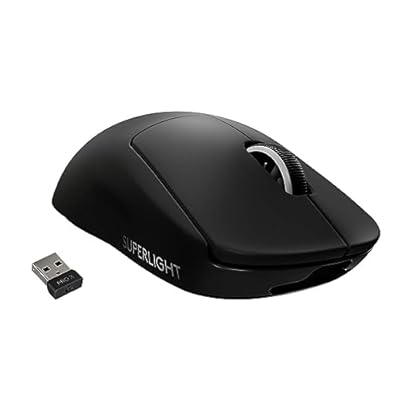
The original SUPERLIGHT is still the shape most FPS players picture when they think of Logitech: a safe, symmetrical shell with gently curved sides, no RGB, and a weight under 63 grams that made heavy mice feel obsolete. Its HERO 25K sensor, mechanical switches with metal spring tensioning, and LIGHTSPEED connection deliver the full competitive checklist, and the zero-additive PTFE feet glide consistently on cloth pads.
The trade-offs are age-related rather than performance-related. Charging is micro-USB rather than USB-C, polling is capped at the standard 1,000 Hz, and there is no Bluetooth for a second device. None of that matters in a match. It suits claw and fingertip players with small to medium hands who want the lightest proven symmetrical Logitech, and left-handers should note the side buttons sit on the left flank only, so it is a right-handed mouse in practice.
Specs
- Sensor: HERO 25K optical, 100–25,600 DPI, 400+ IPS
- Weight: under 63 g
- Dimensions: 125.0 × 63.5 × 40.0 mm
- Shape: symmetrical, right-handed use, side buttons on the left
- Switches: mechanical with metal spring tensioning system
- Connectivity: LIGHTSPEED 2.4 GHz wireless, wired via micro-USB cable
- Polling rate: 1,000 Hz (1 ms report rate)
- Buttons: 5 programmable
- Battery: up to 70 hours of constant motion
- Extras: zero-additive PTFE feet, no RGB lighting
2. Logitech G PRO X SUPERLIGHT 2 DEX — the ergonomic flagship

The DEX takes the current flagship internals — HERO 2 sensor, LIGHTFORCE hybrid optical-mechanical switches, USB-C charging and up to 95 hours of battery — and puts them in a sculpted right-handed shell with a pronounced thumb rest and asymmetric curves. At 60 grams it matches the symmetrical SUPERLIGHT 2 on weight while giving palm and relaxed-claw players a shape that fills the hand instead of floating under it.
LIGHTFORCE switches are the headline difference from the older mice here: they actuate optically for speed and consistency while keeping a mechanical click feel, and Logitech rates them far beyond the click life of conventional mechanical switches. The HERO 2 also unlocks wireless polling up to 8,000 Hz through G HUB for players with high-refresh monitors who want the lowest possible input interval. It suits right-handed palm and claw players with medium to large hands who found the symmetrical PRO shape too flat.
Specs
- Sensor: HERO 2 optical, up to 44,000 DPI, 888 IPS
- Weight: 60 g
- Dimensions: approx. 126 × 68 × 44 mm
- Shape: right-handed ergonomic (DEX)
- Switches: LIGHTFORCE hybrid optical-mechanical
- Connectivity: LIGHTSPEED 2.4 GHz wireless, wired via USB-C cable
- Polling rate: up to 8,000 Hz wireless
- Buttons: 5 programmable
- Battery: up to 95 hours of constant motion
- Extras: USB-C charging, PTFE feet
3. Logitech G703 LIGHTSPEED — the palm-grip all-rounder

The G703 shares its basic shell with the wired G403 below: a 124 mm right-handed ergonomic shape with rubber side grips, a supportive hump and room for a full palm grip. Inside, the HERO 25K sensor and LIGHTSPEED wireless match the PRO line on tracking, while the 95 gram weight (plus an optional 10 gram tuning weight) gives the mouse a planted feel that some players prefer for controlled, lower-sensitivity aiming.
Battery life is the compromise: up to 35 hours with the default LIGHTSYNC RGB running, or up to 60 hours with lighting off — plan on weekly charging in heavy use, or pair it with a POWERPLAY mat, which it supports. Six programmable buttons and onboard memory round out a mouse that doubles comfortably as a daily driver. It suits palm-grip players with medium to large hands who want wireless freedom without the ultralight feel.
Specs
- Sensor: HERO 25K optical, 100–25,600 DPI, 400+ IPS
- Weight: 95 g, plus optional 10 g weight
- Dimensions: 124 × 68 × 43 mm
- Shape: right-handed ergonomic with rubber side grips
- Switches: mechanical with metal spring tensioning system
- Connectivity: LIGHTSPEED 2.4 GHz wireless, wired via included cable, POWERPLAY compatible
- Polling rate: 1,000 Hz (1 ms report rate)
- Buttons: 6 programmable
- Battery: up to 35 hours with default lighting, up to 60 hours with lighting off
- Extras: LIGHTSYNC RGB, onboard memory
4. Logitech G309 LIGHTSPEED — the marathon-battery hybrid

The G309 takes a different route to wireless endurance: a single AA battery that Logitech rates for over 300 hours of LIGHTSPEED play. It pairs the HERO 25K sensor with LIGHTFORCE hybrid switches — hardware usually reserved for the PRO line — in a compact 120 mm symmetrical shell, and it adds Bluetooth as a second connection for a laptop or tablet, which no other mouse here offers.
Weight depends on how you power it: 86 grams with an alkaline AA fitted, or 68 grams with no battery at all when used over a POWERPLAY mat. The egg-shaped shell and modest hump suit small to medium hands and fingertip or claw grips, and it is the natural pick for players who split time between a gaming PC and a work machine and refuse to manage charging cables. Dedicated competitors chasing 8,000 Hz polling should look at the DEX instead; the G309 is capped at 1,000 Hz.
Specs
- Sensor: HERO 25K optical, 100–25,600 DPI
- Weight: 86 g with AA battery, 68 g without battery (POWERPLAY mode)
- Dimensions: 120 × 64 × 39 mm
- Shape: symmetrical, right-handed use
- Switches: LIGHTFORCE hybrid optical-mechanical
- Connectivity: LIGHTSPEED 2.4 GHz wireless and Bluetooth, POWERPLAY compatible
- Polling rate: 1,000 Hz (1 ms report rate) over LIGHTSPEED
- Buttons: 6 programmable
- Battery: 300+ hours on a single AA battery (LIGHTSPEED)
- Extras: dual wireless modes, no charging cable required
5. Logitech G403 HERO — the wired purist’s pick

Everything wireless mice manage around — batteries, receivers, charging habits — the G403 HERO simply removes. It is the wired twin of the G703 shell: the same 124 mm ergonomic shape, rubber side grips and HERO 25K sensor, delivered over a 2.1 metre cable at a 1 ms report rate, with an 87 gram base weight and an optional 10 gram weight for players who like a heavier, more deliberate glide.
For FPS use, the wired connection is a feature, not a limitation: there is no battery to die mid-session and no dongle to lose, and the sensor performance is identical to the wireless G703. Cable drag is the one real cost, largely solved by a mouse bungee. It suits palm and claw players with medium to large hands who play at a fixed desk and want the G703 shape and sensor with zero maintenance.
Specs
- Sensor: HERO 25K optical, 100–25,600 DPI, 400+ IPS
- Weight: 87 g, plus optional 10 g weight
- Dimensions: 124 × 68 × 43 mm
- Shape: right-handed ergonomic with rubber side grips
- Switches: mechanical with metal spring tensioning system
- Connectivity: wired USB, 2.1 m cable
- Polling rate: 1,000 Hz (1 ms report rate)
- Buttons: 6 programmable
- Battery: none (wired)
- Extras: LIGHTSYNC RGB, onboard memory
How to choose among them
Start with shape, because every sensor here is beyond reproach for FPS. Symmetrical shells (SUPERLIGHT, G309) favour claw and fingertip grips and quick vertical flicks; ergonomic shells (DEX, G703, G403 HERO) support the palm and suit longer sessions at lower sensitivity. Then decide on power: the G309’s AA cell and the SUPERLIGHT’s 70-hour cell minimise charging, the DEX stretches to 95 hours, and the G703 needs the most frequent top-ups unless it lives on a POWERPLAY mat. Finally, switches: LIGHTFORCE hybrids (DEX, G309) offer optical actuation and the longest rated life, while the mechanical switches in the other three are the proven, familiar PRO-line feel.
Platform support is uniform across the five: all work on Windows and macOS through G HUB for remapping and DPI steps, and all connect to consoles only where a game itself supports mouse input — a platform limit, not a Logitech one. For most FPS players the SUPERLIGHT remains the default answer; choose the DEX for an ergonomic flagship, the G703 for palm-grip wireless comfort, the G309 for battery freedom and dual-device use, and the G403 HERO if a cable has never bothered you.