A large PC case is not about buying the biggest box on the shelf. The real decision is whether the extra volume solves a problem your current case cannot: a graphics card longer than 400 mm, a thick radiator with fans on both sides, an E-ATX board, or a stack of drives that no mid tower can hold. If none of those apply, a full tower mostly adds footprint, weight and empty space that your desk has to carry.
This guide is for first-time full-tower buyers, upgraders whose graphics card outgrew their last case, custom-loop builders, and anyone combining gaming with workstation duty in one chassis. Each case below was chosen from the name and specifications shown on its Amazon product page, with clearances checked against the figures the maker publishes. If you are weighing a case against a complete system instead, our roundup of the best large gaming PCs covers finished machines built around the same idea.
Quick Picks
As an Amazon Associate we earn from qualifying purchases
| Product | Best for | Key spec from title |
|---|---|---|
| Corsair 7000D AIRFLOW | A first full tower built around a long graphics card | 450 mm GPU clearance, 3x 140 mm fans |
| Lian Li O11 Dynamic EVO XL | A showcase build with a large custom loop | Up to 3x 420 mm radiator support |
| Phanteks Enthoo Pro 2 TG | A storage-heavy workstation or dual-system build | SSI-EEB support, up to 15 fan mounts |
| Thermaltake View 51 TG ARGB | A glass showpiece with big pre-installed fans | 2x 200 mm ARGB front fans |
| Fractal Design Meshify 2 XL | A mesh tower with flexible storage and quiet airflow | 11 fan mounts, 600 x 240 x 566 mm |
How to Choose
Measure GPU length and cooler height first
The two numbers that decide whether a case works are maximum graphics card length and maximum CPU cooler height, and both are printed in the specifications on the Amazon listing. Measure your card from the rear bracket to the far end of the shroud, then add at least 10 mm for the power connectors and any front radiator that sits in the same path. A card listed at 340 mm can still collide with a front-mounted 360 mm radiator once fans are added. The same logic applies to tall air coolers: a 165 mm cooler in a case rated for 160 mm simply does not fit, and no amount of cable tying fixes a lid that will not close.
Plan radiator and fan mounts before you buy
Radiator support is quoted as a maximum size per mounting point, not as a promise that every mount can hold that size at once. A case that lists a 480 mm front radiator and a 420 mm top radiator may not accept both together if the top mount hangs over the motherboard tray or the front mount crowds the graphics card. Count the fan positions you actually need for your loop or air-cooled layout, then check whether the case ships with fans or leaves every mount empty. Cases in this guide range from three bundled 140 mm fans to none at all, so the fan budget changes with the case.
Leave room for cables and the power supply
A large case hides cables well only when it has depth behind the motherboard tray and a shroud or basement that swallows the power supply and its spare leads. Look for the cable routing depth figure, which is 36 mm on the Corsair 7000D AIRFLOW, and compare it with the thickness of your 24-pin and graphics card cables once they are bundled. Power supply length matters too: long high-wattage units can run past 200 mm, and a short shroud turns a tidy build into a forced fit. Check the maximum PSU length in the listing, measure your unit including its modular connectors, and keep spare drive cages out of the way of the cables.
Check front I/O and dust filters for daily use
Front-panel connectors decide how the case feels every day, so count them before you commit. Four USB 3.0 ports plus a USB-C port suit a desk setup with a headset, a controller and a drive dock, while a single USB-C port on a floor case means reaching around the chassis more often than you expect. Dust filters matter just as much: a mesh front panel pulls in more air and more dust, so confirm that the front, top and bottom filters slide out without moving the case or removing the graphics card. A case that is awkward to clean slowly loses the airflow advantage that made you buy it.
The 5 Best Options
Corsair 7000D AIRFLOW

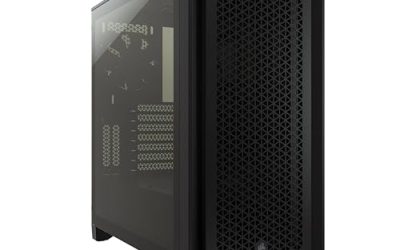
The 7000D AIRFLOW is the most forgiving first full tower in this guide because its clearances cover every mainstream part without forcing compromises elsewhere. A 450 mm graphics card limit and 190 mm of cooler height leave room for long triple-fan cards and tall air coolers, while support for radiators up to 480 mm gives a custom loop somewhere to grow. Three 140 mm AirGuide fans ship in the box, and the 36 mm of cable routing depth keeps thick bundles behind the tray instead of pressed against the side panel. Builders moving up from a cramped mid tower will notice the difference when the motherboard goes in.
Specs
- Full-tower case, 600 x 550 x 248 mm, 20 kg
- Supports Mini-ITX, Micro-ATX, ATX and E-ATX up to 305 x 277 mm
- Maximum graphics card length 450 mm
- Maximum CPU cooler height 190 mm
- Maximum power supply length 225 mm
- Radiator compatibility up to 480 mm
- 8 horizontal plus 3 vertical expansion slots
- Drive bays: 6x 3.5-inch and 4x 2.5-inch
- Front I/O: 4x USB 3.0, 1x USB 3.1 Type-C, audio in and out
- Includes 3x 140 mm AirGuide fans with PWM repeater
- Cable routing space 36 mm
- 2-year warranty
Best for: A first full tower built around a long graphics card and a tall air cooler.
Watch out for: At 600 mm tall and 20 kg empty, confirm desk height, floor space and a clear path through doorways before ordering.
Lian Li O11 Dynamic EVO XL

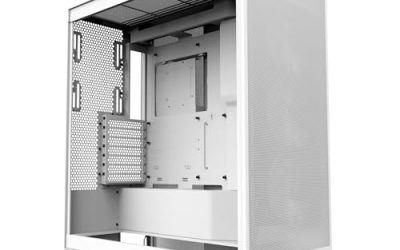
The O11 Dynamic EVO XL suits builders who want their cooling on display, with glass on the front and side and a chassis that can be reversed for a mirrored layout. Its headline figure is support for up to three 420 mm radiators, which covers a dual loop or a thick single loop. Boards up to 280 mm E-ATX fit inside, so workstation boards are welcome alongside gaming hardware. The dual-chamber layout keeps the power supply and drive cables in a rear compartment, which makes the visible side easier to keep tidy. This is the case to pick when the loop itself is part of the build.
Specs
- Full-tower case with front and side tempered glass panels
- Supports motherboards up to 280 mm E-ATX
- Radiator support up to 3x 420 mm
- ARGB lighting strips built in
- Reversible chassis for mirrored layouts
- Dual-chamber design with separate cable compartment
- Model O11DEXL-X
Best for: A showcase build with a large custom water loop and an E-ATX board.
Watch out for: Confirm how many fans ship in the box before ordering, since the listing focuses on radiator mounts rather than bundled fans.
Phanteks Enthoo Pro 2 TG

The Enthoo Pro 2 TG is the workhorse of this guide, built for systems that carry more than a gaming load. It accepts SSI-EEB server boards alongside E-ATX and smaller formats, and it supports dual 480 mm radiators plus dual 360 mm radiators at the same time for liquid cooling. Storage is its other strength, with room for up to 12 hard drives or 11 solid-state drives, and the chassis can host a second system or a second power supply. Fifteen fan mounting positions give air-cooled builds plenty of options. Choose it when one machine has to game, render and store a library at once.
Specs
- Full-tower case, 240 x 560 x 580 mm, 13 kg
- Supports SSI-EEB, E-ATX, ATX, Micro-ATX and Mini-ITX
- Dual 480 mm and dual 360 mm radiator support simultaneously
- Up to 15 fan mounting positions
- Storage up to 12x HDD or 11x SSD
- 8 PCIe slots plus 3 vertical GPU slots
- Front I/O: 1x USB-C Gen 2, 4x USB 3.0, microphone and headphone jacks
- High-performance fabric mesh front panel
- Integrated Digital-RGB controller
- Dual-system and dual-PSU support
- Model PH-ES620PTG_DBK01
Best for: A storage-heavy workstation, server-style build or dual-system setup.
Watch out for: At 580 mm deep, measure desk depth carefully, and confirm you actually need the second-system bay before paying for it.
Thermaltake View 51 TG ARGB

The View 51 TG ARGB is the showpiece pick, with tempered glass on three sides and two 200 mm ARGB fans at the front that move air quietly. It accepts E-ATX boards up to 10.5 inches wide and graphics cards up to 440 mm long. Radiator support reaches 360 mm across the front, top, right side and bottom, giving a single loop several mounting options. The white 200 mm fans and rear 120 mm ARGB fan ship pre-installed, which means the case looks finished the moment the side panels go on. Pick it when the build sits on the desk and gets looked at every day.
Specs
- Full-tower case with three tempered glass panels
- Supports Mini-ITX, Micro-ATX and E-ATX up to 10.5 inches wide
- Maximum graphics card length 440 mm without water pump, 300 mm with water pump
- Radiator support up to 360 mm at front, top, right and bottom
- Includes 2x 200 mm 5V ARGB front fans
- Includes 1x 120 mm 5V ARGB rear fan
- Model CA-1Q6-00M1WN-00
Best for: A glass showpiece on the desk with big, quiet pre-installed fans.
Watch out for: Graphics card clearance drops to 300 mm when a front water pump or reservoir is fitted, so check that figure before planning a loop.
Fractal Design Meshify 2 XL

The Meshify 2 XL is the quiet achiever of the group, pairing an angular mesh front with a flexible interior that adapts to storage-heavy or cooling-heavy builds. It accepts boards from Mini-ITX to SSI-EEB, and its dual-layout interior lets you move the motherboard tray and drive cages to favour either airflow or capacity. Eleven fan mounts and twelve expansion slots leave room for extra cards and drives, while the light-tint tempered glass side panel keeps the build visible without turning the case into a display cabinet. It suits builders who want the airflow of a mesh front without giving up an adaptable interior.
Specs
- Full-tower case, 600 x 240 x 566 mm, 14.1 kg
- Supports SSI-EEB, SSI-CEB, EE-ATX, E-ATX, ATX, Micro-ATX and Mini-ITX
- 11 fan mounting positions
- 12 expansion slots
- 8 drive bays
- Angular mesh front panel with light-tint tempered glass side panel
- Dual-layout interior with movable drive cages
- 2-year warranty
- Model FD-C-MES2X-02
Best for: A mesh-front tower with flexible storage and room for a large air-cooled build.
Watch out for: At 600 mm tall and 14.1 kg, confirm floor clearance and desk strength, and check that the dust filters are easy to reach.
Which One Fits Your Situation
Your graphics card barely fits your current case
Pick the Corsair 7000D AIRFLOW. Its 450 mm graphics card limit is the longest in this guide, and the 190 mm cooler height means a tall air cooler fits at the same time. The three bundled 140 mm fans also mean you are not buying fans on top of the case to get decent airflow on day one.
You plan a custom water loop
Pick the Lian Li O11 Dynamic EVO XL. Support for up to three 420 mm radiators gives a dual loop or a thick single loop somewhere to live, and the reversible chassis lets you mirror the layout to suit your desk. The dual-chamber design hides the power supply and cables behind the motherboard tray.
You need storage, a server board or a second system
Pick the Phanteks Enthoo Pro 2 TG. SSI-EEB support covers server boards, room for up to 12 hard drives covers a media library, and the dual-system option lets one chassis run a gaming rig and a streaming box side by side. No other case here matches its storage and expansion range.
You want the build on display, or maximum mesh airflow
Pick the Thermaltake View 51 TG ARGB when the case sits on the desk and you want glass on three sides with big pre-installed fans doing the visual work. Pick the Fractal Design Meshify 2 XL when airflow and flexibility matter more than display, since its mesh front and movable drive cages adapt to either a cooling-heavy or storage-heavy build.
Common Mistakes
- Buying a full tower before measuring desk height, desk depth and the doorway it must pass through.
- Assuming every board labelled E-ATX fits every full tower, when width limits differ from case to case.
- Forgetting that a radiator plus its fans eats into graphics card and memory clearance at the same mount.
- Skipping the maximum power supply length check in a case with a short shroud or basement.
- Ignoring dust filter access and front-panel placement on a case that will live on the floor.
Frequently Asked Questions
Do I need a full tower for a gaming PC?
Not always. A mid tower handles most single-card gaming builds with room to spare. A full tower earns its size when your graphics card passes 400 mm, your radiator is 360 mm or larger, your board is E-ATX, or you need room for many drives. If none of those apply, the extra volume mostly adds weight and desk space.
Will a full tower fit under a standard desk?
Often not without measuring first. The cases in this guide run up to 600 mm tall, while many desks leave 600 to 700 mm of knee space, and a floor placement needs clearance for the front intake. Measure the height, depth and width of the spot, then compare each figure with the case dimensions in the listing.
How many fans does a large case need?
A large case usually needs at least three intake fans and one or two exhaust fans to keep air moving across the whole interior. The Corsair 7000D AIRFLOW ships with three 140 mm fans, while other cases in this guide ship with fewer or none. Count the mounts you plan to fill and budget for any fans the case does not include.
Can I move an ATX build into a full tower later?
Yes, and it is one of the easiest upgrades you can make. Every case in this guide accepts ATX boards, so your motherboard, graphics card and power supply move across directly. Check the cooler height and graphics card length against the new case first, then reuse your drives, fans and cables where they fit.