Finding the best gaming desktop under eight hundred dollars takes more homework than it did a few seasons ago. Component costs have pushed most big-brand towers with current-generation graphics cards above the eight-hundred-dollar line, so the strongest value in this class now comes from smaller system builders pairing proven parts into ready-to-run machines. The desktops below combine dedicated graphics cards such as the RTX 2070, RTX 3050 and RX 580 with six- and eight-core Ryzen processors, 16GB or 32GB of memory and fast NVMe storage. Each one was checked against its current Amazon US listing and sits below the budget cap at the time of writing, with Wi-Fi included so the tower can go from the box to a first game session in one sitting.
As an Amazon Associate we earn from qualifying purchases.
This guide explains what the budget buys in late 2026, compares five in-stock desktops on processor, graphics, memory, storage and upgrade room, and finishes with the questions buyers ask most often before ordering a budget tower.
What to Check Before You Buy
Start with the graphics card, because it decides which games run well and at what settings. In this price class the realistic options are previous-generation cards: the RTX 2070 and RTX 3050 bring hardware ray tracing and DLSS upscaling to 1080p play, while the RX 580 and RX 6500 XT cover esports titles and older releases at the same resolution. Pay attention to video memory as well as the card name. An 8GB card holds larger textures more comfortably than a 4GB card, which increasingly has to drop texture settings in newer games.
The processor matters next. A six-core Ryzen 5 is the sensible floor for a gaming desktop in this class, since modern titles and background apps such as voice chat and launchers compete for threads. Eight-core chips add headroom for streaming or heavier multitasking. One caution applies to the whole category: some listings describe the processor loosely, so confirm the exact chip, core count and clock speed on the product page before ordering.
Memory and storage are easier to judge. Sixteen gigabytes of DDR4 is the working minimum for gaming plus everyday apps, and 32GB is a genuine bonus when it appears at this price. For storage, an NVMe SSD should be standard; 512GB is workable but fills quickly once a few large games are installed, so a 1TB drive, or a smaller SSD paired with a hard drive for the library, saves an early upgrade.
Finally, think about upgrade room. Standard towers built on the AM4 platform leave a path to a faster processor, more memory and extra drives later. Before planning a graphics card swap, check the power supply wattage and case clearance on the listing, because budget builders do not always publish either figure. Readers who want a wider view of this price class can also work through our guide to the best budget gaming PC under 800 models, which applies the same checks to a broader set of towers.
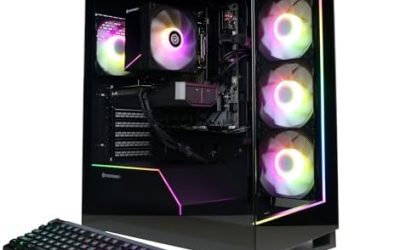
Evounic Gaming PC Desktop Computer, 12-Core Xeon, RTX 2070 8GB, 32GB DDR4, 512GB NVMe SSD and 1TB HDD

Best for: the most graphics memory and system memory in this group
This Evounic tower leads the list because it pairs the strongest graphics card here with double the memory of its rivals. The listing describes a 12-core Xeon processor running at up to 3.5GHz; the exact chip model is not named, so treat the processor as a fixed part of the package rather than a headline feature. The GeForce RTX 2070 carries 8GB of GDDR6 memory, which suits 1080p gaming with ray tracing available in supported titles, and 32GB of DDR4 gives comfortable room for a game, a browser, voice chat and streaming software at once. Storage is split between a 512GB NVMe SSD for Windows and favorite games and a 1TB hard drive for the wider library. A liquid CPU cooler, Wi-Fi 6, Bluetooth 5.4 and an included RGB keyboard and mouse round out a package that needs nothing extra to start playing. Upgrade planning should focus on storage and, after confirming power supply capacity, graphics, because the Xeon platform leaves little processor upgrade headroom.
Specs
- Processor: 12-core Xeon, up to 3.5GHz (exact model not named in the listing)
- Graphics: NVIDIA GeForce RTX 2070, 8GB GDDR6
- Memory: 32GB DDR4
- Storage: 512GB NVMe SSD plus 1TB HDD
- Cooling: liquid CPU cooler
- Connectivity: Wi-Fi 6, Bluetooth 5.4
- Operating system: Windows 11
- Included: RGB keyboard and mouse
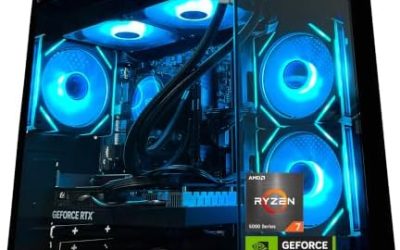
LXZ Gaming Desktop PC, Ryzen 7 4700LE, RTX 3050 8GB, 16GB DDR4, 512GB NVMe SSD

Best for: eight-core multitasking with an 8GB graphics card
This LXZ tower steps up to an eight-core, sixteen-thread Ryzen 7 4700LE and an RTX 3050 in its 8GB form, a combination aimed at players who also stream, edit clips or keep many applications open. The 8GB of video memory is the more forgiving version of this card for texture-heavy games at 1080p, and DLSS support helps lighter titles hold smooth frame rates. Sixteen gigabytes of DDR4 and a 512GB NVMe SSD match the class norm, and Wi-Fi 6 is built in. Because the machine sits on the AM4 platform, a memory increase and added storage are straightforward later steps, and a graphics upgrade is possible once the fitted power supply has been checked against the new card’s requirements.
Specs
- Processor: AMD Ryzen 7 4700LE, 8 cores, 16 threads
- Graphics: NVIDIA GeForce RTX 3050, 8GB
- Memory: 16GB DDR4
- Storage: 512GB NVMe SSD
- Connectivity: Wi-Fi 6
- Form factor: tower, white finish
- Model: LXZ-R7go
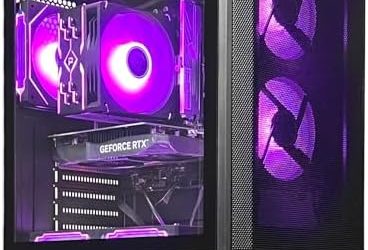
STGAubron Gaming PC Desktop, Ryzen 5 5500, RTX 3050 6GB, 16GB DDR4, 512GB SSD

Best for: a recognized budget brand with a stated warranty
STGAubron is one of the most established names in Amazon’s budget tower category, and this configuration is its current entry point below the cap. A Ryzen 5 5500 with six cores and boost clocks up to 4.2GHz feeds an RTX 3050 with 6GB of GDDR6 memory, which is a sensible pairing for 1080p gaming in esports titles and a wide range of single-player games at medium to high settings. The listing includes 16GB of DDR4, a 512GB SSD, Wi-Fi 6, Bluetooth 5.2 and two RGB fans, plus an RGB keyboard and mouse. A one-year warranty is stated on the listing, which is worth weighing against the shorter return windows offered by some rivals here. The AM4 platform keeps the upgrade door open: memory can grow, storage can be added, and a faster AM4 processor or a stronger graphics card can follow later, subject to the usual power supply check before any graphics swap.
Specs
- Processor: AMD Ryzen 5 5500, up to 4.2GHz, 6 cores, 12 threads
- Graphics: NVIDIA GeForce RTX 3050, 6GB GDDR6
- Memory: 16GB DDR4
- Storage: 512GB SSD
- Connectivity: Wi-Fi 6, Bluetooth 5.2
- Operating system: Windows 11 Home
- Included: RGB keyboard and mouse
- Warranty: 1 year, as stated on the listing
Evounic Gaming PC Desktop, Ryzen 5 5500, RX 580 8GB, 16GB DDR4, 1TB NVMe SSD

Best for: the largest fast storage drive in this group
The second Evounic entry takes a different route to value: a Ryzen 5 5500, a Radeon RX 580 with 8GB of memory and the only full 1TB NVMe SSD on this list. The RX 580 is an older card, so expectations should be set at 1080p with sensible settings rather than ray tracing, but its 8GB of video memory still handles texture loads that trouble 4GB cards. The terabyte of fast storage is the practical headline, since it holds a large library without the shuffle between drives that 512GB machines demand. Liquid cooling, Wi-Fi 6, Bluetooth 5.4 and ARGB fans are included, and the white case suits lighter desk setups. The obvious upgrade path is the graphics card: the AM4 processor, memory and storage already have room to breathe, so a future card, fitted after checking power supply capacity, is where money would go first.
Specs
- Processor: AMD Ryzen 5 5500, up to 4.2GHz
- Graphics: AMD Radeon RX 580, 8GB
- Memory: 16GB DDR4
- Storage: 1TB NVMe SSD
- Cooling: liquid cooled
- Connectivity: Wi-Fi 6, Bluetooth 5.4
- Operating system: Windows 11
LXZ Gaming PC Desktop, Ryzen 5 4500, RX 6500 XT 4GB, 16GB DDR4, 512GB NVMe SSD

Best for: the lowest-cost way into a dedicated-graphics tower
This LXZ machine is the entry point of the group and the one to choose when the goal is a complete, assembled desktop for casual 1080p gaming at the smallest outlay the class allows. The Ryzen 5 4500 provides six cores and twelve threads with boost clocks up to 4.1GHz, and the Radeon RX 6500 XT is aimed at esports and lighter titles at 1080p. Its 4GB of video memory is the main limitation to plan around, since newer, texture-heavy games will need reduced settings. Around that pairing, the specification stays complete: 16GB of DDR4, a 512GB NVMe SSD and Wi-Fi 6 in a white tower. As an AM4 system it also gives a first-time buyer somewhere to go next, with memory, storage and graphics all replaceable as needs grow, again with a power supply check before a stronger card goes in.
Specs
- Processor: AMD Ryzen 5 4500, up to 4.1GHz, 6 cores, 12 threads
- Graphics: AMD Radeon RX 6500 XT, 4GB
- Memory: 16GB DDR4
- Storage: 512GB NVMe SSD
- Connectivity: Wi-Fi 6
- Form factor: tower, white finish
- Model: LXZ-R5go
Side-by-Side Comparison
| Desktop | CPU | GPU | RAM | SSD | Upgrade outlook |
|---|---|---|---|---|---|
| Evounic 12-Core RTX 2070 | 12-core Xeon, up to 3.5GHz | RTX 2070 8GB GDDR6 | 32GB DDR4 | 512GB NVMe SSD plus 1TB HDD | Storage and graphics, subject to power supply check; limited CPU headroom |
| LXZ Ryzen 7 4700LE | Ryzen 7 4700LE, 8 cores | RTX 3050 8GB | 16GB DDR4 | 512GB NVMe SSD | AM4 platform; memory, storage and graphics can grow |
| STGAubron Ryzen 5 5500 | Ryzen 5 5500, up to 4.2GHz | RTX 3050 6GB GDDR6 | 16GB DDR4 | 512GB SSD | AM4 platform; memory, storage and graphics can grow |
| Evounic Ryzen 5 5500 RX 580 | Ryzen 5 5500, up to 4.2GHz | RX 580 8GB | 16GB DDR4 | 1TB NVMe SSD | Graphics card is the natural first upgrade |
| LXZ Ryzen 5 4500 | Ryzen 5 4500, up to 4.1GHz | RX 6500 XT 4GB | 16GB DDR4 | 512GB NVMe SSD | AM4 platform; graphics and storage are the first upgrade targets |
Frequently Asked Questions
Can a gaming desktop in this class run modern games at 1080p?
Yes, with settings matched to the hardware. The RTX 2070 and RTX 3050 machines handle a broad range of current games at 1080p, with DLSS available in supported titles, while the RX 580 and RX 6500 XT systems are better aimed at esports titles and older releases. Cards with 4GB of video memory need texture settings reduced in the newest games.
How much memory and storage should a budget gaming desktop have?
Sixteen gigabytes of RAM is the practical minimum for gaming alongside everyday applications, and 32GB, as fitted to the first Evounic above, adds multitasking headroom. For storage, treat 512GB as a starting point and 1TB as the comfortable target, because individual game installs are large and a small drive fills quickly.
Can these desktops be upgraded later?
The AM4-based towers can accept more memory, additional storage and, in many cases, a faster processor or graphics card from the same platform family. Before any graphics upgrade, confirm the power supply wattage and the physical clearance inside the case on the product listing, since budget builders do not always publish those figures.
What else is needed besides the tower itself?
A monitor, and in some cases peripherals. The STGAubron and the first Evounic include a keyboard and mouse, while the LXZ towers and the second Evounic are the tower only, so budget for peripherals if none are on hand. All five systems include Wi-Fi, so a network cable is optional.
The Bottom Line
The best gaming desktop under eight hundred dollars is a compromise chosen on purpose, and the five towers above split that compromise in different directions. The Evounic RTX 2070 machine offers the most graphics and system memory, the LXZ Ryzen 7 pairs eight cores with an 8GB card, the STGAubron adds a stated warranty from an established budget brand, the second Evounic trades graphics age for a full terabyte of fast storage, and the LXZ Ryzen 5 keeps the entry cost as low as this class goes. Match the machine to the games and the upgrade path that matter most, confirm the final specification on the listing before ordering, and any of the five will start a 1080p gaming setup without crossing the budget line.