- Top Pick: APC Battery Backup 650VA/390W Uninterruptible Power Supply for PC, BE650G1
- Best Value: CyberPower EC650LCD Ecologic UPS Battery Backup and Surge Protector
- Premium Choice: APC by Schneider Electric Back-UPS 650, Canada – Tower – 1 Day Recharge – 3 Minute Stand-by – 110 V AC Input – 120 V AC Output – Stepped Sine Wave – USB – 4 x NEMA 5-15R, 4 x NEMA 5-15R Receptacle(s)
The APC Back-UPS 650VA / 390W (BE650G1) is APC’s compact standby UPS, sized between the entry-level 425VA and 600VA models and the larger mid-range units. It pairs standby topology with eight outlets and adds RJ45 Ethernet surge protection on the line side. At around $107 with over 4,070 Amazon reviews, it is a popular small UPS for buyers protecting networking and a small desktop. This APC Back-UPS 650VA review covers the topology, capacity, outlets and value.
- APC Back-UPS 650VA at a Glance
- Topology and Waveform Quality
- Capacity: VA, Wattage and Real Runtime
- Outlets, Surge Protection and Management
- Compatibility with Modern Gaming PSUs
- Who Is the APC Back-UPS 650VA For?
- Pros and Cons
- Is the APC Back-UPS 650VA Worth It?
- Frequently Asked Questions
- More UPS Reviews
- Related Articles
- Related Articles
- Related Guides

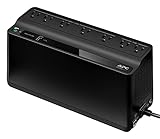
APC Battery Backup 650VA/390W Uninterruptible Power Supply for PC, BE650G1 | UPS battery backup for Office Electronics, NAS. Surge protection (+RJ45 e-net), 29-min runtime, UL & ENERGY STAR certified


As an Amazon Associate we earn from qualifying purchases. Product prices and availability are accurate as of the date/time indicated.
Before getting into specifications, a quick framing matters. Sizing a UPS is about real watts, not VA — VA is apparent power, watts is the real power your gear actually draws, and on a modern PSU with active power-factor correction the two figures sit close together. Topology decides how the unit reacts to mains problems: a standby design only switches to battery when power fails, line-interactive adds automatic voltage regulation (AVR) to smooth brownouts without going to battery, and online double-conversion always feeds the load from the battery side for the cleanest output. Waveform matters for compatibility: a stepped or simulated sine wave is cheap and fine for older gear, but a pure sine wave is what active-PFC modern gaming PSUs are designed for and is the safer choice for current-generation hardware. Runtime is the part most buyers misjudge — a typical mid-range UPS holds a 300W load for a few minutes, which is enough for a graceful shutdown but never enough to keep the PC running through a long blackout. With those four levers in mind, the table below summarises this unit at a glance.
As an Amazon Associate we earn from qualifying purchases.




🛒 Best Price Today on Amazon
Prime members get fast, free shipping on everything above, plus member-only deals. New members get a 30-day free trial — cancel anytime.
APC Back-UPS 650VA at a Glance
| Component | Specification |
|---|---|
| VA / Wattage | 650VA / 390W |
| Topology | Standby (offline) |
| Waveform | Stepped approximated sine wave |
| Outlets (total / battery) | 8 total (4 battery + surge / 4 surge only) |
| Surge joules | Surge protection across all outlets |
| USB / Management | Status LEDs; RJ45 Ethernet line surge protection |
| Battery type | Sealed lead-acid (user-replaceable) |
| Runtime (300W est.) | Brief — sized for graceful shutdown of light loads |
| Price | Around $107 |
Topology and Waveform Quality
The Back-UPS 650VA uses standby (offline) topology, the simplest UPS design — the load runs from the wall under normal conditions and the unit switches to its battery only when utility power fails. Switchover is typically a few milliseconds, comfortably inside the tolerance of standard small electronics. The waveform on battery is a stepped approximated sine wave rather than a pure sine wave. As with the other entry-level standby models, this is the deliberate cost trade-off: the stepped wave is fine for routers, modems and small office PCs but is the wrong choice for a modern high-efficiency gaming PSU with strict active power-factor correction. The BE650G1 is not pretending to be a gaming-PC UPS.
Capacity: VA, Wattage and Real Runtime
The 650VA / 390W rating sits in the small-load envelope. Watts is the right figure to read; 390W comfortably supports a router, modem, a small home office PC and a monitor, or a low-power desktop with peripherals. It is not sized for a gaming PC. Runtime is short, which is the honest reality of every small standby UPS — the target is graceful shutdown rather than continued operation. For a router and modem totalling 20-30W, runtime stretches well into the typical brief-outage range. For a small desktop and monitor under light load, expect long enough to save and shut down. Buyers should size for graceful shutdown, not extended use.
Outlets, Surge Protection and Management
Eight outlets are split four-and-four between battery-backed and surge-only banks, a sensible layout for prioritising essentials. The standout feature on the BE650G1 is the integrated RJ45 Ethernet line surge protection: a separate jack pair allows network cabling to pass through the UPS where it is protected against surges induced on the Ethernet line, which is a real risk in lightning-prone areas. That is a useful upgrade over a plain power-only surge strip and adds genuine value for a unit placed alongside a router. There is no LCD and no USB data port at this tier; LEDs indicate status. Pair with the additional protection in our best surge protectors for gaming PCs guide for a complete setup.
Compatibility with Modern Gaming PSUs
The BE650G1 is not a UPS for a modern gaming PC. The 390W of real power is too small for a typical gaming build, and the stepped approximated sine wave is the wrong waveform for active-PFC modern PSUs in 80+ Gold, Platinum and Titanium units. The correct target market is small, low-wattage loads: routers, modems, networking gear, small office PCs, smart-home hubs and home server units. Within that target use case it is well judged. For a gaming PC, choose a sine wave 1500VA model further up the range — the BE650G1’s role is to keep the network running so the rest of the home stays online. For PSU context, see our best 80+ Gold power supplies guide.
Who Is the APC Back-UPS 650VA For?
The Back-UPS 650VA is for the buyer who wants compact, brand-name battery backup for networking and small-PC loads, with the bonus of Ethernet line surge protection. If you want to keep a router and modem alive through outages, protect home-network cabling from line surges, back up a NAS or a security DVR, or support a low-power office PC, the BE650G1 is squarely your machine. The Ethernet protection is the notable upgrade over the cheaper 425VA and 600VA units. It is not for a gaming PC. For an entry-mid backup of networking and small loads, it is well judged. Compare it with whole-system options in our best budget gaming PC builds guide.
Pros and Cons
Pros: Established APC brand and warranty support; RJ45 Ethernet line surge protection on the unit; eight outlets split between battery and surge banks; user-replaceable sealed lead-acid battery; competitive entry-mid price; healthy review base.
Cons: 390W of real power is too small for a gaming PC; stepped approximated sine wave is not ideal for modern active-PFC PSUs; no LCD or USB management; short runtime.
Is the APC Back-UPS 650VA Worth It?
At around $107 the APC Back-UPS 650VA is a sensible buy for networking and small-load backup. The standby topology and stepped waveform are honest trade-offs at the price, the eight outlets are well organised, and the Ethernet line surge protection is a real practical bonus that the cheaper 425VA and 600VA units in the range do not include. The over four thousand Amazon reviews are a healthy base of long-term ownership feedback for a unit that may sit untouched between outages, and APC’s brand reputation and after-sales support are well established. The user-replaceable battery means the unit can serve far longer than its first battery’s life. For keeping home network gear and a small PC alive through outages, it earns a recommendation. For a gaming PC, step up to a 1500VA sine wave model.
Frequently Asked Questions
Will the APC Back-UPS 650VA run my gaming PC?
No. With 390W of real power and a stepped approximated sine wave, the BE650G1 is not the right UPS for a modern gaming PC. It is sized for networking and small office loads. For a gaming PC, choose a 1500VA pure sine wave model.
What is the Ethernet protection on the APC Back-UPS 650VA?
The unit includes RJ45 line surge protection: a separate pair of jacks lets network cabling pass through the UPS where it is protected against surges induced on the Ethernet line, which is a real risk during lightning events.
How many outlets does the APC Back-UPS 650VA have?
It has eight outlets — four battery-and-surge plus four surge-only — which is enough for a router, modem, small PC, monitor and a couple of accessories.
Is the battery replaceable in the APC Back-UPS 650VA?
Yes. The BE650G1 uses a user-replaceable sealed lead-acid battery, so the unit’s working life can be extended by swapping in a fresh cell every three to five years.
More UPS Reviews
- APC Back-UPS 850VA / 450W Review
- APC Back-UPS Pro Sinewave 1500VA AVR Review
- CyberPower CP1500AVRLCD3 UPS Review
- GOLDENMATE 1000VA Lithium UPS Review
- APC Back-UPS 600VA / 330W Review
- Amazon Basics UPS 1500VA / 900W Review
- APC Back-UPS Pro 1500VA AVR Review
- CyberPower CP1500PFCLCD PFC Sinewave UPS Review
Affiliate Disclosure: As an Amazon Associate, we earn from qualifying purchases. If you click a link and make a purchase, we may earn a small commission at no extra cost to you. Prices and availability are accurate as of publication and may change.
Related Articles
Looking for more on this topic? Browse the hand-picked guides below — each one applies the same scoring rubric used in this review.