Few debates split gamers as cleanly as wired versus wireless. A decade ago the answer was easy: wired gear felt faster and more reliable, and wireless was for people who valued a tidy desk over performance. That trade-off has almost disappeared in 2026. Modern low-latency wireless protocols now match wired response times closely enough that the difference is invisible in nearly every game, which means the choice comes down to how you actually play rather than raw milliseconds.
This guide breaks down what really separates the two today: latency, battery life, weight, connection stability, and long-term cost. By the end you will know which setup fits your play style, your budget, and your desk, and you will be able to spot the marketing claims that do not hold up. Our recommended picks below are all strong wireless mice worth considering if you decide to cut the cord.
As an Amazon Associate we earn from qualifying purchases.




Latency: Is Wireless Actually Slower?
Latency is the delay between moving your mouse and seeing the result on screen. Wired peripherals send that signal down a copper cable with essentially zero transmission delay, which is why competitive players trusted them for years. Modern wireless gear closes the gap using dedicated 2.4GHz USB dongles rather than Bluetooth. A mouse like the Logitech G PRO X2 SUPERSTRIKE or the Razer Viper V3 HyperSpeed reports in the sub-millisecond range, which is faster than most monitors can even display a frame. Bluetooth, by contrast, adds noticeable lag and should be reserved for productivity, not fast-paced shooters. If a wireless product only lists Bluetooth and no dedicated dongle, treat it as a casual device.
Battery Life and the Charging Routine
The one genuine downside of wireless is that it needs power. A dead mouse mid-match is frustrating in a way a wired one never will be. The good news is that current sensors are efficient enough that a mouse like the Logitech G305 Lightspeed can run for months on a single AA battery, while rechargeable models such as the Logitech G502 Lightspeed or Logitech G703 Lightspeed last many days per charge and support charging while you play. Build a simple habit: top up during a break or overnight, and battery anxiety disappears. If you hate charging entirely, a lightweight battery model like the G305 is the most hassle-free path.
Weight, Feel, and Freedom of Movement
Cable drag is real. Even a well-routed wired cable tugs slightly against fast flicks and repositions, and cheaper braided cables can snag on the desk edge. Wireless removes that entirely, giving you a consistent glide every time. The trade-off used to be weight, since batteries and radios added grams, but engineering has caught up. The Razer Viper V3 HyperSpeed weighs just 82 grams, light enough for claw and fingertip grips, while the Razer Basilisk V3 X HyperSpeed leans heavier for players who prefer a planted, controlled feel. Match the weight to your grip, not to the connection type.
Connection Stability and Interference
- Crowded 2.4GHz environments (many wireless devices, apartments, LAN events) can occasionally cause micro-stutters on budget receivers.
- Quality dongles hop frequencies automatically to dodge interference, so stick to reputable brands rather than no-name adapters.
- Keep the dongle close to the mouse using the included USB extender when your PC tower sits far under the desk.
- Wired gear sidesteps all of this entirely, which is why some tournament players still carry a wired backup even if they train on wireless.
Total Cost Over Time
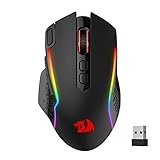
Wireless gear carries a price premium for the same sensor and build quality, sometimes 30 to 50 percent more than a wired sibling. For a tight budget, a wired mouse gets you a better sensor and switches per dollar. But factor in longevity: wireless gear has no cable to fray, which is one of the most common failure points on wired mice. A model like the Redragon M810 PRO offers wireless freedom at an aggressive price, proving the premium is shrinking. Decide whether the convenience is worth the upfront cost for the years you will actually use it.
Tips
- Ignore Bluetooth-only devices for competitive play; insist on a dedicated 2.4GHz dongle for real low latency.
- Buy a mouse whose weight matches your grip first, then decide wired or wireless second.
- Use the included USB extension cable to park the dongle near your mousepad for a rock-solid link.
- If you switch to wireless, set a charging habit tied to an existing routine so you never get caught with a dead battery.
Frequently Asked Questions
Can pros really not tell the difference between wired and wireless?
At the top level, blind tests consistently show that top wireless mice with 2.4GHz dongles are indistinguishable from wired in reaction time. Many professional players in 2026 compete on wireless gear, which is the clearest proof that the latency gap is effectively closed.
Does wireless drain my battery even when I am not gaming?
Most gaming mice sleep after a short period of inactivity, using almost no power. As long as you are not leaving it swinging around or with RGB blazing on a desk, standby drain is minimal and battery estimates reflect real-world use.
Is wireless bad for fighting games or rhythm games?
No. Those genres are demanding on timing but the millisecond-level latency of a good dongle is far below human perception thresholds. Any reputable 2.4GHz wireless mouse or controller is fully suitable.
Should I buy a mousepad with wireless charging?
It is convenient but optional. A powered charging pad keeps a compatible mouse topped up passively so you never think about battery, but it locks you into one brand’s ecosystem and costs extra. A simple charging habit achieves the same result for free.
Conclusion
In 2026 the honest answer is that wireless wins for most people. The latency penalty that once justified wired gear has effectively vanished with modern 2.4GHz dongles, leaving you with cleaner desk space, freer movement, and no cable to fray. Choose wired only if your budget is tight or you want a guaranteed zero-maintenance backup. Otherwise, pick a wireless mouse whose weight and grip fit your hand, build a small charging habit, and enjoy the freedom.