Hidden in Plain Sight is a local-multiplayer hiding game: some players blend into a crowd of identical characters while others try to pick them out. Adam Spragg released it in July 2014, and its Steam record has quietly said the right things about Linux ever since — a written-out requirements tab, a Linux depot of real size, and a Steam Deck badge earned on the native runtime rather than through a compatibility layer.
The twist arrived a decade later. In September 2026 the game received a free Online Multiplayer add-on, a separate app whose own record is far thinner: three platform flags, three empty requirement lists, and no depots at all. This piece reads the family in reverse — the new app first, then the 2014 record beneath it.
As an Amazon Associate, we earn from qualifying purchases.
Quick answer
Yes. Hidden in Plain Sight is native on Linux. Steam’s record flags all three platforms, the Linux requirements tab is written out in full at both tiers, and the purchase package contains a dedicated Linux depot. Valve rates it Verified on Steam Deck on the native runtime, and ProtonDB classifies it Native.
Start with the newest app: the Online Multiplayer add-on
The family’s second app, Hidden in Plain Sight – Online Multiplayer (app 5047770), is a free add-on released on 18 September 2026. It requires owning the base game, and its record flags Windows, macOS and Linux all true. One layer down, the paperwork thins out. All three requirements fields are empty lists outright — no minimum, no recommended tier, no notes — and SteamDB lists no depots for the add-on app at all.
That shape is the mirror image of the trap this cluster usually warns about. A soundtrack app flagging Linux over an empty field proves nothing when the game underneath has no Linux build. Here the direction is reversed: the add-on publishes no build of its own anywhere, so there is nothing separate to port. Its mode rides inside the base game’s builds, and the base game’s current public build — updated in October 2026, a month after the add-on appeared — is the one whose package includes the Linux depot.
What the base game’s record says
The 2014 game (app 303590) flags Windows, macOS and Linux true, and its Linux requirements tab is genuinely written at both tiers. The minimum asks for glibc 2.15 or newer on a 32- or 64-bit system, 512 MB of memory and 200 MB of storage, and notes that S3TC texture support is not required — a line that only appears when someone has actually shipped the build. The recommended tier moves to 64-bit and 1 GB of memory. Both tiers close with the same note: SDL_GameController devices are fully supported, the game’s way of saying a standard pad is the intended input.
The rest of the record matches that couch-first design. Steam’s categories are the local set — multi-player, PvP, shared and split screen, co-op, Remote Play Together — with full controller support and no online category at all: on its own record the 2014 game is a same-room game, and online play belongs to the 2026 add-on. The Windows tab’s notes state plainly that the game requires Xbox-compatible or emulated controllers and a minimum resolution of 1280 by 720. There is no DRM notice and no external-account notice. SteamDB’s detected technology is engine plumbing only: the FNA and XNA engines, SDL, and the SteamworksNET wrapper.
Anti-cheat takes one paragraph because all three sources are empty chairs. Steam names no anti-cheat and attaches no account requirement. SteamDB detects no anti-cheat component among the game’s technologies. The Are We Anti-Cheat Yet dataset carries no entry for this title at all, and the online add-on’s record names nothing either.
Depots and the purchase package
SteamDB’s depot table is where the native claim stops being paperwork. The game ships three depots: 303591 for Windows at 48.52 MiB, 303592 for Linux at 78.32 MiB, and 303593 for macOS at 79.52 MiB. The Linux depot is larger than the Windows build — the opposite of the token 0-byte or config-only depots that give thin Linux records away.
Membership matters as much as existence, and here it is clean. The ordinary purchase package, sub 44769 — the package a buyer actually receives — contains the game app and all three depots, Linux included, each stamped with an October 2026 update. Nothing is stranded in a package nobody can buy. The branch list tells the same story: the public branch serves build 25921277 from October 2026, and a second branch, xna-original, preserves the original four-player build from December 2025. A twelve-year-old party game is still being built on all three platforms.
The ProtonDB file
ProtonDB’s summary API returned an error page on repeated attempts during this session, so no summary tiers or confidence scores are claimed here — for a native game those Proton-facing tiers would describe a route nobody needs. What the game’s ProtonDB page itself shows is readable: it heads its requirements block “Natively Supports:”, classifies the game as Native, and carries a single report. The heading check comes back clean-agreement: page and Steam record say the same thing.
The lone report is filed on EndeavourOS Linux, running the native build, and centres on local multiplayer with a mix of different controllers. One report is a thin file and is treated at that weight: the verdict below rests on Steam’s own flags, fields, depots and package, not on it.
The Steam Deck sheet
Valve’s own compatibility endpoint returned no readable sheet in this session, so the Deck facts here are read from SteamDB’s republication of Valve’s compatibility data. The category is Verified, the strongest badge Valve gives, and SteamOS is separately marked Compatible. All four Verified items pass: full functionality on the default controller configuration, Deck controller icons, legible in-game text, and a default graphics configuration that performs well. The configuration’s recommended runtime reads native — the badge certifies the Linux build itself, not a Proton run of the Windows one.
One date deserves plain statement. Valve’s test was recorded on 1 April 2022 against build 7875643; the public branch now serves build 25921277, from October 2026, and the game has gained an entire online mode since the test. Nothing in the newer record contradicts the badge, but this is a 2022 test standing behind a 2026 build.
The storefront ruling
There is no GOG edition of Hidden in Plain Sight. GOG’s product searches return no listing, and the natural product address resolves to GOG’s general catalogue rather than a product page — there is no GOG record to verify a platform list against. The Steam copy is the only PC edition, and it is the package carrying the native build anyway.
Gear that fits the record
The gear follows the record’s shape: the Deck itself, pads for the extra players, a desk mouse, and library storage.
Valve Steam Deck OLED 512GB

The handheld the Verified badge was written for: its whole footprint is a rounding error next to the Deck’s storage, and one screen suits a game about hiding in a crowd.
Specs
- Display: 7.4-inch HDR OLED, 1280 by 800, up to 90 Hz
- Processor: AMD Zen 2 and RDNA 2 custom APU
- Memory: 16 GB LPDDR5
- Storage: 512 GB NVMe, plus a microSD slot
- Wireless: Wi-Fi 6E and Bluetooth
- Channel note: Valve sells the Deck mainly through its own store, so Amazon listings are third-party sellers
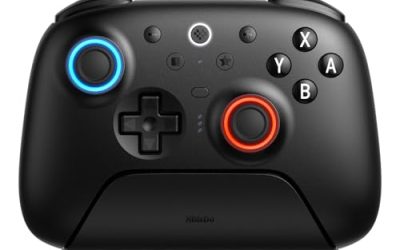
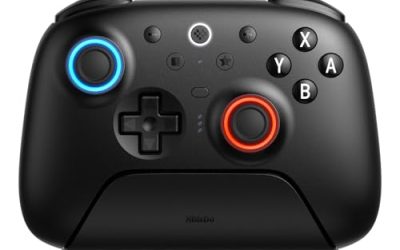
8BitDo Ultimate 2 Bluetooth Controller
The extra-player pick. This game is built for several pads on one machine, and its own notes promise full support for standard controller devices; this pad covers an extra seat with modern sticks and triggers.
Specs
- Connectivity: Bluetooth wireless and USB-C wired
- Joysticks: TMR electromagnetic, anti-drift design
- Triggers: Hall effect, with mode switching
- Extras: two remappable back buttons, motion control
- In the box: charging dock included
Xbox Wireless Controller, Carbon Black
The reference shape the game’s own notes name: an Xbox-compatible controller. The glyphs match what the game expects, pairing is painless on a Linux desktop or a docked Deck, and a spare fills the last couch seat.
- Connectivity: Xbox Wireless and Bluetooth
- Port: USB-C for wired play
- Controls: hybrid D-pad, dedicated Share button
- Power: AA batteries or optional rechargeable pack
Logitech G502 HERO
The game itself is pad-led, but a Linux gaming desk still earns its mouse: mode setup, library management and everything around the session.
Specs
- HERO optical sensor, up to 25,600 DPI
- 11 programmable buttons
- Adjustable weight system
- Wired USB connection
- On-board memory profiles
Samsung T9 Portable SSD 2TB
For the library around the game, not the game itself — at roughly 206 MB installed, this title could hide in any corner of a drive. A fast USB-C SSD moves a whole Linux library between desktop, laptop and dock without re-downloading it.
Specs
- Capacity: 2 TB portable SSD
- Interface: USB 3.2 Gen 2×2, USB-C connector
- Maker-rated speeds: up to 2,000 MB per second read, 1,950 MB per second write
- Features: Dynamic Thermal Guard, maker-rated drop resistance
How to choose
Start from the room, not the store page. If your group is on one couch, the base game is the whole purchase: the native build is in the standard package, and the only hardware question is whether you own enough pads — any modern pad that presents itself as Xbox-compatible qualifies. Add the free Online Multiplayer add-on when the group is scattered. On Steam Deck, install and play — the badge was earned on the native runtime, so leave compatibility tools off. On a desktop distro, the published floor is glibc 2.15 and half a gigabyte of memory.
Who should skip
Skip this one if you play alone: the base game’s categories are entirely multiplayer, with no single-player mode on the record. Skip it if your group expects the online mode to be the whole game — online play is a 2026 add-on layered on a local-first design, and its own record is flags over empty lists. Skip it if you buy exclusively on GOG. And skip it if nobody will play with a controller: the game’s own notes make pads a requirement.
FAQ
Is Hidden in Plain Sight native on Linux?
Yes. Steam flags Linux true, the Linux requirements tab is written out at both tiers — glibc 2.15 or newer, S3TC support explicitly not required — the purchase package contains a dedicated Linux depot of 78.32 MiB, and Valve’s Deck sheet recommends the native runtime.
Does the Online Multiplayer add-on work on Linux?
The add-on’s own record flags all three platforms but publishes empty requirement lists and no depots — it ships no separate build to port. Its content rides in the base game’s builds, and the base game’s current public build, updated a month after the add-on’s release, is the one whose package includes the Linux depot.
Is Hidden in Plain Sight Steam Deck Verified?
Yes. Valve’s sheet, read via SteamDB’s republication, gives the game the Verified category with all four checks passing and the native runtime recommended. The test dates from April 2022, against an older build than the current October 2026 one — the badge is genuine, its paperwork dated.
Can I buy Hidden in Plain Sight on GOG?
No. GOG’s searches return no listing and the natural product address resolves to the general catalogue, so no GOG edition exists. The Steam copy is the only PC edition — and the one carrying the native Linux build in its standard package.
Final verdict
Hidden in Plain Sight is one of the clean native files in this cluster: a requirements tab written for the platform, a Linux depot larger than the Windows one inside the ordinary purchase package, a Deck badge earned on the native runtime, and a ProtonDB page whose native label agrees with Steam. The honest caveats are about paperwork age, not the build — Valve’s test is from 2022, the ProtonDB file is a single report, and the online add-on’s own page is flags over empty lists. The game underneath all three is native, current, and still maintained on Linux today.
Product and ASIN Reference
| Product | ASIN |
|---|---|
| Valve Steam Deck OLED 512GB | B0CQ3RWQQZ |
| 8BitDo Ultimate 2 Bluetooth Controller | B0F194QFT2 |
| Xbox Wireless Controller, Carbon Black | B08DF248LD |
| Logitech G502 HERO | B07GBZ4Q68 |
| Samsung T9 Portable SSD 2TB | B0CHFS9K14 |