As an Amazon Associate we earn from qualifying purchases
A standard controller asks your thumbs to leave the sticks every time you jump, slide, reload or swap weapons, and in a ranked match that split second is often the whole fight. Pro controllers exist to remove it: extra buttons move to the back of the shell where your fingers already rest, triggers shorten into instant clicks, and sticks gain tournament-grade durability.
This guide compares the best pro controllers for competitive gaming across PlayStation 5, Xbox and PC. Every pick is officially licensed for its platform and carries remappable rear controls. If your matches happen only on a PlayStation console, our roundup of the best PS5 pro controllers goes deeper on that platform; the five models here cover the cross-platform field.
What separates a pro controller from a standard pad
Back buttons and paddles. The defining feature of a pro controller is a set of extra inputs on the rear of the shell. Two back buttons are the minimum; four paddles or buttons open up full claw-free play, letting you jump, crouch, reload and ping while both thumbs stay on the sticks. Placement matters as much as count: buttons where your fingers naturally grip are far easier to learn.
Trigger stops. A full trigger pull is wasted travel in a shooter. Trigger stops, hair-trigger locks and mouse-click modes shorten that travel so a shot registers almost instantly. The trade-off is analogue control: racing games still need a full pull, so the best designs switch between instant and analogue modes per profile.
Stick technology. Traditional sticks use potentiometers that physically wear, which is why drift appears after heavy use. Hall effect sticks read magnetic fields instead, with no contact surfaces to grind down, and TMR sensors refine the same idea with lower power draw and finer resolution. For players who run small deadzones, that anti-drift design protects aim consistency across a season. Replaceable modules and adjustable tension are the other answers to wear.
Remapping and profiles. Extra buttons only help if they can mirror the inputs your game demands, so look for quick remapping or a companion app, plus onboard profiles that travel between machines.
Polling rate and connection. Polling rate describes how often the controller reports its state. Wired connections remain the tournament benchmark, and some PC modes now report at 1000Hz. Consoles cap rates lower than PC, so a headline figure usually applies to one mode only; each section below states which mode its figure belongs to. Wireless has closed most of the gap through 2.4GHz dongles.
Platform licensing. Compatibility is not a detail to guess at. PS5 games only accept licensed PS5 controllers, and Xbox wireless play is restricted to licensed designs, so each pick states exactly which platforms its licence covers.
PlayStation DualSense Edge Wireless Controller

Sony’s own pro controller is the default choice for PS5 competition because it keeps full access to the console’s feature set. Haptic feedback and adaptive triggers work exactly as on the standard DualSense, and the two Fn buttons under the sticks switch profiles and adjust game and chat balance without opening a menu.
Two back buttons, supplied in half-dome and lever shapes to match your grip, carry the competitive load. Trigger sliders offer three stop levels, from a full analogue pull to a short, fast press for shooters. Stick caps come in standard, high dome and low dome forms, and deadzones are tuned per profile in the PS5 settings.
The Edge’s answer to drift is mechanical rather than magnetic: each stick is a replaceable module, so a worn stick can be swapped instead of replacing the whole controller. The sticks remain potentiometer designs, so players who want magnetic sensors should look at the Wolverine V3 Pro or G7 SE below. Battery life is shorter than a standard DualSense, making wired play the practical default.
Specs
- Platforms: PlayStation 5, PC
- Connection: Bluetooth wireless, USB-C wired
- Rear inputs: 2 back buttons (half dome and lever sets included)
- Triggers: adaptive triggers with three-position stop sliders
- Sticks: replaceable stick modules; standard, high dome and low dome caps
- Customisation: remapping and profiles in PS5 settings, Fn button profile switching
- Best for: PS5 players who want first-party features with pro controls
Xbox Elite Wireless Controller Series 2

Microsoft’s Elite Series 2 remains the most complete Xbox package. Four removable paddles sit across the back, thumbstick tension adjusts across three settings with the included tool, and hair trigger locks shorten trigger travel in three steps. Interchangeable stick tops and two D-pad shapes are included in the case.
Connectivity is the other strength. Xbox Wireless handles console play, Bluetooth pairs with PC and mobile devices, and USB-C covers wired play and charging. Microsoft rates the battery at up to 40 hours per charge, and the included dock makes top-ups effortless. The Xbox Accessories app stores mappings, stick curves and up to three onboard profiles.
Two honest limits apply. The sticks are potentiometer-based, so there is no magnetic anti-drift design as on the Razer and GameSir picks, and the dense kit suits players who enjoy fine-tuning more than players who want a pad that disappears in the hand. For adjustability above all, it is still the benchmark.
Specs
- Platforms: Xbox Series X|S, Xbox One, Windows PC, Android, iOS
- Connection: Xbox Wireless, Bluetooth, USB-C wired
- Rear inputs: 4 removable paddles
- Triggers: three-step hair trigger locks
- Sticks: adjustable tension (three settings), interchangeable tops
- Customisation: Xbox Accessories app, up to 3 onboard profiles plus default
- Battery: internal rechargeable, rated up to 40 hours by Microsoft
- Extras: charging dock, carrying case, wrap-around rubberised grip
- Best for: Xbox and PC players who want maximum physical adjustability
Razer Wolverine V3 Pro Wireless Gaming Controller

Razer’s flagship Xbox controller is the most esports-focused design in this group. Six remappable inputs lead the layout: four mouse-click back buttons built into the grips and two extra claw grip bumpers beside the standard shoulders, all using the same style of switch actuation as Razer’s gaming mice for a short, crisp click.
The sticks are Hall effect units with anti-friction rings, addressing drift at the sensor level, and two sets of swappable caps are included. Pro HyperTriggers switch between an instant mouse-click mode and full analogue travel. Mecha-tactile face buttons and an eight-way floating D-pad complete the layout.
Connection runs through Razer’s HyperSpeed 2.4GHz dongle for Xbox and PC wireless play, with a wired USB-C mode for tournaments. On PC, Tournament Mode raises the polling rate to 1000Hz over the cable; wireless play and Xbox connections run at 250Hz, a platform-side limit worth knowing before you buy. There is no Bluetooth.
Specs
- Platforms: Xbox Series X|S, Xbox One, Windows PC (officially licensed by Xbox)
- Connection: 2.4GHz HyperSpeed wireless via USB-A dongle, USB-C wired
- Rear inputs: 4 mouse-click back buttons, 2 claw grip bumpers (6 remappable total)
- Triggers: Pro HyperTriggers with instant and analogue modes
- Sticks: Hall effect with anti-friction rings, two sets of swappable caps
- Polling rate: 1000Hz in wired PC Tournament Mode, 250Hz wireless and on Xbox
- Customisation: Razer Controller app, onboard profiles
- Extras: mecha-tactile buttons, 8-way floating D-pad, carrying case, 10 ft cable
- Best for: Xbox and PC esports players who want Hall effect sticks and clicky inputs
PDP Victrix Pro BFG Wireless Gaming Controller

The Victrix Pro BFG takes a different route from every other pick here: it rebuilds itself around the game you are playing. The left module reverses, switching the left stick between the PlayStation-style symmetric position and an offset layout. A fightpad module replaces the right side with six microswitch buttons in two rows, the classic arcade arrangement for fighting games.
Four remappable back buttons and clutch triggers with adjustable stop points cover the shooter essentials, and the PC app handles remapping and deadzones. Connectivity spans a 2.4GHz dongle, Bluetooth and wired USB-C. The licence covers PS5 and PS4, and the audio controls and 3.5mm jack support Sony’s 3D audio on PS5.
That modular design is the reason to buy it: players who split time between shooters and fighting games get two specialist controllers in one shell. Players who only need a shooter pad may prefer the simpler layouts above, and the potentiometer sticks lack the magnetic anti-drift design of the Razer and GameSir models.
Specs
- Platforms: PlayStation 5, PlayStation 4, PC (officially licensed for PlayStation)
- Connection: 2.4GHz wireless dongle, Bluetooth, USB-C wired
- Rear inputs: 4 remappable back buttons
- Triggers: clutch triggers with adjustable stop points and hair-trigger mode
- Sticks: modular, swappable sticks; reversible left module for symmetric or offset layout
- Customisation: Victrix Control Hub app on PC, onboard profiles
- Extras: six-button fightpad module, 3.5mm audio jack, carrying case
- Best for: PS5 and PC players who compete in both shooters and fighting games
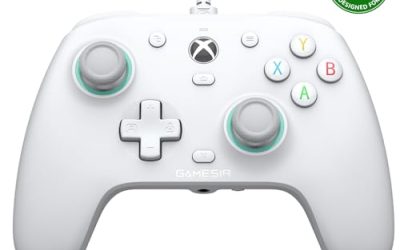
GameSir G7 SE Wired Controller

The G7 SE is proof that the core pro features no longer require a flagship budget. It is wired only, which many tournament players prefer anyway: the detachable three-metre USB-C cable removes battery management and wireless interference, and the listing rates the connection at 1000Hz polling.
Hall effect sticks and triggers are the headline. Magnetic sensors on both inputs target drift and wear together, and the triggers switch from a smooth analogue pull to a quick mouse-click style action for fast shots. Two mappable back buttons include quick latches that physically disable them, preventing accidental inputs when the controller is packed.
The Xbox licence covers Series X|S, Xbox One and Windows PC, and the GameSir Nexus app handles remapping, deadzones and profiles. You give up wireless play, two rear inputs and the deep accessory kits of the premium picks, but you keep the sensor technology and polling speed that most affect aim.
Specs
- Platforms: Xbox Series X|S, Xbox One, Windows 10/11 PC (officially licensed for Xbox)
- Connection: wired only, 3 m detachable USB-C cable
- Rear inputs: 2 mappable back buttons with quick-latch disable
- Triggers: Hall effect, switchable between analogue pull and quick-click action
- Sticks: Hall effect anti-drift sticks
- Polling rate: 1000Hz
- Customisation: GameSir Nexus app, multiple profiles
- Extras: magnetic swappable faceplate, 3.5mm headset jack, mute button
- Best for: Xbox and PC players who want Hall effect hardware at an entry-level price
How to choose between them
Start with your platform, because licensing decides the shortlist: PS5 players choose between the DualSense Edge and the Victrix Pro BFG, Xbox players between the Elite Series 2, the Wolverine V3 Pro and the G7 SE, and PC players can use any of the five. Then count your rear inputs honestly. Two back buttons cover jump and crouch in most shooters; four or more pay off in games with slide cancels, weapon swaps and ability triggers layered together. Finally, weigh drift and connection together: Hall effect sticks in the Wolverine V3 Pro and G7 SE remove the most common wear failure, wired play gives the highest polling rates on PC, and Bluetooth is the flexible option for switching devices between matches.
FAQ
Do pro controllers work on every platform?
No. Console compatibility follows licensing, not plugs. A PS5 game requires a licensed PS5 controller, and Xbox wireless play requires a licensed Xbox design. Each pick lists its licensed platforms in its Specs, and PC support is broader than console support for all five.
Are Hall effect sticks worth it for competitive play?
For players who run small deadzones and play daily, yes. Hall effect and TMR sticks read position magnetically, so there is no contact surface to wear into drift. The Wolverine V3 Pro and G7 SE use Hall effect sticks; the DualSense Edge instead makes its stick modules replaceable, solving the same problem a different way.
How many back buttons do I actually need?
Two is the practical minimum and covers jump and crouch or slide in most shooters. Four paddles or buttons, as on the Elite Series 2, Wolverine V3 Pro and Victrix Pro BFG, suit games where reloads, swaps and abilities also need to stay off the face buttons. More inputs only help if your fingers can reach them comfortably.
Does a 1000Hz polling rate make a difference on console?
The headline rates apply to PC modes. The Wolverine V3 Pro reaches 1000Hz in wired Tournament Mode on PC and runs at 250Hz wirelessly and on Xbox, and consoles generally cap polling below PC levels. On PC, a higher rate means inputs are reported more often, which players value in fast shooters; on console, everyone shares the same platform limits.
Conclusion
Competitive controllers are about keeping your thumbs on the sticks and your inputs consistent all season. The DualSense Edge is the complete first-party answer on PS5, the Elite Series 2 is the tuner’s choice on Xbox, the Wolverine V3 Pro pairs Hall effect sticks with the fastest PC mode here, the Victrix Pro BFG rebuilds itself for fighting games, and the G7 SE delivers magnetic sticks and a wired 1000Hz connection for the least money. Match the licence to your platform first; the rest follows from there.