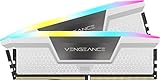
Is 16GB still enough for gaming in 2026? The honest answer: mostly yes — but with a growing list of asterisks. The latest AAA titles like Alan Wake 2, Hogwarts Legacy, and several Unreal Engine 5 games now officially recommend 16GB, and a handful of titles (Microsoft Flight Simulator 2024, Palworld with heavy mods) have been spotted consuming 18–22GB of system memory under load. For esports titles, competitive shooters, and most mainstream gaming, 16GB remains a capable and cost-effective sweet spot. The key is picking the right kit — one that delivers stable speeds, tight timings, and a smooth upgrade path. This guide cuts through the noise and identifies the five best 16GB gaming RAM kits in 2026, covering both DDR4 and DDR5 options so you can make the right call regardless of your platform.
The 5 Best 16GB Gaming RAM Kits in 2026
G.Skill Trident Z5 DDR5-6000 16GB (8GBx2)
The G.Skill Trident Z5 DDR5-6000 CL30 is the top-performing 16GB DDR5 kit available today, and it earns that crown without apology. Running at 6000 MT/s with CL30-38-38-96 timings, this kit sits right at the sweet spot Intel and AMD both identify as the optimal frequency for DDR5 — where the memory controller operates most efficiently and latency stops scaling dramatically with further overclocking. Real-world gaming benchmarks consistently show a 4–8% frame rate improvement over DDR5-4800 baseline kits, and in latency-sensitive titles like CS2, Valorant, and Rainbow Six Siege, the tighter CL30 timings make a noticeable difference.
XMP 3.0 support means a single BIOS toggle gets you to rated speeds on any compatible Intel platform. AMD EXPO compatibility is also present, so Ryzen 7000 and Ryzen 9000 users are not left out. The kit uses Samsung or Hynix A-Die ICs — among the most overclock-friendly DRAM dies available — and experienced users have reported pushing stable 6400 MT/s with manual tuning. The aluminum heatspreader is visually striking in a Vega-inspired design, though it stays functional rather than flashy, with optional RGB versions available if aesthetics matter to your build.
The only real limitation here is the 16GB total capacity. If you are building a gaming PC that you plan to keep for four or five years, or if you do any video editing or streaming alongside gaming, you will feel the ceiling sooner than you might expect. The dual-rank 8GBx2 configuration does maximize memory controller efficiency on modern platforms, but upgrading to 32GB later means buying a whole new kit — the Trident Z5 does not offer easy capacity expansion. For pure gaming on a mid-to-high-end platform right now, this kit is close to flawless.
Pros: Best-in-class DDR5 timings at 6000 MT/s, XMP 3.0 + EXPO, excellent overclocking headroom, premium build quality
Cons: Expensive premium over slower DDR5 kits, 16GB cap limits longevity, no 32GB upgrade path from same kit
Corsair Vengeance DDR5-5600 16GB (8GBx2)
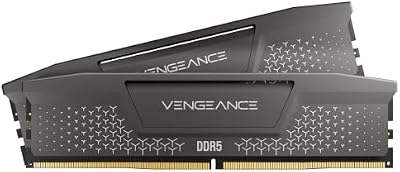
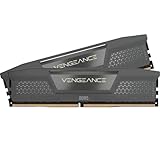
Corsair’s Vengeance DDR5-5600 CL36 kit occupies the most logical position in the 2026 DDR5 market: it is fast enough to matter, priced reasonably, and compatible with nearly every DDR5 platform on the market. At 5600 MT/s with CL36 timings, it lands just below the G.Skill Trident Z5 in raw throughput benchmarks — the practical gaming performance gap is around 2–4 frames per second in CPU-limited scenarios, which most players will not notice during normal sessions.
Corsair ships this kit with Intel XMP 3.0 profiles and AMD EXPO support baked in, and compatibility testing across Z790, B760, X670E, and B650 motherboards has been consistently solid. The low-profile design (34mm height) is a genuine advantage if you are running a large air cooler like the Noctua NH-D15 or any tower cooler with RAM-clearance concerns. Corsair’s iCUE software integration works well if you are already in that ecosystem, though the standard Vengeance DDR5 lacks RGB — a non-issue for most builders, and arguably a plus for those who want clean aesthetics.
Thermal performance is good under sustained workloads. The aluminum heatspreader keeps temperatures in check, and the kit has proven stable in long-duration stress tests at rated speeds without throttling. If you plan to push frequencies above 5600 MT/s, results vary — Corsair’s IC sourcing changes between production batches, and some users hit a ceiling around 5800 MT/s while others have reached 6000 MT/s with manual timing adjustments. Out of the box, though, this kit simply works, and that consistency is worth real money.
Pros: Reliable XMP 3.0 and EXPO performance, low-profile design, broad motherboard compatibility, good thermal management
Cons: IC lottery for overclocking above rated speed, smaller performance gap over cheaper DDR5 kits than price suggests
Kingston Fury Beast DDR5-5200 16GB (8GBx2)
Kingston’s Fury Beast DDR5-5200 CL40 is the entry point for DDR5 gaming in 2026, and it delivers genuine value for builders who want next-generation memory without paying a premium. At 5200 MT/s — which is close to the JEDEC standard DDR5-4800 with a modest factory overclock — this kit won’t win benchmark competitions, but it offers a meaningful step up from DDR4 in memory bandwidth-sensitive workloads like open-world streaming, large asset loading, and multitasking while gaming.
The CL40 latency is this kit’s most visible trade-off. Compared to the Trident Z5’s CL30 at 6000 MT/s, the Fury Beast operates at a higher latency relative to its frequency, meaning real-time responsiveness in competitive gaming scenarios is slightly softer. That said, in absolute gaming benchmarks across a wide range of titles — including Cyberpunk 2077, Elden Ring, and Call of Duty: Black Ops 6 — the difference rarely exceeds 3 frames per second at 1080p, and at 1440p or 4K, the gap effectively disappears as the GPU becomes the bottleneck.
Kingston’s reliability track record is strong, and the Fury Beast comes with a lifetime warranty that outclasses most competitors in its price tier. Intel XMP 3.0 profiles are included, and AMD EXPO support is present on the designated EXPO variants — double-check the model number before purchasing, as not all Fury Beast DDR5 kits ship with EXPO. The low-profile, no-frills heatspreader suits small form factor builds and cases with limited clearance. If budget is the primary constraint and you are building on a DDR5 platform, this is the kit to buy.
Pros: Lowest entry price for DDR5, lifetime warranty, low-profile design, solid platform compatibility
Cons: CL40 latency hurts competitive gaming responsiveness, EXPO support varies by SKU, limited OC ceiling
G.Skill Ripjaws V DDR4-3600 16GB (8GBx2)
The G.Skill Ripjaws V DDR4-3600 CL16 is the definitive 16GB DDR4 kit for gaming in 2026. If you are building on an Intel 12th or 13th Gen platform, an AMD Ryzen 5000 system, or any DDR4-based board, this kit represents the ideal intersection of price, performance, and platform maturity. DDR4-3600 with CL16-19-19-39 timings hits the sweet spot the industry settled on years ago — it is the frequency where Ryzen platforms show the best Infinity Fabric synchronization, and it’s the inflection point on Intel where memory bandwidth gains flatten out and further frequency increases yield diminishing returns.
In pure gaming performance, the Ripjaws V DDR4-3600 CL16 trades blows with DDR5-4800 kits in many real-world titles. Memory bandwidth improvements in DDR5 matter most in workstation and content creation tasks; in gaming, CPU and GPU performance typically determine frame rates long before memory bandwidth becomes a limiting factor. This means a well-tuned DDR4-3600 kit on a Ryzen 5000 or Alder Lake system can outperform entry-level DDR5 setups in latency-sensitive titles, where the tighter absolute latency of mature DDR4 gives it an edge.
The Ripjaws V has been on the market long enough that virtually every motherboard on the DDR4 platform supports it without compatibility drama. XMP 2.0 profiles load reliably, and the kit’s Samsung B-Die heritage (in earlier revisions) made it a favorite for manual overclockers — though current production runs use Hynix or Micron dies, which still overclock well but have different characteristic limits. If you already own a capable DDR4 platform and want to maximize performance without a full rebuild, the Ripjaws V DDR4-3600 CL16 is the smartest money you can spend on memory.
Pros: Best price-per-performance in DDR4, CL16 tight timings, excellent platform maturity and compatibility, ideal Ryzen Infinity Fabric sync
Cons: DDR4 is end-of-life for new platforms, limited upgrade path, no DDR5 bandwidth advantages
Teamgroup T-Force Vulcan DDR4-3200 16GB (8GBx2)
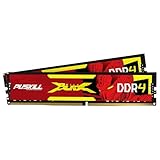
The Teamgroup T-Force Vulcan DDR4-3200 CL16 is the ultra-budget pick for builders who need functional, reliable DDR4 without any premium whatsoever. At DDR4-3200 — the JEDEC standard for DDR4 — with CL16 timings, this kit represents the minimum viable specification for modern gaming. Performance is indistinguishable from more expensive DDR4-3200 kits in gaming workloads, and for titles like Fortnite, League of Legends, Minecraft, and older AAA games that aren’t particularly memory-sensitive, the T-Force Vulcan holds its own without complaint.
The real differentiator here is the aggressive pricing. Teamgroup prices this kit to compete with unbranded and white-label alternatives, but delivers a warranted, tested product with decent build quality. The flat heatspreader profile keeps compatibility broad across cooler configurations, and the red-accented design is inoffensive. DDR4-3200 is universally supported across all DDR4 motherboards, so there is essentially zero compatibility risk.
Where this kit falls short is the ceiling. DDR4-3200 offers noticeably lower memory bandwidth than DDR4-3600, which translates to measurable frame rate differences in CPU-bottlenecked scenarios — typically 5–10% lower average frame rates in titles like Civilization VII, Cities: Skylines 2, or heavily modded Skyrim where the CPU churns through memory rapidly. If you have any room in your budget to step up to DDR4-3600, the Ripjaws V is a better long-term investment. The T-Force Vulcan makes most sense as a stopgap — a kit you buy to get a system running while saving for an upgrade, or the right choice when every dollar genuinely counts.
Pros: Lowest possible price for branded 16GB DDR4, universal motherboard compatibility, functional for esports and casual gaming
Cons: Lower bandwidth than DDR4-3600, 5–10% gaming performance deficit in CPU-limited titles, no overclocking headroom worth pursuing
Comparison Table
| Kit | Type | Speed | Latency | Approx. Price |
|---|---|---|---|---|
| G.Skill Trident Z5 | DDR5 | 6000 MT/s | CL30 | ~$85–$100 |
| Corsair Vengeance DDR5 | DDR5 | 5600 MT/s | CL36 | ~$65–$80 |
| Kingston Fury Beast | DDR5 | 5200 MT/s | CL40 | ~$50–$65 |
| G.Skill Ripjaws V | DDR4 | 3600 MT/s | CL16 | ~$35–$50 |
| Teamgroup T-Force Vulcan | DDR4 | 3200 MT/s | CL16 | ~$25–$35 |
Prices are estimated at time of writing and fluctuate with market conditions. Check Amazon for current pricing.
Is 16GB Enough for Gaming in 2026?
The short answer is yes — for the majority of gaming use cases in 2026, 16GB remains a fully capable configuration. The longer answer requires some nuance.
Modern Windows 11 idles at roughly 3.5–4.5GB of RAM depending on background processes. A typical gaming session with Discord, a browser with a few tabs, and a game running simultaneously will consume 10–13GB. That leaves meaningful headroom with a 16GB kit, and most titles — including graphically demanding releases like Black Myth: Wukong, Dragon’s Dogma 2, and Indiana Jones and the Great Circle — run comfortably within that envelope at their recommended settings.
Where 16GB starts showing cracks is in the extremes. Microsoft Flight Simulator 2024 can push past 20GB of memory usage during complex, scenery-heavy sessions. Palworld with a full mod load has been documented consuming 18GB+. Running a stream via OBS at high quality settings while gaming adds another 2–3GB of overhead. In these scenarios, a 16GB kit will trigger Windows memory compression and paging — an audible performance hit that manifests as stuttering, longer load times, and occasional hitching.
The 16GB versus 32GB debate comes down to your intended use. If you game exclusively — no streaming, no content creation, no heavy multitasking — 16GB is fine today and will likely remain adequate through 2026 and into 2027. If you stream, edit video, use your gaming PC for work, or play simulation-heavy games, 32GB is the smarter buy. The price gap between 16GB and 32GB kits has narrowed substantially; on DDR5 platforms, 32GB (2x16GB) often costs only $20–$30 more than a comparable 16GB kit.
The final consideration is upgrade path. On DDR5 platforms using 8GBx2 sticks, you can potentially add another matching kit later for 32GB — though four-DIMM setups can create stability issues on some motherboards and may require dropping to lower speeds. On DDR4, upgrading is straightforward and proven. Either way, if budget allows, the jump to 32GB at build time is increasingly the pragmatic choice.
Final Verdict
For most builders in 2026, the G.Skill Ripjaws V DDR4-3600 CL16 remains the best value recommendation if you are on a DDR4 platform — it punches above its weight class and has proven reliability across years of real-world use. If you are building on a DDR5 platform, the Corsair Vengeance DDR5-5600 CL36 hits the sweet spot between cost and performance, offering genuine DDR5 gains without the premium of flagship kits.
The G.Skill Trident Z5 DDR5-6000 CL30 is the choice for performance enthusiasts who want the absolute best 16GB DDR5 experience and plan to stay at that capacity. The Kingston Fury Beast DDR5-5200 CL40 earns its spot as the budget DDR5 entry point, and the Teamgroup T-Force Vulcan DDR4-3200 CL16 covers builders who need the most affordable path to a functional gaming system.
Whichever kit you choose, pair it with a motherboard that supports your target XMP or EXPO profile, enable those profiles in the BIOS, and you will be running at optimal speed without any manual configuration. Memory is one of the few components where spending slightly more upfront buys noticeably better longevity — and in 2026, the kits on this list represent the clearest paths to doing exactly that.