

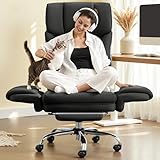
- Top Pick: Cross Legged Office Chair, Ergonomic Cloud Criss Cross Desk Chair, Meditation Chair with Wheels, Height Adjustable Seat for ADHD, Wide Kneeling Chair with Back Support, Black
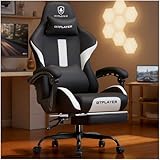
- Best Value: FelixKing Big and Tall Office Chair, 400LBS Wide Leather Executive Chair, Reversible Armrest for Pets Criss Cross Legged, 135° Reclining High Back Gaming Desk Chair with Lumbar Support Footrest, Black
- Premium Choice: Easyego Kneeling Chair Ergonomic Posture Chair – Gray
Affiliate disclosure: As an Amazon Associate we earn from qualifying purchases. This post contains affiliate links — if you buy through them we may earn a small commission at no extra cost to you. This never affects our recommendations.
As an Amazon Associate we earn from qualifying purchases at no extra cost to you. Product prices and availability are accurate as of the date shown and are subject to change.




If you spend hours at a gaming desk, your lower back already knows the cost. Traditional gaming chairs promise lumbar support, but most just lock you into a passive slump. Kneeling chairs take a different approach — they tilt your pelvis forward, engage your core, and distribute your weight between your seat and shins so your spine can actually find its natural curve. The result is less compression, less fatigue, and a surprisingly comfortable position once your body adapts. This guide covers the five best kneeling chairs for gaming in 2026, what separates a great one from a gimmick, and everything you need to know before buying.
In a hurry? See the top-rated Kneeling Chair for Gaming deals available right now:
🛒 Check Kneeling Chair For Gaming Prices on Amazon →🛒 Best Price Today on Amazon
Prime members get fast, free shipping on everything above, plus member-only deals. New members get a 30-day free trial — cancel anytime.
Start 30-Day Prime Free Trial →See Today’s Amazon DealsQuick Comparison Table
| Chair | Frame Material | Seat Height Range | Knee Pad Padding | Rolling Casters | Weight Capacity |
|---|---|---|---|---|---|
| Sleekform Austin | Steel | 21″–28″ | Thick dual foam | No | 250 lbs |
| Varier Variable Balans | Beech wood | Fixed rocker | Medium foam | No | 220 lbs |
| CommunityMed Adjustable | Steel | 21″–28″ | Medium foam | No | 250 lbs |
| Flash Furniture Mobile | Steel | 21″–28″ | Medium foam | Yes (5-wheel) | 250 lbs |
| Dragonn Adjustable | Steel | 21″–28″ | Thick foam | No | 250 lbs |
Our Top Picks
1. Sleekform Austin Kneeling Chair — Best Overall
Sleekform Austin Kneeling Chair
Price: ~$89
The Sleekform Austin is the kneeling chair most gamers should buy first. It hits the sweet spot between build quality, padding comfort, and practical features at a price that doesn’t require a second mortgage. The steel frame is solid without being excessively heavy, and the foldable design means you can stow it in a closet when you want to switch to a standing desk or reclaim floor space between sessions.
The cushioned seat and knee pads use dual-density foam that holds its shape over long sessions — a detail that separates it from budget chairs where the padding flattens out within weeks. Height adjusts from 21 to 28 inches, covering most gamers from about 5’2″ to 6’2″. Setup takes under ten minutes with no special tools.
Pros
- Generous foam density on both seat and knee pads
- Foldable for easy storage between sessions
- Straightforward height adjustment with secure locking
- Strong value at the ~$89 price point
- Easy assembly with clear instructions
Cons
- No rolling casters — fixed position only
- Fabric upholstery may retain heat during extended summer sessions
- Not ideal for users over 6’3″
2. Varier Variable Balans — Best Premium Pick
Varier Variable Balans Kneeling Chair
Price: ~$599
The Varier Variable Balans is the chair that invented the kneeling chair category back in the late 1970s, and the Norwegian design has barely needed updating since. Where every other chair on this list is a fixed-height frame with a cushion, the Variable Balans is a rocker. The curved beech wood base lets the chair glide forward and backward, continuously engaging your core and shifting micro-loads across your spine rather than holding one static position all day.
At $599 it is not for everyone, but for serious gamers who already deal with chronic back pain or anyone who spends 6-plus hours a day at a desk, the investment in genuine Norwegian ergonomics is defensible. The build quality is heirloom-grade — this chair will outlast multiple gaming setups.

Pros
- Rocking base promotes continuous micro-movement, reducing fatigue
- Beech wood frame is exceptionally durable — built to last decades
- Iconic ergonomic design validated by decades of clinical use
- Ships in multiple fabric and leather colorways
Cons
- Premium price (~$599) is a significant investment
- No height adjustment — sizing is determined by model selection at purchase
- Takes longer to adapt to the rocking motion than a fixed chair
- Not ideal if you need to slide between multiple workstations quickly
3. CommunityMed Adjustable Kneeling Chair — Best Budget Ergonomic
CommunityMed Adjustable Kneeling Chair
Price: ~$79
The CommunityMed Adjustable Kneeling Chair punches well above its price. The adjustable tilt on both the seat angle and knee rest positions gives you more customization than most chairs in the sub-$100 bracket, letting you dial in the exact forward-lean angle that works for your body and desk height. The steel frame is sturdy enough for daily use, and the padded surfaces are comfortable for sessions up to two to three hours.
Where it falls short of the Sleekform Austin is padding longevity — the foam is medium density and will compress noticeably after a few months of heavy use. Still, for gamers exploring kneeling chairs for the first time without wanting to spend $89 or more, this is the smartest entry point.
Pros
- Adjustable tilt angle on seat and knee pads — rare at this price
- Solid steel frame with reliable locking mechanism
- Good starter chair for kneeling chair beginners
- Lightest chair on this list, easy to move around
Cons
- Medium-density foam compresses faster than premium options
- Limited weight capacity documentation from manufacturer
- Fabric quality is functional but not premium
4. Flash Furniture Mobile Kneeling Chair — Best for Multi-Desk Setups
Flash Furniture Mobile Kneeling Chair
Price: ~$69
The Flash Furniture Mobile Kneeling Chair is the only option on this list with rolling casters, and that single feature opens up use cases that fixed chairs cannot serve. If your gaming setup shares space with a work desk, a secondary monitor station, or a homework area, being able to roll 18 inches without standing up is a genuine quality-of-life upgrade. The five-wheel caster base is stable and rolls smoothly on both hardwood and carpet.
Height adjusts from 21 to 28 inches matching the other adjustable chairs here, and the steel frame is rated to 250 lbs. Padding is medium density — adequate but not exceptional. At $69 it is the most affordable pick on this list and delivers solid value if mobility is your priority.
Pros
- Five-wheel rolling caster base — only mobile option in this roundup
- Lowest price on the list at ~$69
- Standard 21″–28″ height range covers most body types
- Quick, tool-free height adjustment
Cons
- Medium-density padding — not ideal for sessions longer than 2 hours
- Rolling casters mean the chair can drift on slick floors without a mat
- Frame finish is thinner than more expensive options
5. Dragonn Adjustable Kneeling Chair — Best Padding for Long Sessions
Dragonn Adjustable Kneeling Chair

Price: ~$99
The Dragonn leads this list on padding thickness. Both the seat and knee pads use noticeably denser foam than any other chair in this price range, and that difference matters when you are three hours into a raid or a ranked playlist. The 21″–28″ height range is standard, but the frame construction feels more robust than comparably priced competitors — there is no wobble at the max height setting, which is a common failure point on budget kneeling chairs.
It sits at the top of the sub-$100 bracket, but the extra $10–$30 over the competition buys you foam that will not flatten out in two months. For gamers who already know they want a kneeling chair and plan to use it as their primary seat, the Dragonn is the best long-session investment outside of the Varier.
Pros
- Thickest foam padding of any chair under $100 on this list
- Sturdy steel frame with no wobble across the full height range
- Excellent for extended gaming sessions of 3+ hours
- Height range suits most body types from 5’2″ to 6’2″
Cons
- No rolling casters
- Slightly heavier than competitors due to denser frame construction
- Not foldable — takes more storage space than the Sleekform Austin
How to Choose the Best Kneeling Chair for Gaming
How Kneeling Chairs Improve Posture
Standard chairs let your pelvis tilt backward, flattening the lumbar curve and loading your discs unevenly. Kneeling chairs reverse this by dropping your knees below your hips at roughly a 110–130 degree angle. That forward tilt rotates your pelvis anteriorly, restoring the lumbar curve your spine is designed to maintain. Your core muscles engage passively to hold the position, and the weight that would otherwise compress your lower vertebrae gets distributed across your shins and knees.
The adaptation period is real — most people feel muscle fatigue in their shins and lower back during the first one to two weeks. This is normal and resolves as your postural muscles strengthen. Starting with 45–60 minute sessions and alternating with standing breaks accelerates the adaptation.
Adjustment Range for Your Height
The standard 21″–28″ range on most kneeling chairs works for people between approximately 5’2″ and 6’2″. If you are shorter, look for chairs that drop below 21 inches. If you are taller, 6’3″ and above, look for extended-range models or the Varier Variable Balans where sizing is determined by model selection rather than adjustment.
The critical measurement is the distance from your floor to your desk surface. Your forearms should rest flat on the desk with your shoulders relaxed and your elbows at roughly 90 degrees. Adjust the chair height to achieve that arm position, and the seat-to-knee angle will follow naturally.
Fixed vs Rolling Kneeling Chairs
Fixed kneeling chairs — every pick on this list except the Flash Furniture — stay where you put them. That stability is useful for focused gaming where you are not moving between surfaces, and it eliminates the drift problem on slick floors. Rolling kneeling chairs add mobility at the cost of a slightly higher profile and potential instability on smooth surfaces without a mat.
Choose fixed if your gaming desk is your only workspace. Choose rolling if you regularly move between a gaming monitor, a second display, or a shared desk surface.

Padding Quality and Long-Session Comfort
Padding quality is the most important spec that listings routinely underreport. Budget kneeling chairs use low-density foam that compresses within weeks and stops providing meaningful cushioning. Look for chairs that describe their foam as “high-density” or “dual-density,” and read recent reviews specifically about padding longevity rather than padding thickness at unboxing.
The knee pads take more cumulative pressure than the seat on most people, so prioritize knee pad foam density when comparing. The Dragonn and Sleekform Austin lead this category in the sub-$100 range. If padding longevity is your primary concern and budget is not, the Varier Variable Balans uses quality foam that holds up across years of daily use.
Kneeling Chair vs Standing Desk: Which Is Better
The honest answer is that neither is universally better — and the best setups use both. Standing desks eliminate seated compression entirely but introduce fatigue, varicose vein risk, and lower limb stress when used for more than two hours continuously. Kneeling chairs reduce lumbar compression significantly compared to standard chairs but still involve a seated position with pressure on the shins.
For gamers specifically, kneeling chairs win on focus and fine motor control. It is nearly impossible to play at a high level while standing — the slight body sway and lack of grounding affect mouse precision and reaction times. A kneeling chair keeps you seated and engaged while delivering most of the postural benefits people buy standing desks to achieve.
If budget allows, the optimal setup is a height-adjustable desk paired with a kneeling chair: sit in the kneeling position for focused gameplay, raise the desk and stand during cutscenes, queues, or breaks. If budget forces a choice, the kneeling chair delivers more consistent posture improvement per dollar for desk-bound gamers than a standing desk converter.
Final Verdict
For most gamers, the Sleekform Austin is the right answer. It delivers the best combination of padding quality, build durability, and practical features at a price that makes the experiment low-risk. If you are already certain a kneeling chair is your long-term primary seat and budget is not a constraint, the Varier Variable Balans is a generational purchase that will outlast multiple gaming setups and computers.
For budget-first buyers, the Flash Furniture Mobile at $69 offers the most features per dollar. For long marathon sessions on a tighter budget, step up to the Dragonn — the padding investment pays off fast.
Whatever you choose, commit to the adaptation period. Two weeks in, your back will tell you it was the right call.
Frequently Asked Questions
How does a kneeling chair help with gaming posture?
A kneeling chair tilts your pelvis forward and opens the hip angle, encouraging a naturally upright spine. This can reduce lower-back slouching during long seated sessions.
Is a kneeling chair comfortable for long gaming sessions?
It works best in rotation with a regular chair. Kneeling chairs reduce back strain but can put pressure on the shins, so many users alternate rather than use one all day.
Can you game well in a kneeling chair?
Yes, for desk gaming a kneeling chair positions you upright and close to the desk. It lacks recline and armrests, so it suits focused play more than relaxed sessions.
Kneeling chair or ergonomic gaming chair?
A kneeling chair promotes active posture and core engagement, while an ergonomic chair offers adjustable support and recline. Many people use a kneeling chair part-time alongside a supportive main chair.
Related Articles
Looking for more on this topic? Browse the hand-picked guides below — each one applies the same scoring rubric used in this review.
Ready to decide? Our #1 pick for 2026 is the Chair.
Live price & availability on Amazon.


