As an Amazon Associate we earn from qualifying purchases


Best Desk Lamps for Studying
A study desk asks more of a lamp than a bedside table does. You need enough light to read printed pages and handwritten notes for hours, a colour temperature you can warm up late at night or cool down for focused daytime work, and a head you can aim so the light lands on the book instead of reflecting off a screen. The best desk lamps for studying below cover five different desk situations: a wide-coverage swing-arm lamp, a monitor-mounted bar that uses no desk space at all, a simple touch-control lamp, a foldable lamp that also charges your phone and runs on a timer, and a clip-on light for shelves and headboards.
Every brightness figure below is the manufacturer’s own rating, stated in lumens or lux as the maker publishes it. Where a brand describes a lamp as flicker-free or eye-caring, that is the manufacturer’s description of its driver and optics — treat it as a design claim to weigh alongside brightness and adjustability, not as a medical guarantee.
How to choose a desk lamp for studying
Brightness: lumens and lux. Lumens describe total light output; lux describes how much light actually lands on the page, and it falls quickly as the lamp head moves further away. For reading and writing, look for a lamp whose maker rates it clearly in one or both units, and prefer models with several brightness levels or stepless dimming so late-night revision does not have to run at full power.
Colour temperature. Measured in kelvin, this runs from warm (around 2700K, closer to evening light) through neutral to cool daylight (5700K–6500K). A lamp with multiple colour modes, or a continuous range, lets you match the light to the task and the time of day instead of studying under one fixed tone.
Dimming and memory. Stepped levels are simpler; stepless dimming is finer. A memory function that restores your last setting saves re-adjusting the lamp at the start of every session.
Eye-care features, as makers describe them. Brands variously cite flicker-free drivers, diffused panels, asymmetric optics that keep light off the screen, and high colour rendering (CRI) so printed diagrams and highlighted notes keep their colours. These are manufacturer descriptions — useful for comparing designs, not a substitute for breaks, sensible screen brightness and a properly lit room.
Arm and mounting. A swing arm or gooseneck lets you pull light close for a textbook and push it back for a laptop. Then choose the footprint: a weighted base is easiest to move, a clamp or clip frees the desk surface entirely, and a monitor bar takes no desk space but only suits screen-centred study. For a wider comparison before you narrow down, our guide to the best desk lamps looks at the same mounting choices across more models.
Extras that earn their keep. A USB charging port in the base keeps a phone or earbuds topped up without another wall adapter. A 30- or 60-minute auto-off timer suits timed revision blocks and reading before sleep. Neither matters more than the light itself, but both are genuinely useful on a crowded student desk.
The best desk lamps for studying at a glance
| Lamp | Mount | Brightness (maker rating) | Colour temperature | Standout feature |
|---|---|---|---|---|
| BenQ e-Reading Desk Lamp (WiT) | Weighted base, swing arm | 850 lumens; 1,800 lux at 40 cm | 2700K–5700K | Auto-dimming e-Reading mode, very wide coverage |
| BenQ ScreenBar Plus | Monitor clamp | 930 lux centre at 45 cm (BenQ figure) | 2700K–6500K | Desktop dial, lights desk without screen glare |
| JOSTIC LED Desk Lamp | Folding base | 60 LEDs, 10 brightness levels | 5 colour modes | Wireless charger, USB port, 30/60 min timer |
| LEPOWER Desk Lamp (LS-H2) | Base | 8W LED panel | 3 colour modes | Touch control, 5 brightness levels |
| LEPOWER Clip On Light | Clip / clamp | 5W gooseneck light | Colour changeable | Clips to shelf, headboard or desk edge |
1. BenQ e-Reading Desk Lamp (WiT) — widest coverage for a full study desk
- Amazon: https://www.amazon.com/dp/B017NOD9KI
BenQ’s WiT lamp is built around a curved head that, in BenQ’s description, throws light across a 90 cm-wide area — about 150 percent wider than a conventional desk lamp, per the manufacturer — so an open textbook, a notebook and a keyboard can sit in the same pool of light. BenQ’s specification sheet rates it at 850 lumens and a centre illuminance of 1,800 lux at 40 cm, with dual-colour LEDs giving a 2700K to 5700K colour temperature range and a maximum draw of 18W.
The control knob adjusts brightness and colour temperature, and a long touch on the control ring switches on the intelligent e-Reading mode: a built-in ambient sensor reads the room and adjusts output automatically, with BenQ describing the pattern as brighter at the sides and darker in the middle to cut contrast glare against a screen. BenQ also describes the lamp as flicker-free at all brightness levels. The head sits on a patented ball joint and a flexible swing arm, so it tilts and swivels rather than only moving up and down, and the body is aluminium alloy. This is the pick for a dedicated study desk where one lamp has to cover paper and screen work together. It is also the largest and heaviest design here, so it suits a desk it can stay on.
2. BenQ ScreenBar Plus — best for screen-based studying in a small space
- Amazon: https://www.amazon.com/dp/B07DP7RYXV
The ScreenBar Plus takes the opposite approach to desk space: it clamps to the top of your monitor and uses none. Its asymmetric optics are designed, in BenQ’s description, to throw light forward and down onto the desk in front of the screen rather than onto the display itself, so notes and a keyboard are lit without a bright reflection washing out the monitor. BenQ publishes a centre illuminance of 930 lux at 45 cm and a colour rendering figure of Ra above 95 for this light class, with colour temperature adjustable from 2700K to 6500K.
What separates the Plus from the standard bar is the desktop dial: a separate controller that handles brightness and hue and carries the auto-dimming function, where an ambient sensor adjusts the bar toward a level BenQ sets at around 500 lux for the surrounding light. It is USB powered, so it runs from the monitor or computer rather than a wall socket. Check the fit before ordering — BenQ’s stated window is a monitor top roughly 1 to 3 cm thick — and remember it lights the zone in front of one screen, which is exactly right for laptop-and-monitor study but not a substitute for a lamp over a big paper spread.
3. JOSTIC LED Desk Lamp — charging and a timer in one folding lamp
- Amazon: https://www.amazon.com/dp/B08D8FCXVW
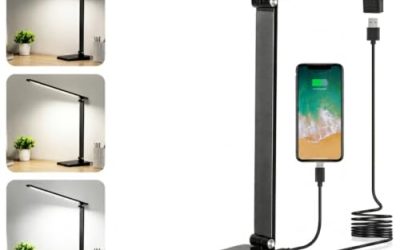
For a dorm desk or a small bedroom setup, the JOSTIC folds the extras students actually use into the base. The listing specifies 60 LEDs split between warm and cold emitters, five colour modes and ten brightness levels with touch control, plus a memory function that restores the last setting while the lamp stays connected to power. The base carries a 10W wireless charging pad and a USB charging port rated at 5V with up to 2A output, so a phone can charge on the pad while earbuds or a tablet use the port.
Its most study-friendly feature is the auto timer: an indicator shows the lamp will switch itself off after 30 minutes, or after 60 minutes on the second setting — a simple way to structure a timed revision block or to read in bed without leaving the light on all night. The lamp folds flat for storage and moving between rooms, which suits students who pack up their desk at the end of term. The trade-off is coverage: a compact folding lamp lights a personal work zone well, but it will not spread light across a wide desk the way the BenQ WiT does.
4. LEPOWER Desk Lamp (LS-H2) — simple touch-control lamp for reading and notes

- Amazon: https://www.amazon.com/dp/B0744984HF
LEPOWER’s desk lamp keeps the formula deliberately simple: an 8W LED panel, touch controls on the base, three colour modes — white, natural white and warm white in the maker’s naming — and five adjustable brightness levels to step through. The manufacturer describes the output as soft and non-flickering, aimed at reading, working and bedside use, and the listing gives the lamp’s dimensions at roughly 6.1 by 5.5 by 23.6 inches, so the head stands tall enough to clear a stack of books and a laptop screen.
There is no timer, no charging port and no sensor here, and that is the point: fewer features means fewer things to set up, and the stepped brightness levels are quick to learn by touch in a dark room. Choose it if your study is mostly paper-based — reading, annotating, writing — and you want a lamp that turns on, steps to a comfortable level and gets out of the way.
5. LEPOWER Clip On Light — clamp light for shelves, bunks and tight desks
- Amazon: https://www.amazon.com/dp/B016U6ZJI0
When there is no flat desk space left for a base, this LEPOWER light clips onto the edge of a desk, a shelf or a bed headboard instead. A flexible gooseneck holds the head where you aim it, the colour of the light can be changed between its settings, and the control is a simple switch on the cord. LEPOWER describes the design as providing stable, soft light without flicker interference, and the whole unit is a 5W LED, so it runs cool and sips power compared with the full-size lamps above.
A clip light is a focused reading light rather than a whole-desk solution: it is ideal for a bunk, a reading chair or the edge of a shared table, and it travels easily between rooms. Pair it with the room’s main light for long study sessions, since a single small source in an otherwise dark room creates strong contrast; used as targeted light over a book, it does its job neatly.
Who should choose which lamp?
- Mostly paper study on a dedicated desk: the BenQ WiT, for its wide, even coverage, auto-dimming mode and full colour temperature range.
- Screen-centred study on a small desk: the BenQ ScreenBar Plus — zero footprint, a proper desktop dial, and light aimed at the desk rather than the display.
- Dorm room or shared space: the JOSTIC, because the wireless charger, USB port and 30/60 minute timer replace several separate accessories.
- Simple, affordable reading light: the LEPOWER LS-H2, with touch control and five brightness steps and nothing else to manage.
- No desk space at all: the LEPOWER Clip On, which mounts to furniture you already have.
FAQ
How bright should a desk lamp be for studying?
Look at the maker’s lux figure at a stated distance, not lumens alone: lux is what reaches the page. Lamps in this guide publish figures from a compact reading light up to 1,800 lux at 40 cm for the BenQ WiT. Multiple brightness levels matter as much as the maximum, so you can lower the light at night.
Which colour temperature is best for studying?
There is no single correct setting. Cooler settings in the 5000K–6500K part of a lamp’s range resemble daylight and suit detailed daytime work; warmer settings around 2700K–3000K are easier to wind down with in the evening. A lamp with several modes or a wide range lets you change with the task instead of compromising.
Do flicker-free and eye-care claims matter?
They describe how the maker built the lamp — driver design, diffusion and optics — and BenQ and LEPOWER both use the terms for the models above. Treat them as design information, not medical advice: no desk lamp prevents eye strain on its own, and regular breaks plus balanced room lighting do as much as any single feature.
Clamp, base or monitor bar — which mounting is best?
A base is the most flexible and portable. A clamp or clip is best when the desk surface is full or shared. A monitor bar is best when almost all your studying happens at one screen and desk space is the scarcest thing you have.
Is a USB charging port worth having on a study lamp?
On a small desk, yes: the JOSTIC’s port and wireless pad remove a separate phone charger from the surface. On a large desk with power to spare, it is a convenience rather than a reason to choose one lamp over another — brightness, colour range and aiming come first.