- Top Pick: Anker Nano II 65W (715)
- Runner-up: UGREEN Nexode 65W GaN Charger (CD244)
- Also consider: Anker 735 Charger (GaNPrime 65W)
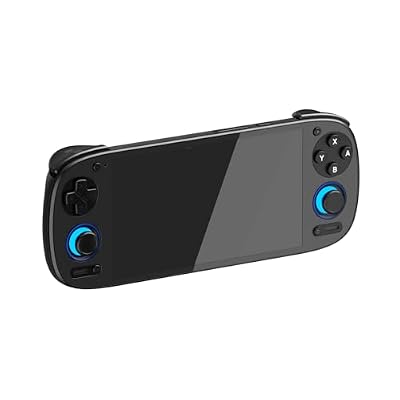
A gaming handheld is only as portable as the brick that feeds it. Lose the adapter from the box, or travel with a phone charger, and a machine that plays beautifully starts charging slowly, or even losing charge while you play. Every major handheld PC charges over standard USB-C Power Delivery, so one good third-party charger can stand in for the original adapter at home, in a bag, or at a hotel.
As an Amazon Associate, we earn from qualifying purchases.
Choosing it is not about chasing the biggest number on the box. It is about matching the output your handheld was designed around, knowing how that output splits across several ports, and using a cable that does not quietly cap the setup. This guide works through those checks, then compares five chargers from Anker and UGREEN.
This article contains affiliate links; purchases through them may earn a commission supporting the site at no extra cost to you.
Quick Answer
Match the charger to the adapter your handheld shipped with. Valve documents a 45W USB-C PD supply for Steam Deck, while ASUS, Lenovo and MSI each document 65W adapters for the ROG Ally, Legion Go and Claw. Any single-port 65W USB-C PD charger covers all four; multi-port models share their headline wattage, so check the split before buying.
What your handheld actually asks for
The most reliable wattage figure for any handheld is the adapter its maker put in the box, the input its charging circuitry was designed around. Valve’s official Steam Deck specifications list a 45W USB Type-C PD 3.0 power supply. ASUS specifies a 65W AC adapter for the ROG Ally and Ally X, at 20V and 3.25A; Lenovo’s PSREF datasheet for the Legion Go lists the same 65W, 20V, 3.25A adapter class; MSI’s Claw specification sheets list a 65W PD adapter.
Two consequences follow. A Steam Deck is fully served by a 45W-class charger, and a stronger charger forces nothing: USB PD is a negotiation. The Windows handhelds, though, are 65W machines. Feed one from a small phone charger and the documented input is not met; charging slows, and under load a weak supply can fail to keep pace with battery drain. The adapter class in the box is the floor to shop against.
The multi-port math nobody prints in large type
A single-port charger’s headline is what its one port delivers. A multi-port headline is a total shared across every port, and when a second device plugs in, each port’s ceiling drops per a distribution table in the fine print.
Anker’s own specifications for the 735 Charger show the pattern. One USB-C port alone delivers the full 65W. Both USB-C ports together are rated at 45W plus 20W. Fill all three ports and the top port falls to 40W, with the other two sharing 12W each. That 40W matters: it sits below the 65W input the Windows handheld makers document, so a fully loaded 735 charges an Ally, Legion Go or Claw more slowly than its stock adapter, even though the box says 65W.
The same arithmetic applies at higher totals. Anker’s listing for the Prime 100W states that two USB-C ports split as 65W plus 35W, and that three ports share a reduced 89W maximum. UGREEN’s listing for the Nexode 65W shows its top port dropping to the 45W class when all three ports are busy. The split table, not the headline, is the number to buy on.
Cables: the silent wattage cap
A charger and a handheld negotiate through the cable, and the cable can veto the deal. Under the USB-IF framework behind USB Power Delivery, a USB-C cable without an electronic marker chip is limited to 3A of current, which at the 20V level these handhelds use means a 60W ceiling. Cables rated above that carry an e-marker chip identifying them to the charger, and they are the ones sold as 100W or 240W cables.
This bites at exactly the handheld boundary. A 65W handheld draws 3.25A at 20V, already beyond the unmarked 3A limit, so a plain phone cable can hold an Ally, Legion Go or Claw below its documented input even when the charger is strong enough. The Steam Deck’s 45W draw stays under the limit. For any 65W handheld, pair the charger with an e-marked cable rated for at least 100W.
The five chargers, compared
Anker Nano II 65W (715)

The single-port purist pick. One USB-C port, the full 65W whenever it is plugged in, and no split table, because there is nothing to split. Anker rates the port at up to 20V and 3.25A with PPS support, matching the documented input of every Windows handheld here and covering the Steam Deck easily. GaN II construction and foldable prongs keep it pocket-small.
Specs:
– Model: A2663 (Anker 715)
– Output: 1x USB-C, 65W max (20V at 3.25A), PPS supported
– Input: 100-240V, 50/60Hz
– Certification: not stated
UGREEN Nexode 65W GaN Charger (CD244)

The compact three-port alternative. Either USB-C port delivers 65W alone, so a solo handheld gets its full documented input, while the USB-A port handles earbuds or a watch. UGREEN’s listing gives the USB-C output as 5V to 20V at up to 3.25A with a PPS range, and shows the top port stepping down to the 45W class when all three ports are busy: one demanding device plus small accessories, not two handhelds at once.
Specs:
– Model: CD244
– Output: 2x USB-C (65W max each, single port), 1x USB-A (22.5W max), 65W total
– PPS range: 3.3-21V at 3A, as listed by UGREEN
– Input: 100-240V, 50/60Hz
– Certification: not stated
Anker 735 Charger (GaNPrime 65W)
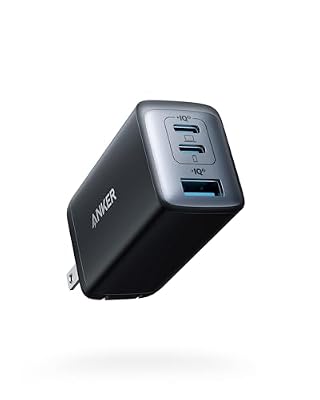
The three-port pick with the most honest paperwork. Anker publishes the full distribution: 65W from one USB-C port, 45W plus 20W across two, and 40W plus 12W plus 12W with everything occupied. That transparency is the warning label: with a phone and earbuds sharing, a Windows handheld sees 40W, so treat the extra ports as overnight trickle slots. Anker states it uses PowerIQ 4.0 distribution and ActiveShield 2.0 temperature monitoring.
Specs:
– Model: A2668
– Output: 2x USB-C, 1x USB-A, 65W total
– Published splits (Anker): 65W single; 45W + 20W dual USB-C; 40W + 12W + 12W triple
– Input: 100-240V at 1.8A, 50/60Hz
– Maker-stated protection: ActiveShield 2.0 temperature monitoring
Anker Prime Charger (100W, 3 Ports, GaN)
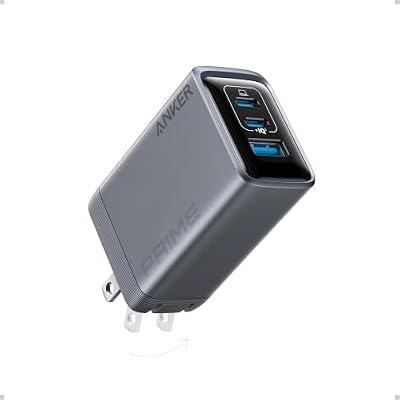
The headroom pick for a desk that charges everything. Alone, either USB-C port delivers 100W, well beyond any handheld’s documented input. Anker’s listing states the two-USB-C split as 65W plus 35W and the three-port maximum as 89W, so a handheld on the top port keeps its full 65W class while a phone charges beside it, something no 65W-total charger can do. Its 100W output runs at 5A, so reaching it needs an e-marked cable.
Specs:
– Model: A2688
– Output: 2x USB-C (100W max single port), 1x USB-A (22.5W max), 100W total
– Published splits (Anker listing): 65W + 35W dual USB-C; 89W max across three ports
– Size and weight: 1.7 x 1.1 x 2.7 in, 170 g, as listed by Anker
– Input: 100-240V at 2.1A, 50/60Hz
UGREEN Nexode 100W GaN Charger (CD226)

The four-port desk option. Three USB-C ports and one USB-A port share a 100W total, and the top USB-C port is rated for the full 100W when it works alone. That headline is a pool, not a per-port promise: UGREEN’s published distribution steps the top port down as more ports join, so check the table against your nightly combination. For one handheld plus phone, earbuds and watch, port count is the appeal.
Specs:
– Model: CD226
– Output: 3x USB-C, 1x USB-A, 100W total; top USB-C 100W max single port
– Multi-port split: published by UGREEN; top port steps down as ports are added
– Input: 100-240V, 50/60Hz
– Certification: not stated
Safety, certifications and the recall question
Chargers are mains devices, so the safety layer deserves scrutiny too. Certification claims belong to the makers: Anker states that its GaNPrime models run ActiveShield 2.0, temperature monitoring that adjusts output, and UGREEN describes multi-layer protection covering over-voltage, overheating and short circuits. Where a listing names no specific UL or ETL listing for the exact model, this guide records that as not stated rather than assuming it.
On recalls: the widely reported CPSC recalls here cover specific power bank models from Anker, Belkin and others. None of the five wall chargers in this guide is named in a CPSC recall, and no recall names UGREEN’s chargers. The habit still applies: check any model number against the maker’s recall page, and buy from the maker’s own storefront so the unit is genuine.
Travel notes
All five accept 100-240V input as their makers state it, so they work on foreign mains with a simple plug adapter. One 65W brick plus an e-marked cable covers a handheld and, in sequence overnight, a phone. Wall chargers also fall outside the airline battery rules that govern power banks.
How to Choose
Start from your handheld’s documented adapter: 45W class for Steam Deck, 65W class for the ROG Ally line, Legion Go and MSI Claw. One device at a time points to a single-port 65W model. A handheld plus small accessories points to a 65W three-port model, bought on its split table rather than its total. A handheld that must keep its full 65W while a phone charges beside it points to a 100W model, whose split keeps the top port in the 65W class. Finally, budget for the cable: a 65W handheld needs an e-marked cable rated above its 3.25A draw.
Who Should Skip
Skip this category if your original adapter works and never leaves your desk; a spare charger solves travel problems, not performance ones. Skip multi-port models if you will not read the split table, because a shared 65W total disappoints anyone expecting 65W at every port. Skip the 100W bricks for pure travel, where the compact models cover every handheld here. And skip any no-name charger whose maker publishes neither a model number nor an output table.
FAQ
Will a 100W charger damage a Steam Deck that ships with a 45W adapter?
No. USB Power Delivery is a negotiation: the charger advertises what it can offer and the handheld requests what it is designed to take. Valve documents a 45W PD 3.0 input for the Steam Deck, and the Deck draws only its own class of power from a larger charger.
Why does my 65W handheld charge slowly from a 65W multi-port charger?
Because the 65W is a shared total. As Anker’s published figures for the 735 show, filling every port can drop the main USB-C port to 40W, below the documented 65W input. Charge the handheld alone, or choose a 100W model whose split keeps the top port at the 65W class.
Does the cable really matter at these wattages?
Yes, at exactly the 65W class. An unmarked USB-C cable is limited to 3A, capping it at 60W at 20V, while a 65W handheld draws 3.25A. An e-marked cable rated for 100W removes the cap. The Steam Deck, at 45W, stays under the unmarked limit.
Are any of these chargers recalled?
No. The CPSC recalls in this category name specific power bank models, not wall chargers; none names these five models, and no recall names UGREEN’s chargers. Checking a model number against the maker’s recall page before buying remains a sensible habit.
Final Verdict
The Anker Nano II 65W is the cleanest buy: one port, the full documented input for every machine here, and nothing to misread. If a phone and earbuds must share, the Anker 735 or the UGREEN Nexode 65W do it honestly, provided the handheld gets the top port. If the handheld must never drop below its 65W class while other devices charge, step up to the Anker Prime 100W or the four-port UGREEN Nexode 100W. Whichever you choose, pair it with an e-marked cable; the cable is half the charger.