Our Short List of 3

- Best for: commuters and everyday riders who value a wired connection that never drops.
- Model: CC-VL820
- Sensor: wired fork sensor with spoke magnet
- Functions: current, maximum and average speed, trip distance, total distance (odometer), elapsed time, calorie consumption, carbon offset, pace arrow, clock
- Auto start/stop: yes

- Best for: riders with tired eyes, glove wearers, and anyone who reads the screen at speed.
- Model: CC-PA100W
- Display: 5.5 cm LCD, oversized digits
- Sensor: analog wireless fork sensor with spoke magnet
- Functions: current, maximum and average speed, trip distance, total distance (odometer), elapsed time, clock, stopwatch

- Best for: riders who want wireless convenience and a clean fork without moving up to the Padrone’s size.
- Model: CC-VT230W
- Sensor: analog wireless fork sensor
- Functions: current, maximum and average speed, trip distance, total distance (odometer), elapsed time, clock, calorie consumption, pace arrow
- Auto start/stop: yes; programmable odometer; menu screen
All 4 Picks at a Glance
| Product | Specs | Action |
|---|---|---|
| CatEye Velo 9 |
| Check price on Amazon |
| CatEye Padrone |
| Check price on Amazon |
| CatEye Velo Wireless |
| Check price on Amazon |
 CatEye Velo 7 |
| Check price on Amazon |
The real decision with a bike computer is not how much data it can collect, but how much friction it adds to a ride. A GPS head unit needs charging, satellite lock and often a phone app before it tells you anything. A wheel-sensor computer skips all of that: a magnet passes a sensor on the fork, and the screen shows speed and distance the moment the wheel turns. The trade is honest — you give up maps, uploads and elevation, and in return you get a device that wakes instantly and runs for a year or more on a coin cell.
This roundup is for commuters, casual road riders and anyone putting a first computer on a bike who wants speed, distance and ride time without accounts or cables on the charger. Every pick below is a non-GPS model chosen from its Amazon product title and listing details, and all four come from CatEye’s long-running Velo and Padrone lines.
Quick Picks
As an Amazon Associate we earn from qualifying purchases.
| Product | Best for | Key spec from title |
|---|---|---|
| CatEye Velo 9 | Fit-and-forget commuting on a wired setup | Wired sensor, 9 functions, calorie and carbon offset |
| CatEye Padrone | Riders who want the biggest, easiest-to-read digits | Oversized display, wireless, FlexTight mount |
| CatEye Velo Wireless | A clean cockpit without a cable down the fork | Analog wireless, programmable odometer |
| CatEye Velo 7 | A first computer or a second bike on a tight setup | Wired, 7 functions, pre-set tire sizes |
How to Choose
Wired or wireless sensor
Both designs count wheel revolutions the same way; they differ in how the count reaches the head unit. A wired computer such as the Velo 9 or Velo 7 runs a thin cable from the fork sensor to the bar mount, which takes a few extra minutes with zip ties but never drops a signal and never needs a second battery. A wireless model such as the Padrone or Velo Wireless keeps the fork clean and swaps between bikes more easily, at the cost of a coin cell in the sensor as well as the head unit, and a short-range analog signal that strong lights or other electronics can occasionally disturb.
The functions you will actually read
Most riders glance at current speed, trip distance and ride time, and check the odometer once in a while. Every computer here covers that core set. The differences sit at the edges: the Velo 9 adds calorie consumption and a carbon offset estimate, the Padrone adds a stopwatch, and the Velo Wireless adds calories without the carbon figure. Average and maximum speed matter if you train by them; all four models record both. Decide which two or three screens you will genuinely use, because extra functions you never open are not worth a more complicated menu.
Screen size and how you change screens
A computer is read at arm’s length, in sunlight, often through sunglasses. The Padrone exists for exactly this problem, with the largest display in this group and ClickTec operation: you press the bottom of the unit itself to change screens, which works with gloves on. The Velo models use a single button and a smaller window, so they show one or two values at a time and ask you to cycle through the rest. If your eyesight makes small digits a strain, screen size should outrank every other feature on this page.
Wheel size setup and battery life
A sensor computer is only accurate if it knows your wheel circumference. The Velo 7 and Velo 9 simplify this with pre-programmed tire sizes you pick from a list, while the Velo Wireless and Padrone also accept a measured circumference for odd sizes. Enter it carefully: a wrong value skews every speed and distance figure the unit ever shows. Battery life is the other quiet advantage of this category. The wired Velo models run up to about three years on one CR2032 at an hour a day, and the wireless units ask for a fresh cell roughly yearly, with a second cell in the sensor.
The 4 Best Options
CatEye Velo 9
- Best for: commuters and everyday riders who value a wired connection that never drops.
- Model: CC-VL820
- Sensor: wired fork sensor with spoke magnet
- Functions: current, maximum and average speed, trip distance, total distance (odometer), elapsed time, calorie consumption, carbon offset, pace arrow, clock
- Auto start/stop: yes
commuters and everyday riders who value a wired connection that never drops.
the cable needs tidy routing along the fork and brake line, and there is no backlight for night rides.
The Velo 9 is the wired computer for riders who want to install a unit once and stop thinking about it. Its nine functions cover the standard speed and distance set and add calorie consumption plus a carbon offset readout, which suits commuters tracking the trips their bike replaces. Setup is simplified by pre-programmed tire sizes, operation is a single button, and the auto start/stop function keeps stopped time at lights out of your averages. Because the sensor signal travels by cable, there is no pairing, no interference and no sensor battery to replace — just the head unit’s coin cell.
CatEye Padrone
- Best for: riders with tired eyes, glove wearers, and anyone who reads the screen at speed.
- Model: CC-PA100W
- Display: 5.5 cm LCD, oversized digits
- Sensor: analog wireless fork sensor with spoke magnet
- Functions: current, maximum and average speed, trip distance, total distance (odometer), elapsed time, clock, stopwatch
riders with tired eyes, glove wearers, and anyone who reads the screen at speed.
the analog wireless signal can be disturbed by some high-powered lights and electronics, and this base model has no backlight.
The Padrone is built around one idea: the numbers should be readable at a glance, without squinting or slowing down. CatEye gives it an oversized 5.5 cm LCD, the largest screen in this roundup, and its ClickTec design lets you change screens by pressing the base of the unit rather than hunting for a small button. It is a wireless analog computer with eight functions, including a stopwatch the smaller models leave out, and the odometer can be programmed manually so your lifetime mileage survives a battery change. The FlexTight bracket mounts without tools and makes moving the head unit between bikes straightforward.
CatEye Velo Wireless
- Best for: riders who want wireless convenience and a clean fork without moving up to the Padrone’s size.
- Model: CC-VT230W
- Sensor: analog wireless fork sensor
- Functions: current, maximum and average speed, trip distance, total distance (odometer), elapsed time, clock, calorie consumption, pace arrow
- Auto start/stop: yes; programmable odometer; menu screen
riders who want wireless convenience and a clean fork without moving up to the Padrone’s size.
the wireless link is short-range analog, so keep the sensor and head unit within the listed distance when mounting.
The Velo Wireless takes the Velo formula and removes the cable. An analog wireless sensor on the fork talks to a compact head unit that covers the full everyday function set, including calorie consumption, and adds two conveniences the wired Velo 7 lacks: a programmable odometer and a menu screen for changing settings. CatEye notes it installs easily on almost any bike, including 27.5 and 29er mountain bikes, and the zip-tie bracket keeps the fitting tool-free. For riders who want a tidy cockpit and plan to move the computer between bikes, this is the natural step up from the wired models.
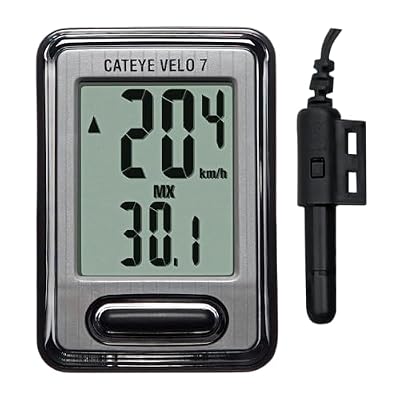
CatEye Velo 7
- Best for: first computers, second bikes and young riders who only need the core numbers.
- Model: CC-VL520
- Sensor: wired fork sensor with spoke magnet
- Functions: current, maximum and average speed, trip distance, total distance (odometer), elapsed time, clock
- Auto start/stop: yes
first computers, second bikes and young riders who only need the core numbers.
it has the shortest function list here — no calorie readout and no stopwatch — and the wired sensor takes a little patience to route neatly.
The Velo 7 strips the formula to its essentials: seven functions, one button, a wired sensor and a battery that lasts for years. It covers current, maximum and average speed, trip and total distance, elapsed time and a clock — everything a new rider or a second bike actually needs — and its pre-set tire sizes start small enough for children’s and folding bikes as well as adult wheels. There is no calorie counter and no wireless link to manage. If the goal is a dependable speedometer for a spare bike, a trainer bike or a child’s first computer, the Velo 7 is the simplest tool here.
Which One Fits Your Situation
You commute daily and hate maintenance
Choose the Velo 9. The wired sensor cannot lose its connection in city interference, auto start/stop keeps your averages honest at traffic lights, and the battery stretches to roughly three years. The calorie and carbon offset figures also fit the commuter mindset of tracking what the ride replaces.
You ride with gloves or reading glasses
Choose the Padrone. Its oversized display is the easiest to read in this group, and ClickTec operation means a press on the unit itself changes screens, which works through winter gloves. The programmable odometer also protects your total mileage when the battery eventually comes out.
You swap one computer between two bikes
Choose the Velo Wireless. There is no cable to unthread, the zip-tie bracket is cheap to duplicate for a second bike, and the programmable odometer keeps your records sensible. Just remember each bike needs its own sensor and the correct wheel size selected.
You are equipping a child or a spare bike
Choose the Velo 7. Its pre-set tire sizes reach down to small wheels, the wired setup has nothing to pair, and a coin cell lasts for years of short rides. It shows the numbers a new rider cares about and nothing that complicates the single button.
Common Mistakes
- Entering the wrong wheel size, or skipping setup entirely, so every speed and distance reading is off by a fixed percentage.
- Mounting the sensor and magnet too far apart; the gap usually needs to be only a few millimetres for a reliable signal.
- Expecting a non-GPS computer to record routes or upload rides — these units display and total your numbers, and that is all they promise.
- Buying a wireless model for a bike with a suspension fork or e-bike motor without checking sensor placement and interference first.
- Throwing away the odometer total at battery change on models without a programmable odometer; write it down before you swap the cell.
Frequently Asked Questions
How does a bike computer work without GPS?
It counts wheel rotations. A magnet on a spoke passes a sensor on the fork once per revolution, and the computer multiplies those turns by the wheel circumference you entered to calculate speed and distance. That is why the wheel size setting matters so much, and why these units work in tunnels, forests and cities where satellite signals struggle.
Are wired or wireless sensor computers more accurate?
Neither has an inherent accuracy advantage, because both count the same wheel revolutions. Accuracy comes from the circumference value you enter. Wired models are immune to radio interference and have one less battery, while wireless models install more cleanly. Measured carefully, both will agree with a GPS unit on distance within a percent or so.
How long do the batteries last?
The wired Velo 7 and Velo 9 run up to about three years on a single CR2032 at roughly an hour of riding a day. The wireless Padrone averages about a year in the head unit, and its fork sensor carries its own coin cell on a similar schedule. None of these computers needs recharging; you replace a coin cell and ride on.
Can I use one of these computers on two bikes?
Yes, with the right extras. The head unit slides off its bracket, so a second bracket and sensor kit lets you move it between bikes. Check whether your model stores two wheel sizes or needs the circumference changed each swap; the Velo Wireless and Padrone make this easier with their menu and programmable settings.