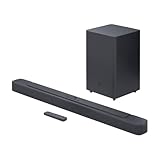
- Top Pick: TCL S55H 2.1 Sound Bar with Wireless Subwoofer for Smart TV | Dolby Atmos DTS:X Auto Room Calibration| 220W Power Wireless Bluetooth Home Theater Audio | App Control & Remote Control | Latest Model
- Best Value: Samsung B-Series Soundbar HW-B550F 2.1 ch DTS Virtual:X Soundbar with Subwoofer (2025 Model) Voice Enhance Mode, Bass Boost, Adaptive Sound
- Premium Choice: ULTIMEA 2.1 Sound Bar System for TV with Dolby Atmos and Wireless Subwoofer | Bluetooth 6.0, 240W Peak, HDMI eARC, VoiceMX Clear Dialogue, BassMX Deep Bass, App Control, TV & Home Theater, Poseidon M40
A 2.1 soundbar is the simplest meaningful upgrade over built-in TV speakers: two channels in the bar and one dedicated channel for low frequencies. That layout suits buyers who want clearer dialogue and fuller bass without running rear speakers across the living room. The catch is that the label covers very different hardware, from a 16 inch bar with a built-in subwoofer to a walnut-finished unit that supports Dolby Atmos.
This guide sorts ten 2.1 models by the connections and sound modes spelled out in their listings, so you can match a bar to your TV inputs, your room, and whether movies, music, gaming, or karaoke nights matter most in 2026.
Quick Picks
As an Amazon Associate we earn from qualifying purchases at no extra cost to you.






| Product | Best for | Key spec from the title |
|---|---|---|
| TCL S55H | Atmos with room correction | Dolby Atmos, DTS:X, Auto Room Calibration, 220W |
| Samsung HW-B550F | Dialogue clarity | DTS Virtual:X, Voice Enhance Mode |
| ULTIMEA Poseidon M40 | Feature-packed Atmos | Dolby Atmos, HDMI eARC, Bluetooth 6.0, 240W peak |
| JBL Bar 2.1 Deep Bass MK2 | Big bass | 6.5 inch wireless subwoofer, 300W max |
| LG S40T | LG TV owners | TV Synergy, AI Sound Pro |
| LARKSOUND 16 Inch | Small spaces | Built-in subwoofer, 110W, Night Mode |
| MZEIBO Detachable | Gaming and music | Detachable bar, Bluetooth 5.3, 120W peak |
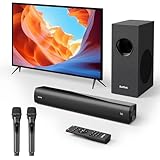
| Karaoke 2.1 Soundbar | Parties | Microphones included, Bluetooth 5.3 |
| Klipsch Flexus CORE 100 | Design-minded rooms | Dolby Atmos, powered by Onkyo, 28 inches wide |
| Philips B6309 | Movie nights | HDMI eARC, Dolby Atmos, 320W max |
How to Choose
Wireless subwoofer or built-in bass
A separate wireless subwoofer can sit beside the sofa and move more air, which matters for explosions and film scores. A built-in subwoofer saves floor space and wiring but cannot match that low-end depth. If your listing names a driver size, such as the 6.5 inch unit on the JBL, treat it as a rough guide to bass capability; below roughly 6 inches, expect bass that is better than TV speakers but not dramatic.
TV connection: ARC, eARC, or optical
HDMI ARC passes standard surround audio and lets your TV remote control volume. HDMI eARC adds the bandwidth needed for lossless and Atmos-class streams. Optical works on nearly every TV but caps out at compressed formats and often loses remote volume control. Check your TV's ports before you pick a bar; a model that lists only optical and AUX will not fit a setup that relies on HDMI.
Surround formats versus virtual modes
Dolby Atmos and DTS:X are real object-based formats, but a 2.1 bar has no ceiling speakers, so height effects are simulated either way. DTS Virtual:X is a virtualization mode rather than a streaming format. For most buyers, the practical question is whether your streaming apps and consoles send Atmos at all. If they do not, a plain bar with good dialogue modes is enough.
Power figures and the extras that matter
Wattage listings such as 110W, 240W peak, or 300W max are ceilings, not guarantees of loudness, and they are not comparable across brands. Ignore them when choosing between two bars. Look instead at Bluetooth version (5.0 versus 5.3 or 6.0 affects stability), Night Mode for late viewing, EQ presets, and app control. The cheapest bars cut corners on port variety and on subwoofer pairing reliability.
The 10 Best Options
TCL S55H
The S55H pairs a wireless subwoofer with Dolby Atmos and DTS:X support, which is uncommon among compact 2.1 systems. It is aimed at buyers who want a format-heavy bar without a complicated setup, with the subwoofer handling the low end so the bar itself can focus on dialogue and effects.
- Auto Room Calibration is listed, which adapts output to your space.
- App control and a remote give two ways to adjust sound.
- Trade-off: the 220W figure is a headline power number, and the title does not confirm which HDMI port type is fitted.
Skip it if eARC is a must; verify the ports on the spec sheet first, and look elsewhere if you want a very small bar for a desk.
Samsung HW-B550F
Samsung's B-Series bar targets people whose main complaint is muddy speech. It lists Voice Enhance Mode, Bass Boost, and Adaptive Sound alongside a subwoofer. That makes it a sensible fit for a bedroom or family room TV where voices matter more than spectacle, and where a familiar TV brand ecosystem is reassuring.
- Voice Enhance Mode speaks directly to dialogue clarity.
- Adaptive Sound adjusts output to what is playing.
- Trade-off: it relies on DTS Virtual:X, with no Dolby Atmos listed.
Skip it if native Atmos support is on your checklist, or if you want a Bluetooth version or wattage figure confirmed in the title.
ULTIMEA Poseidon M40
This one stacks the most modern connectivity in the group: Bluetooth 6.0, HDMI eARC, and Dolby Atmos with a wireless subwoofer. It suits buyers who want newer standards at a mid-range tier and plan to keep the bar through a future TV upgrade, since eARC is the connection that newer sets tend to emphasize.
- VoiceMX and BassMX modes target dialogue and low end separately.
- App control adds EQ flexibility.
- Trade-off: 240W is a peak figure rather than continuous output.
Skip it if you prefer a name with a long track record in living-room audio, or if you would rather not manage separate dialogue and bass modes through an app.
JBL Bar 2.1 Deep Bass MK2
JBL leads with low end: a 6.5 inch wireless subwoofer and a 300W maximum output figure. It fits action-movie fans who want simple plug-in bass, plus anyone who mostly streams music over Bluetooth and wants the low end to carry beats without much tuning.
- The subwoofer driver size is stated outright.
- Bluetooth is listed for casual music streaming.
- Trade-off: the title mentions no Atmos or eARC, so it is a straightforward stereo-plus-bass design.
Skip it if surround formats matter to you, or if your TV only offers eARC and you want to confirm the bar's HDMI details on the spec sheet before buying.
LG S40T
The S40T is a no-frills 2.1 channel bar with a wireless subwoofer, built for people already living in the LG TV ecosystem. TV Synergy and Wow Interface point to tight integration with LG sets, which can make everyday volume and input control feel like part of the TV itself rather than a separate gadget.
- TV Synergy suggests simple pairing with a compatible LG television.
- AI Sound Pro is listed as the adaptive sound mode.
- Trade-off: no wattage, Atmos, or Bluetooth version appears in the title.
Skip it if your TV is another brand and you want spec-sheet depth, or if you plan to chase Atmos or eARC later and would rather buy those features now.
LARKSOUND 16 Inch Soundbar
At 16 inches wide with a built-in subwoofer, this is the small-footprint choice for bedrooms, dorms, and desks. It lists 110W, four EQ modes, and Night Mode, which together cover most small-room needs: boosting speech, softening loud scenes, and switching sound character between films and music.
- Connection options cover HDMI ARC, optical, AUX, USB, and Bluetooth 5.0.
- Night Mode helps with late-evening viewing.
- Trade-off: a built-in subwoofer cannot reach the depth of a separate unit.
Skip it if you have a large room or want cinematic rumble, since a 16 inch bar is designed for compact spaces and nearby listening.
MZEIBO Detachable 2.1 Soundbar
MZEIBO calls this a 2-in-1 system: the bar detaches, giving two ways to arrange the speakers. DSP processing, Bluetooth 5.3, HDMI ARC, optical, and AUX cover movies, music, and gaming. The detachable concept is useful if your TV stand is cramped or you want to experiment with placement rather than commit to one fixed bar position.
- The detachable design offers flexible placement.
- Bluetooth 5.3 is a recent version for wireless music.
- Trade-off: 120W peak is on the modest end of this group.
Skip it if you want Atmos or eARC, or if you need a power figure that is not described as peak output.
Karaoke 2.1 Soundbar with Microphones
This unusual entry bundles microphones with a 2.1CH bar and subwoofer, so it doubles as a party machine. Bluetooth 5.3 and ARC and AUX inputs handle connections. It makes sense when the soundbar has to serve both the TV and a living room full of people taking turns on the mic.
- Microphones are included, which is rare among soundbars.
- Party-oriented surround sound suits family gatherings.
- Trade-off: the title gives no brand name or power figure, so confirm specs before buying.
Skip it if you only want a serious movie bar, or if you want a recognizable brand name and a spec sheet you can compare line by line.
Klipsch Flexus CORE 100
Klipsch positions this as a premium-feeling bar, powered by Onkyo, with Dolby Atmos and custom tuned bass in a walnut finish at 28 inches wide. It suits design-conscious buyers with a smaller living room, where a wood-finish bar doubles as part of the decor and a huge subwoofer would be unwelcome.
- Dolby Atmos support comes from a recognized audio pairing.
- The compact 28 inch width fits many TV stands.
- Trade-off: the title lists no separate subwoofer, so bass depth relies on the tuning.
Skip it if a big wireless sub is your priority, or if you want a detailed rundown of HDMI and Bluetooth versions in the title itself.
Philips B6309
The B6309 is the spec-sheet leader: HDMI eARC, Dolby Atmos, DTS Virtual:X, a wireless subwoofer, and 320W max power. It is built for movie fans who want every format box ticked, including both Atmos and DTS-family processing, in one tidy bar-and-sub package.
- eARC and Atmos together are the combination to look for.
- The highest maximum power figure in this list.
- Trade-off: it is listed only in dark grey, and the wattage is a peak number.
Skip it if a tiny footprint matters more than formats, or if you want a lighter color finish to match a bright living room.
Which One Fits Your Situation
You have a small apartment or bedroom
The LARKSOUND 16 Inch keeps everything in one narrow bar, and Night Mode helps when neighbors sleep nearby.
You stream a lot of Atmos movies
The Philips B6309 combines eARC, Atmos, and a wireless subwoofer. The ULTIMEA Poseidon M40 is the alternative if you prefer a newer Bluetooth standard.
You host parties and family nights
The Karaoke 2.1 Soundbar with Microphones is the only model here built around singing, with Bluetooth 5.3 for playlists.
You want something simple that matches your TV
The LG S40T suits LG owners, and the Samsung HW-B550F makes sense if dialogue clarity is the main goal.
Common Mistakes
- Choosing by peak wattage alone, when it says little about real loudness or clarity.
- Skipping the TV's port list and buying an HDMI-only bar for an optical-only TV, or the reverse.
- Expecting true overhead sound from a 2.1 layout, which has no height speakers.
- Placing the wireless subwoofer in a cabinet corner, which makes bass boomy.
- Ignoring the bar's width and height, which can block a TV's remote sensor or overhang a stand.
Frequently Asked Questions
What does 2.1 actually mean?
It means two main channels, left and right, plus one subwoofer channel for bass. There are no rear or height speakers, so any surround effect is processed from the front.
Do I need HDMI eARC?
Only if you want lossless audio or full Atmos streams from a source such as a console or media player. For everyday TV and music, HDMI ARC or optical is usually adequate.
Is a wireless subwoofer better than a built-in one?
Generally yes for bass depth, since a separate cabinet can be larger and placed for the best results. A built-in sub wins on space and simplicity.
Can I use these for gaming?
Yes, via HDMI ARC or optical on most listings. Look for a low-latency connection and keep wireless Bluetooth for music rather than fast-paced games.