

- Top Pick: ASUS ROG Rapture WiFi 6E Gaming Router (GT-AXE16000) – Quad-Band, 6 GHz Ready, Dual 10G Ports, 2.5G WAN Port, AiMesh Support, Triple-Level Game Acceleration, Lifetime Internet Security, Instant Guard
- Best Value: ASUS ROG Rapture GT-BE98 Pro WiFi 7 Gaming Router – Quad-Band, 30Gbps, Mesh
- Premium Choice: ASUS ROG Rapture GT-AX11000 Pro Tri-Band WiFi 6 Extendable Gaming Router, 10G & 2.5G Ports, ASUS RangeBoost Plus, Triple-Level Game Acceleration (Renewed)
The ASUS ROG Rapture GT-AXE16000 WiFi 6E gaming router earns its flagship price tag in exactly three situations: you have multi-gig internet, you own 10GbE wired gear, or you need a dedicated wireless band for gaming or mesh backhaul — everyone else is paying for radio capacity they’ll never use, and an AX5400-class router (or ASUS’s own GT-AX6000) does the same job for a fraction of the cost. Here’s what the specs actually deliver in practice.
As an Amazon Associate we earn from qualifying purchases at no extra cost to you.
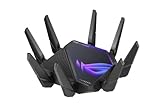

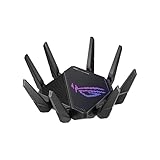

What “Quad-Band AXE16000” Actually Means
The 16000 figure is the sum of four radios’ theoretical PHY rates — not a speed any single device will ever see. The breakdown:
| Band | Config | Max PHY rate | Best use in practice |
|---|---|---|---|
| 2.4 GHz | 4×4 | 1,148 Mbps | IoT devices, smart home, long-range legacy clients |
| 5 GHz-1 | 4×4, 160 MHz | 4,804 Mbps | General clients, or dedicated AiMesh backhaul |
| 5 GHz-2 | 4×4, 160 MHz | 4,804 Mbps | Reserved “gaming band” for PC/console only |
| 6 GHz | 4×4, 160 MHz | 4,804 Mbps | WiFi 6E/7 clients: VR headsets, new laptops, phones |
Two things the spec sheet doesn’t tell you:
- The second 5 GHz radio is the hidden value. Most homes have 15–40 clients fighting over one 5 GHz band. Here you can exile everything except your gaming PC and console to 5 GHz-1, leaving 5 GHz-2 (or 6 GHz) uncontested. For competitive play, a clean band reduces jitter and latency spikes more than raw bandwidth ever will — games need under 5 Mbps; they need consistency.
- The 6 GHz band is a short-range sprinter. It uses clean, DFS-free spectrum with zero neighbor interference, but it attenuates faster through walls than 5 GHz and mandates WPA3-only security, so nothing older than WiFi 6E can even see it. Expect full speed in the same or adjacent room; don’t expect it to cover a whole floor.
Dual 10G Ports: A Worked Example
The GT-AXE16000 carries two 10GbE ports (one WAN/LAN-configurable, one LAN), a 2.5GbE WAN port, and four 1GbE ports. That layout supports two real-world setups: a multi-gig WAN up to 10 Gbps, or a 10G LAN spine between, say, a NAS and a desktop.
Does 10G matter? Take a common job — pulling a 150 GB game install or project folder from a NAS to your PC:
| Link | Realistic throughput | Time for 150 GB |
|---|---|---|
| 1 GbE | ~940 Mbps (~112 MB/s) | ~22 minutes |
| 2.5 GbE | ~2,350 Mbps (~280 MB/s) | ~9 minutes |
| 10 GbE | ~9,400 Mbps (~1.1 GB/s) | ~2.2 minutes |
If you move large files weekly, that’s a genuine time save. If your NAS tops out at 1 GbE and your internet is 500 Mbps cable, both 10G ports sit idle — the hardware is only as useful as what’s plugged into it. One practical note: each 10G port is a single connection, so fanning 10G out to multiple devices still requires a multi-gig switch.
Realistic WiFi Throughput (Not the Box Number)
PHY rates assume a 4×4 client; almost nothing is. Most phones, laptops, and the Quest 3-class headsets are 2×2 radios, which halves the ceiling:
- 2×2 WiFi 6E client on 6 GHz, 160 MHz: 2,402 Mbps link, roughly 1.3–1.8 Gbps real throughput at close range.
- Same client one or two walls away on 6 GHz: expect a steep drop — often 400–800 Mbps, sometimes falling back to 5 GHz levels.
- 2×2 WiFi 6 client on 5 GHz, 160 MHz: 2,402 Mbps link, ~900 Mbps–1.4 Gbps real.
Context for that math: uncompressed-quality wireless PCVR streaming (Virtual Desktop, Steam Link) wants a sustained ~200–500 Mbps with low jitter — a 6 GHz band in the same room delivers that with headroom, which is why the GT-AXE16000 became a default recommendation for wireless VR setups. Cloud gaming at 4K needs only ~45 Mbps; a 4K stream needs ~25 Mbps. Even a busy household’s simultaneous demand rarely exceeds 600–800 Mbps, which is why internet speed — not WiFi speed — is usually the real bottleneck.
Decision Matrix: Who Should Actually Buy It
| Your situation | Sensible choice |
|---|---|
| Internet ≤1 Gbps, no NAS, under ~25 devices | AX5400-class router (typically $100–$180). You’re bottlenecked by WAN, not WiFi. |
| 1–2.5 Gbps fiber, competitive gaming, want a dedicated band | ASUS ROG Rapture GT-AX6000 (dual-band WiFi 6, dual 2.5G ports, usually $250–$350) — or the GT-AXE16000 if you specifically want band separation. |
| Multi-gig internet above 2.5 Gbps, or a 10GbE NAS/desktop | GT-AXE16000 — the dual 10G ports are the point. |
| Large home, planning AiMesh with wireless nodes | GT-AXE16000 — the second 5 GHz band serves as dedicated backhaul without stealing client bandwidth. |
| WiFi 6E clients (Quest 3, recent laptops/phones) in the same room as the router | GT-AXE16000 — clean 6 GHz spectrum is a real, felt upgrade. |
| Tri-band appeal but no 6 GHz clients and no 10G gear | Older ROG Rapture GT-AX11000 (WiFi 6, tri-band, 2.5G port) at discounted prices, or an AX5400 and pocket the difference. |
Worth noting in 2026: ASUS’s WiFi 7 flagships (like the GT-BE98 class) now occupy the “money-no-object” tier. The GT-AXE16000’s counter is price — it’s frequently discounted well below its launch range — plus mature firmware and the fact that 6 GHz 160 MHz channels are unchanged between WiFi 6E and 7 for most 2×2 clients.
If You Buy It: Settings That Matter
- Split SSIDs per band (disable Smart Connect’s single name) so your gaming devices can’t wander onto a congested band. Put gaming PC/console on 5 GHz-2 or 6 GHz; IoT on 2.4 GHz; everything else on 5 GHz-1.
- Force 160 MHz channel width on the 5 GHz-2 and 6 GHz bands — required for the 2,402 Mbps link rate on 2×2 clients. On 5 GHz, manually select a DFS channel if your area’s non-DFS channels are crowded.
- In AiMesh, lock dedicated backhaul to 5 GHz-1 (or 6 GHz where nodes support it) so node-to-node traffic never shares airtime with clients.
- Enable Gear Accelerator / Adaptive QoS with gaming prioritized — useful on slower WAN links; on a multi-gig connection it’s mostly irrelevant since congestion won’t happen anyway.
- WPA3 is mandatory on 6 GHz, so keep older clients on the other bands rather than weakening security router-wide.
When the Cheaper Router Wins
The ASUS ROG Rapture WiFi 6E gaming router family is overbuilt by design. If your plan is ≤1 Gbps, your heaviest traffic is game downloads and streams, and you have no 10G hardware, a $120–$180 AX5400-class model delivers identical in-game latency and identical download speed. The ROG Rapture GT-AX6000 WiFi 6 gaming router is the middle ground: dual 2.5G ports and the same ROG gaming software stack, minus the radios and 10G hardware you’re paying a premium for here. Buy the GT-AXE16000 for its ports and band count — not for the badge.






