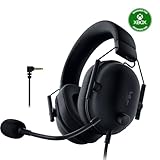
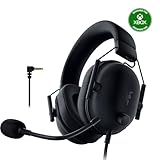
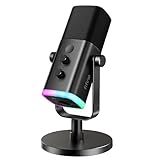
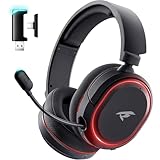
- Top Pick: Ozeino Wireless Gaming Headset for PS5, PC, Switch| Lossless Audio-40H Batt
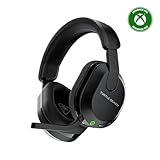
- Best Value: Turtle Beach Stealth 600 Wireless Gaming Headset for Xbox, PS5, PC, Mobile
- Premium Choice: SteelSeries Arctis Nova 5 Wireless Multi-System Gaming Headset — Neodymium Magnetic Drivers — 100+ Audio Presets — 60 HR Battery — 2.4GHz or BT — ClearCast Gen2.X Mic — PC, PS5, PS4, Switch, Mobile
For most of the last decade, the wireless-versus-wired question had an easy answer: if you cared about latency or fidelity, you plugged in. That answer no longer holds. By 2026, low-latency 2.4GHz radios, smarter codecs and multi-day batteries have pushed wireless headsets into territory that used to belong exclusively to cables — and prices have dropped far enough that a capable wireless set now costs roughly what a mid-range wired one did three years ago.
That doesn’t make wired obsolete. A cable is still the cheapest route to a good driver, it never dies mid-raid, and it remains the default at LAN events and sanctioned tournaments. The real decision in 2026 comes down to how and where you play rather than raw specs. Below we break down the trade-offs and highlight the wireless models worth shortlisting.
As an Amazon Associate we earn from qualifying purchases at no extra cost to you. Product prices and availability are accurate as of the date shown and are subject to change.




⚡ Save on Your Next PC — Amazon Prime
Prime members get fast free shipping on the systems above, plus early access to Prime Day & Black Friday PC deals. New members get a 30-day free trial.
Watch: Wireless vs Wired Gaming Headset in 2026 — Video Review
Quick Verdict
Wireless is the right default for the majority of players in 2026: if you game on a couch, switch between a PS5 and a phone, or simply hate cable drag, something like the SteelSeries Arctis Nova 5 or Turtle Beach Stealth 600 will serve you better than any cable. Wired still wins for two groups — competitive players bound by tournament rules or chasing the absolute lowest latency, and budget buyers who want the best possible drivers for the least money and don’t mind being tethered.
Key Differences
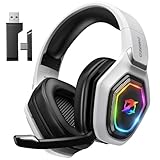
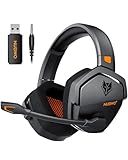
- Latency: Wired is effectively zero. Modern 2.4GHz wireless sits around 20–25ms — the NUBWO headset advertises 23ms sync — which is imperceptible for the vast majority of players, though Bluetooth-only connections still lag noticeably.
- Battery: Wired needs none. Wireless now ranges from around 40 hours on the Ozeino to 60 on the Arctis Nova 5 and 100+ on the NUBWO and similar long-life models, turning charging into a weekly rather than daily chore.
- Audio quality per dollar: At the same price, a wired headset usually has better drivers, because none of the budget goes toward a radio, battery or charging circuit.
- Compatibility: Wired 3.5mm works with almost anything that has a jack. Wireless depends on dongle support — the Turtle Beach Stealth 600 covers Xbox as well as PS5 and PC, while many rivals skip Xbox entirely.
- Freedom of movement: Wireless lets you walk away mid-match; wired anchors you to the desk and adds cable microphonics when you turn your head.
- Failure points: Cables fray at the jack, the single most common headset failure. Wireless trades that for battery degradation over several years and occasional dongle hassle.
Wireless Gaming Headsets
The wireless category has split into tiers. At the premium end, the SteelSeries Arctis Nova 5 pairs neodymium magnetic drivers with an app offering 100+ audio presets, a 60-hour battery and simultaneous 2.4GHz plus Bluetooth — useful when you want Discord on the PC and a phone call in the same ear cups. The Razer BlackShark V3 X HyperSpeed takes the esports approach instead: lightweight, focused on positional clarity, and built around Razer’s low-latency HyperSpeed link.
Mid-range and budget wireless has improved most dramatically. The Turtle Beach Stealth 600 remains the safest all-rounder thanks to genuine multi-platform support, while the Ozeino wireless headset targets PS5, PC and Switch players with lossless audio and 40 hours of runtime. Below that, options like the NUBWO 100-hour triple-mode set and the 7.1 surround 100-hour models chase endurance and virtual surround over refinement. All of them share the same core advantage: nothing tugs at your head.
Wired Gaming Headsets
Wired headsets survive because physics is on their side. A direct analogue or USB connection carries no compression, no pairing handshake and no radio interference, which is exactly why you still see cables at every major LAN — many tournament rulesets mandate them. If your priority is shaving every millisecond and never troubleshooting a dropout mid-scrim, a cable removes an entire category of problems.
The other argument is value. Strip out the battery, transmitter and charging hardware and the same budget buys larger drivers, better padding and a sturdier frame. For a desk-bound PC player who never moves more than a metre, that’s a genuinely better use of money. The trade-offs are real, though: cable snag, microphonics, and a jack that will eventually wear out — plus the awkwardness of splitter cables on some setups.
Which Should You Buy?
- For console and living-room play: pick wireless — the Turtle Beach Stealth 600 if you need Xbox support, the Ozeino if you’re on PS5, PC and Switch.
- For competitive FPS: pick wired if your league requires it; otherwise the Razer BlackShark V3 X HyperSpeed or NUBWO’s 23ms link are close enough that you won’t feel the difference.
- For all-day comfort and features: pick the SteelSeries Arctis Nova 5, whose presets and dual-connection setup do the most work outside of gaming.
- For the tightest budget: pick wired, or a long-battery wireless set like the 100-hour 7.1 surround models if freedom matters more than driver quality.
- For multi-device users: pick a triple-mode wireless headset that offers 2.4GHz, Bluetooth and a wired fallback in one package.
Frequently Asked Questions
Is wireless latency still a problem in 2026?
Not on 2.4GHz. Figures around 20–25ms are standard and sit below the threshold most players can detect. Bluetooth is a different story — use it for music and calls, not for competitive matches.
Does wired really sound better?
At the same price, usually yes, because more of the cost goes into the drivers. Above the mid-range, the gap narrows to the point where tuning and fit matter far more than the connection type.
How long do wireless headset batteries last before degrading?
Expect meaningful capacity loss after roughly two to three years of daily charging. Headsets quoting 60–100 hours, like the Arctis Nova 5 or NUBWO, keep usable runtime much longer simply because they’re charged less often.
Can I use a wireless headset while it charges?
Most modern models support it, and many also include a 3.5mm or USB-C wired mode as a backup. Check for that fallback before buying if you can’t afford downtime.
Final Verdict
In 2026, wireless has won the default position: the latency argument is largely settled, batteries have outgrown the daily charge, and multi-platform support is finally reliable. Buy wired only if tournament rules demand it or your budget is tight enough that every pound should go into the drivers — for everyone else, a well-chosen wireless headset is the better long-term purchase.