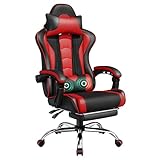
- Top Pick: X-Rocker Officially Licensed Nintendo Super Mario Gaming Chair, Pedestal Folding Chair with 2.1 Audio Built-in – Mario
- Best Value: X Rocker Pixel Printed Video Gaming Floor Chair with Headrest Speakers, Wireless Bluetooth, Foldable, Vegan Leather, 300 lbs Max, Amazon Exclusive, Black, Gifts for Gamers
- Premium Choice: X Rocker G-Force Video Gaming Floor Chair with Armrests, Built-in Audio via Wireless Bluetooth, Foldable, Vegan Leather, 300 lbs Max, Black, Gifts for Gamers
A Super Mario rocker chair is a legless, foam-padded floor seat shaped like a bean bag with a backrest, licensed by Nintendo and sold mainly in two forms: a basic folding foam rocker (no electronics) and an audio/Bluetooth version with built-in speakers in the headrest. Both sit directly on the floor with no legs or frame, and both are sized for kids roughly 3 to 9 years old, not teens or adults. Below is the breakdown of which version fits which situation, the actual dimensions and weight limits, and how the no-legs design behaves on carpet versus hardwood or tile.
As an Amazon Associate we earn from qualifying purchases at no extra cost to you.


The two versions, and what actually separates them
Every Super Mario rocker chair on the market falls into one of these two categories. The shape is nearly identical in both — molded high-density foam wrapped in a printed polyester or vinyl-blend cover — but the internals and price differ a lot.
- Folding foam rocker (no electronics): Solid foam wedge that folds flat for storage, no speakers, no battery, no ports. This is the version most often sold as a general kids’ room chair with a Mario or Luigi print.
- Audio/Bluetooth rocker: Same foam shape, but the headrest section houses two small speakers and a control panel (volume, power, pairing button) on the side seam. Runs on a rechargeable battery or AC adapter, pairs over Bluetooth to a phone, tablet, or Switch in handheld mode.
The audio version is not louder or better-built than the plain version — the speakers are small (typically 2–3 watts each), fine for one kid watching a show or playing a Switch game solo, not for filling a room. If your kid mainly wants a comfortable spot to game handheld or watch a tablet, the audio version adds real convenience. If it’s just a reading/lounging chair, the plain foam rocker does the same job for less money and has nothing to break.
Seat dimensions and weight limits
Manufacturers don’t always publish identical numbers, but licensed Mario rockers cluster tightly around the same footprint because they’re built on a shared foam mold used across several character licenses (Mario, Sonic, Marvel, etc. from the same factories). Here’s the typical spec range you’ll see across listings:
| Spec | Typical value | Why it matters |
|---|---|---|
| Overall height | 24–27 in (61–69 cm) | Backrest height when upright, unfolded |
| Seat width | 19–21 in (48–53 cm) | Determines fit for wider kids or two small kids sharing |
| Seat depth | 14–16 in (36–41 cm) | Distance from front edge to backrest base |
| Folded thickness | 4–6 in (10–15 cm) | Storage under a bed or in a closet |
| Weight capacity | 100–150 lbs (45–68 kg) | Hard limit before foam compresses permanently or seams stress |
| Chair weight (empty) | 4–7 lbs (1.8–3.2 kg) | Whether a young kid can move/fold it themselves |
| Battery life (audio version) | 4–6 hours per charge | Roughly one long play session or two shorter ones |
The weight limit calculation that matters more than the number on the box
The printed capacity (say, 120 lbs) is a static load rating — it assumes a kid sitting still. Rocking motion adds dynamic load, meaning the foam and stitching take repeated stress spikes above the sitting weight, similar to how a rocking chair’s joints wear faster than a stationary chair’s. As a practical rule, plan to retire the chair (or stop rocking hard in it) once the child’s weight reaches about 75–80% of the printed limit. For a 120 lb rated chair, that means treating 90–95 lbs as the real ceiling for active rocking, even though the chair “technically” holds more. This is why a lot of these chairs feel fine for a 6-year-old but start sagging in the seat within a year for a 9-year-old near the upper weight range.
Age and height range: when kids outgrow it
There’s no strict age printed on most packaging beyond a generic “ages 3+,” but the seat depth and backrest height put a practical ceiling on comfortable use:
- Ages 3–5: Ideal fit. Seat depth and width are proportional, feet don’t awkwardly hang off the front edge.
- Ages 6–8: Still comfortable for most kids in the 45–60 inch height range, though taller kids in this bracket will have knees higher than the seat edge since there’s no leg support — normal for a legless rocker, not a defect.
- Ages 9+ or over 60 inches tall: This is where fit breaks down. The backrest stops supporting mid-back instead of shoulders, and sitting cross-legged or with legs out front becomes the only comfortable position. Weight also starts approaching the practical ceiling described above.
If you’re buying for a kid already at the older end of that range, or buying as a “grows with them” purchase, size up expectations accordingly — this chair is a 2–4 year product for most kids, not something that lasts from toddler to tween.
How the legless design performs on carpet vs. hard floor
Since there’s no frame or legs, the entire base is a flat foam-and-fabric underside, and floor type changes the experience more than people expect before buying.
- On carpet: Grips well and doesn’t slide during rocking motion because carpet fiber creates friction against the fabric base. This is the floor type these chairs are actually designed around — most product photography and use cases assume carpet or a rug.
- On hardwood, laminate, or tile: The chair can slide several inches with each rocking motion, especially with a lighter kid who doesn’t anchor it with body weight. Some vinyl-covered versions slide more than polyester-covered ones because vinyl has a slicker underside.
Fix for hard floors: place a small rug or a rubberized shelf-liner mat (the grippy waffle-textured kind, roughly 2×3 ft) under the chair. This solves the sliding almost completely and costs very little compared to the chair itself. Without it, expect to reposition the chair every few minutes of active rocking on tile or hardwood.
Which version to buy: a quick decision guide
| Your situation | Best pick | Reasoning |
|---|---|---|
| Kid mainly reads, watches TV nearby, or just wants a cozy seat | Plain folding foam rocker | No electronics to charge or fail; usually $30–$50 |
| Kid games handheld on Switch or tablet in their room | Audio/Bluetooth rocker | Built-in speakers remove the need for separate speakers or headphones; usually $60–$100 |
| Room has hardwood/tile floors | Either version + non-slip mat | Prevents sliding regardless of chair type |
| Kid is already 9+ or tall for their age | Consider skipping, or treat as short-term | Seat depth and backrest height won’t fit long |
| Need it to survive rough/active use | Plain foam version, mid weight-range kid | Fewer failure points than electronics; foam alone tolerates rougher handling |
Care and durability notes
The polyester or vinyl cover is usually spot-clean only — full washing risks the foam absorbing water and staying damp inside, which leads to odor and mildew over weeks. For the audio version, keep the charging port area dry and avoid leaving it charging unattended overnight, standard practice for any small lithium-battery device. Folding it fully flat for storage (rather than leaving it bent at an angle) extends foam life, since foam creased at a fixed angle for months tends to develop a permanent dent line.