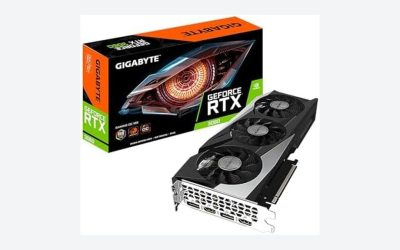
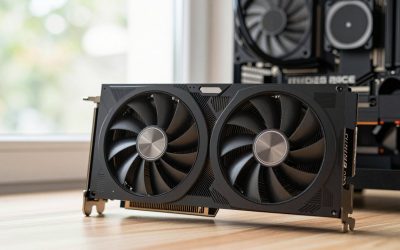
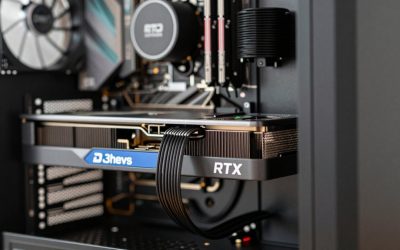
Both of these cards hover around the same price used and new-adjacent, which is exactly why people get stuck comparing them. The RTX 3080 Ti launched as a halo-adjacent 1440p/4K card in 2021, built on the older Ampere architecture with a huge, power-hungry die. The RTX 4070 came out in 2023 on the newer Ada Lovelace architecture, trading raw brute force for efficiency and better software features. On paper the 3080 Ti wins some raster benchmarks. In practice, which one you want depends on what you play, how long you plan to keep it, and whether you care about things like power draw and frame generation.
Specs at a glance
| Spec | RTX 3080 Ti | RTX 4070 |
|---|---|---|
| Architecture | Ampere | Ada Lovelace |
| VRAM | 12GB GDDR6X | 12GB GDDR6X |
| Memory bus | 384-bit | 192-bit |
| TDP | ~350W | ~200W |
| Recommended PSU | 750W+ | 650W |
| DLSS support | DLSS 2 (upscaling only) | DLSS 3 (frame generation) |
| Launch MSRP | $1,199 | $599 |
Both have 12GB of VRAM, which surprises people who assume newer always means more memory. The difference is how that memory is fed. The 3080 Ti has a much wider memory bus and more raw bandwidth, which is why it still edges ahead in some older, bandwidth-heavy raster titles at 4K. The 4070 compensates with a larger L2 cache and smarter memory management, so in most current games the real-world gap is smaller than the spec sheet suggests.
Gaming performance
At 1440p, these two trade blows depending on the game, usually within 5-10% of each other. At 4K the 3080 Ti pulls ahead more consistently in raw rasterization because of that memory bandwidth advantage. But the moment ray tracing gets involved, especially with DLSS 3’s frame generation on the 4070, that gap closes or reverses. Frame generation isn’t free of trade-offs, it can introduce input latency and visual artifacts in fast-paced games, but in single-player titles like story-driven RPGs or open-world games it’s a legitimate way to get smoother frame counters without a stronger GPU.
If you’re mostly playing competitive shooters where latency matters more than eye candy, the raw horsepower of the 3080 Ti plus a high refresh monitor is the safer bet. If you play a mix of newer AAA titles with ray tracing, the 4070’s feature set tends to age better.
Power, heat, and the hidden cost
This is where the 4070 actually wins by a wide margin and people underrate it. The 3080 Ti pulls around 350W under load, sometimes spiking higher, and needs a beefy 750W+ power supply plus a case with real airflow. The 4070 sits around 200W, runs cooler, and works fine in a lot of existing 650W builds. Over a few years of regular gaming, that difference shows up on your electricity bill, and it also means less fan noise and less heat dumped into your room in summer.
This matters more if you’re buying used. A used 3080 Ti has been running hot and loud for years in someone else’s rig, often in a mining or heavy-gaming scenario. Check the cooler for dust buildup, ask about thermal paste history, and don’t be shy about asking for GPU-Z or HWInfo logs showing temps under load. A 4070, new or used, is a gentler card on itself simply because it runs so much cooler.
Pricing reality
The 3080 Ti is no longer sold new in meaningful quantities, so your realistic path is the used market, where prices swing a lot based on condition and whether it’s a founder’s edition or a loaded third-party cooler. The 4070 is still sold new, which means warranty coverage, more predictable pricing, and the ability to pick a specific cooler design and brand. If you want the simplest, lowest-risk purchase, browse RTX 4070 graphics cards and compare models by cooler size and price. If you’re specifically hunting for a 3080 Ti because you found a good used deal, it’s still a capable card, just budget for the power supply it demands.
Don’t ignore the rest of your system while shopping. A 3080 Ti paired with an underpowered PSU is a common failure mode, people buy the card, skip the PSU check, and get random shutdowns under load. If you’re not sure your current unit can handle it, it’s worth looking at 750W 80 Plus Gold power supplies before you commit to the purchase.
Who should buy which
Buy the 3080 Ti if you found a genuinely good used price, your PSU and case can already handle 350W+ cards, and you mostly play games where raw raster performance at 4K matters more than ray tracing or frame generation. It’s a strong card for someone building a budget 4K rig, provided the deal is real.
Buy the 4070 if you want new-card peace of mind, lower power bills, quieter operation, and better long-term software support through DLSS 3. It’s also the better pick if you’re not totally sure what you’ll be playing in two years, since Nvidia’s newer feature set tends to get prioritized in upcoming titles.
Neither is a bad choice. The 3080 Ti is a brute-force relic from a less efficient era that still performs. The 4070 is a smarter, calmer card that trades a bit of raw bandwidth for features that matter more as games evolve. If your budget allows and you’re torn, lean toward whichever one fits your existing power supply and case without upgrades, since that often decides the real cost difference.
FAQ
Is the RTX 3080 Ti still worth buying in 2024?
Only if the used price is meaningfully below a new 4070 and your PSU already supports its power draw. Otherwise the price gap often isn’t worth the extra heat and risk of buying used silicon.
Does the RTX 4070 beat the 3080 Ti in every game?
No. In pure 4K rasterization without ray tracing, the 3080 Ti often leads thanks to its wider memory bus. The 4070 pulls ahead in ray-traced titles and anything that benefits from DLSS 3 frame generation.
Can I use my existing power supply with a 3080 Ti?
Check the wattage and connector count first. Nvidia recommends 750W or higher for the 3080 Ti, versus 650W for the 4070. Running it on an undersized PSU can cause crashes or shutdowns under load.
Which card is better for 1440p gaming?
They’re close enough at 1440p that the decision usually comes down to price, power draw, and whether you value DLSS 3 frame generation. Neither is overkill or underpowered for that resolution.