

- Top Pick: Retroid Pocket 5
- Runner-up: ASUS ROG Xbox Ally
- Also consider: Lenovo Legion Go S
Every emulation handheld is portable in the showroom sense. Travel asks a harder question: what does the device weigh next to your laptop, your water bottle and everything else already in the bag, and how long does it keep playing once the seatbelt sign goes off? Ranked by home specs, the most powerful handheld always wins. Ranked by the physics of carrying, the order flips.
As an Amazon Associate, we earn from qualifying purchases.
This guide ranks by grams, watt-hours and case footprint first, and by chip tier only where the library demands it. The split that matters is your game library. Cartridge-era systems through the PSP travel beautifully on the smallest hardware here. PlayStation 2 and GameCube need the middle tier. PlayStation 3, honestly, does not travel well on anything yet.
This article contains affiliate links, and we may earn a commission when you buy through them at no extra cost to you.
Quick Answer
For most travellers, the Retroid Pocket 5 is the answer: at roughly 280 g it carries cartridge-era through PSP libraries all day and disappears into a jacket pocket. If your travel library is PS2 and GameCube, step up to the ROG Xbox Ally at about 670 g. PS3 does not travel well on anything: every device that attempts it is heavy, hot and title-by-title.
Ranked by the Physics of Carrying
Weight is the spec that decides whether a handheld comes on the trip at all. Lenovo states the Legion Go 2 at roughly 920 g with its controllers attached, and MSI’s Claw line sits near 795 g; both are superb machines that many travellers quietly leave at home. The three devices below sit at 280 g, about 670 g and about 740 g respectively, and each one earns its grams with a different library ceiling. The case and the card after them are not filler: on the road, your library lives on a microSD card you can swap in seconds, and the case is the difference between a handheld in a bag and a handheld in a repair queue.
Retroid Pocket 5
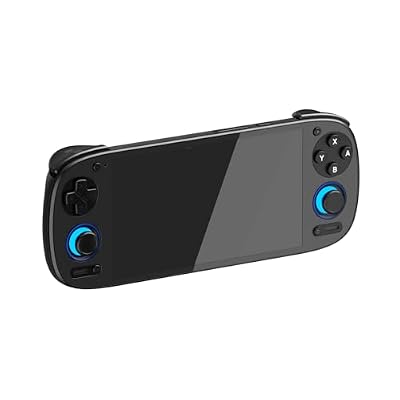
The Pocket 5 is the only device here that is pocketable in the literal sense. Retroid states the weight at around 280 g, less than half the lightest Windows handheld in this guide, and the 5.5-inch AMOLED panel makes 240-line and 272-line libraries look dense and sharp at native integer scales. The Snapdragon 865 is an old phone chip by flagship standards, but for travel libraries it is the right size of fast: cartridge-era systems, PS1 and PSP are its home turf, and PSP’s 480×272 output sits at a clean 2x on the 1080p screen. GameCube and PS2 are a per-game stretch tier here, not the reason to buy it. Android means instant sleep and resume, no desktop waiting at the gate, and a microSD slot carries the whole library.
Specs:
– Chip: Qualcomm Snapdragon 865
– Memory and storage: 8GB RAM, 128GB internal storage
– Display: 5.5-inch AMOLED, 1920×1080
– Battery: 5000mAh (watt-hours not stated)
– Weight: about 280 g, as stated by Retroid
– Operating system: Android 13
– Expansion: microSD card slot
View the Retroid Pocket 5 on Amazon
ASUS ROG Xbox Ally

The base Xbox Ally is the lightest Windows handheld in this guide, with ASUS stating about 670 g, and it is the smallest machine here that treats PS2 and GameCube as a core library rather than a stretch goal. The Ryzen Z2 A is an efficiency chip, four Zen 2 cores, so the honest framing matches the program record: native resolution is the baseline for the heavier PS2 and GameCube titles and 2x is per game, while everything from the cartridge era through PSP and Dreamcast runs with headroom. The 60Wh battery is the largest in this guide relative to the weight you carry, and the 7-inch 1080p 120Hz panel with FreeSync Premium keeps motion smooth when a title’s frame pacing wobbles. It runs full Windows 11 under the Xbox full screen experience, which matters on the road because every standalone emulator is native here.
Specs:
– Chip: AMD Ryzen Z2 A (Zen 2, 4 cores / 8 threads, RDNA 2 graphics)
– Memory and storage: 16GB RAM, 512GB SSD (M.2 2280)
– Display: 7-inch IPS, 1920×1080, 120Hz, FreeSync Premium
– Battery: 60Wh
– Weight: about 670 g, as stated by ASUS
– Operating system: Windows 11 with Xbox full screen experience
– Expansion: UHS-II microSD card slot
View the ROG Xbox Ally on Amazon
Lenovo Legion Go S

The Go S is the big-screen travel compromise. Lenovo’s PSREF lists it at about 740 g, only slightly heavier than the Xbox Ally, but the 8-inch 1920×1200 panel is a class larger and it is the screen that makes text-heavy RPGs and stacked DS layouts genuinely comfortable on a train table. The panel also runs a 48 to 120Hz variable refresh range, which forgives the frame pacing of harder titles. The Ryzen Z2 Go is a Zen 3 efficiency chip, so the library verdict matches the Ally’s: superb through PSP, PS2 and GameCube at native resolution as the baseline with 2x per game, and PS3 only as light, per-title experiments. Its 55.5Wh battery is a little smaller than the Ally’s despite the extra weight, which is the one place the physics argue against it. Note that this listing is the Windows model with the Z2 Go; a SteamOS edition and a Z1 Extreme configuration exist as separate machines.
Specs:
– Chip: AMD Ryzen Z2 Go (Zen 3, 4 cores / 8 threads)
– Memory and storage: 16GB LPDDR5x RAM, 512GB SSD (M.2 2242)
– Display: 8-inch IPS, 1920×1200, 48-120Hz variable refresh
– Battery: 55.5Wh
– Weight: about 740 g, as listed by Lenovo
– Operating system: Windows 11 (this configuration)
– Expansion: microSD card slot
View the Legion Go S on Amazon
tomtoc Arccos G47 Carrying Case
A travel handheld without a hard case is a screen waiting for a bag zip to find it. The Arccos G47 is a slim hard-shell case built around the 7-inch handheld class, sized to disappear into a carry-on or a daypack rather than demanding its own compartment the way the bulky factory cases do. It suits the Xbox Ally’s size class best; Go S owners should check tomtoc’s current fit list before ordering, because the 8-inch panel makes that machine a tighter squeeze. Buy the case for the device you actually carry, and treat it as part of the device’s travel weight, because it is.
Specs:
– Type: hard-shell carrying case
– Fit: sized for 7-inch-class handheld PCs; confirm your model on the maker’s fit list
– Shell material: not stated
– Weight: not stated
View the tomtoc Arccos G47 on Amazon
SanDisk 1TB Extreme microSDXC

On the road, the microSD card is the library. A 1TB card holds a travel-sized collection of your own dumped games for every system in this guide, swaps between the Pocket 5, the Ally and the Go S in seconds, and means you never open a handheld to change a drive mid-trip. All three devices read microSD, and a card is also the cheapest backup you own: dump your cartridges and discs at home, copy the library to the card, and leave the originals on the shelf where they belong.
Specs:
– Capacity: 1TB
– Format: microSDXC, UHS-I
– Model: SDSQXAV-1T00-GN6MA
– Read speed: not stated
View the SanDisk 1TB Extreme microSDXC on Amazon
How to Choose
Start with the library, not the chip. If your travel games are cartridge-era, PS1 and PSP, the Pocket 5 is the rational end of the search: lightest, smallest, longest-legged on light loads, and nothing about the bigger machines improves those libraries. If PS2 and GameCube are the point of the trip, choose between the two Windows handhelds on screen and battery: the Xbox Ally is lighter with the bigger battery, the Go S answers with the larger, higher-resolution variable-refresh panel.
Then check the charging story. All three devices charge over USB-C, so one good power bank and one cable serve the whole bag; published airline guidance is consistent that spare batteries and power banks travel in the cabin, never in checked luggage, so keep the bank in the same bag as the handheld. Finally, plan for offline play. Emulators run your own dumped games locally and need no account check at altitude, but sync your saves and finish any setup downloads before you leave, because travel Wi-Fi is where good libraries go to wait.
Who Should Skip
Skip this whole category if your library is PS3-first. RPCS3’s own recommended tier is a desktop-class six-core machine, and on handhelds its library is a per-title patchwork; the devices that attempt it best are the 795 to 920 g flagships this guide deliberately left out, and even they drain fast at the wattages PS3 emulation wants. Skip the Pocket 5 if GameCube and PS2 are your main libraries rather than a bonus. Skip the Windows pair if you know you will resent carrying three-quarters of a kilo before you have added the case, the bank and the cable. And skip every pick here if you want Switch emulation on the road: that library belongs on its own hardware.
FAQ
Can I charge these handhelds from a power bank on a flight?
Yes. All three charge over USB-C, and a power bank that can sustain a handheld’s charging rate will top any of them up in the cabin. Keep the bank in your carry-on: published airline guidance puts spare batteries and power banks in the cabin only, never in checked bags. Check your bank’s model number before you fly, too; a few popular models from major brands have been recalled in recent years, and a recalled bank should stay home entirely.
Will my games work offline, with no account sign-in?
Yes, that is the natural state of emulation. Your dumped games sit on the device or the microSD card and the emulators run locally, with no server to check in with. Do your setup, updates and save syncing at home, then put the device in airplane mode and play.
Is the Legion Go S too heavy for handheld play on a long flight?
At about 740 g it is a two-handed device, and on a tray table or propped against a bag it is comfortable for hours. Held up in the air for a full film’s length, you will feel it; that is exactly the trade the 280 g Pocket 5 exists to solve for lighter libraries.
Why is there no flagship like the Legion Go 2 here?
Because this guide ranks by carrying, and the flagships lose that ranking honestly: roughly 920 g before the case, for chip headroom that only PS3-class libraries really use, and those libraries remain per-title on any handheld. If your bag has the room and your library needs it, they are excellent machines; they are just not travel picks.
Final Verdict
For travel, buy the smallest machine that covers your library. The Retroid Pocket 5 is the default recommendation: 280 g, a beautiful screen, and every library up to the PSP handled with ease. The ROG Xbox Ally is the step up when PS2 and GameCube come along, and the Legion Go S is the same step taken for the screen instead of the scale. Add the case and the card, charge from one bank in the cabin, and the whole setup weighs less than the flagship handhelds do on their own.







