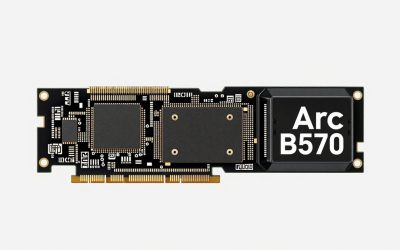
Choosing between Intel’s Arc B570 and Arc B580 is not the kind of decision that used to exist in the sub-$250 GPU market. For years, that bracket meant picking between two or three near-identical options from the same vendor and praying the pricing stayed stable through the sale cycle. Battlemage changed that equation by giving Intel a genuine second entry point with meaningfully different capabilities between two cards that sit only $30 apart on paper.
In 2026, the practical question is whether those $30 and the 12% gap in silicon translate into a frame-rate difference large enough to justify the jump. The answer depends heavily on your monitor, the games you play, and how much headroom you need for the next two years. The B580’s extra VRAM and wider memory bus are not just marketing advantages—they determine whether a card remains comfortable at 1440p or falls behind quickly as texture budgets grow.
As an Amazon Associate we earn from qualifying purchases at no extra cost to you.


Quick Verdict
Buy the Arc B580 if you run a 1440p monitor, do any content creation, or want the most headroom from a budget GPU. The 2GB VRAM advantage and 192-bit bus make it a noticeably longer-lived card in heavier titles. Buy the Arc B570 if you are locked to 1080p, prioritize low power draw and quiet operation in a compact case, or need the absolute cheapest entry into Intel’s ecosystem for AV1 encoding or multi-GPU workstation tasks. The performance gap is real but manageable at 1080p.
Specs Side by Side
| Specification | Intel Arc B570 | Intel Arc B580 |
|---|---|---|
| Architecture | Xe2-LPG (Battlemage) | Xe2-LPG (Battlemage) |
| GPU Die | BMG-G21 | BMG-G21 |
| Xe Cores | 18 | 20 |
| Vector Engines | 144 | 160 |
| Ray Tracing Units | 18 | 20 |
| Matrix Engines (XMX) | 18 | 20 |
| Boost Clock | ~2550 MHz (board partner dependent) | ~2670 MHz (board partner dependent) |
| Memory | 10 GB GDDR6 | 12 GB GDDR6 |
| Memory Bus | 160-bit | 192-bit |
| Memory Bandwidth | ~280 GB/s | ~320 GB/s |
| TDP | 150W | 190W |
| MSRP | $219 | $249 |
Gaming Performance
1080p
At 1080p, the gap between these two cards narrows to its smallest because neither is consistently memory-bandwidth limited in most titles. Across launch review suites, the B580 averaged roughly 8-14% faster than the B570 depending on the outlet. TechPowerUp reported a cumulative average near 12%, while Tom’s Hardware found similar results slightly under that figure in their 14-game test set. In practice, this translates to about 5-10 FPS at 1080p high settings in AAA titles. Competitive shooters at medium-to-low settings will show the smallest difference—often single-digit percentages—because the CPU and engine overhead dominate.
1440p
This is where the architecture gap becomes tangible. Hardware Unboxed’s 1440p suite placed the B580 ahead by approximately 15-22% depending on the game and texture settings. Gamers Nexus noted that titles like Hogwarts Legacy and Alan Wake 2 saw wider margins because the B570’s 10GB buffer and 160-bit bus began constraining performance once texture loads exceeded comfortable headroom. If you are running a 1440p panel at 100+ Hz, the B580 is not just marginally better—it is the card that keeps the experience smooth rather than borderline.
4K
Neither card is a true 4K solution, and both will struggle with max settings at 2160p without upscaling. That said, TechSpot’s 4K testing showed the B580 pulling ahead by 20-30% in the titles that did produce playable results, largely because the wider bus and additional VRAM prevent the stutters and texture pop-in that plague the B570 at that resolution. The B570 at 4K is best described as “occasional” territory—fine for lighter titles, inadequate for current AAA without XeSS set to Performance or Ultra Quality.
Power, Heat and Noise
The B570’s 150W TDP versus the B580’s 190W is a meaningful difference in small form factor builds. Gamers Nexus found that reference-style B570 boards ran noticeably cooler and quieter under sustained load, with stock coolers holding GPU temperatures in the low 70s Celsius versus mid-to-high 70s on comparable B580 designs. Board partner cards with triple-fan arrangements reduce the thermal gap substantially, but the B570’s lower power target means it throttles less aggressively in confined spaces. If you are building into an ITX chassis or a compact office tower with a 300-400W PSU, the B570 is the easier card to manage thermally and electrically.
Under full gaming load, the B570 draws approximately 120-135W in practice, while the B580 sits around 155-175W depending on the board and title. This is a meaningful difference for your total system power draw and PSU headroom calculation.
Features
Both cards share the same software and platform feature set, which is a major strength for Intel’s current generation. XeSS upscaling works identically on both, including AI-based sharpening and the newer XeSS Frame Generation mode that inserts synthetic frames between rendered ones. AV1 hardware encoding and decoding are present on both GPUs, making either a viable choice for streamers or video editors who need fast exports without a separate capture card.
DirectX 12 Ultimate support, hardware ray tracing, and the Xe Media Engine (dedicated video encode/decode silicon) are identical across both models. Platform-wise, both require PCIe 4.0 x8 lanes and will drop to x4 behavior on PCIe 3.0 boards, so pairing them with a recent platform (Intel 600/700 series, AMD 500/600 series) is advisable. Neither card has an NVENC equivalent for streamer workflows, but the AV1 encoder quality is competitive with AMD’s and approaches NVIDIA’s HEVC output.
Price and Value
At launch MSRP, the B580 costs roughly 14% more than the B570 ($249 vs $219), while delivering 12-18% more average frame rate depending on resolution. This makes the cost-per-frame math nearly even at 1080p, but it tilts decisively toward the B580 at 1440p where the performance advantage widens. Street pricing in late 2026 has narrowed the real-world gap further as board partner discounts bring both cards into the $200-230 range.
On the used market, both cards are still relatively abundant given their recent release, so depreciation has not been severe. A lightly used B580 at $170-190 represents the best value proposition in Intel’s lineup at the time of writing. The B570 rarely drops below $150 used, which erodes its cost advantage over the B580 to near zero.
Who Should Buy Which
Competitive 1080p Gamers
The B570 is fine here. Most esports titles cap frame rates far above what either card can sustain at max settings, and the 8-10% difference between these two GPUs is invisible when you are already pushing 250-400 FPS. Save the $30 for a better monitor or mouse.
1440p High-Refresh Gamers
The B580 is the clear choice. At 1440p, the extra bandwidth and VRAM headroom keep frame times consistent and prevent the sudden dips that the B570 experiences when texture budgets exceed 8-9GB. If you are running a 1440p 144-165Hz panel, the B580’s performance band is closer to what your refresh rate demands.
4K Gamers
Neither card is ideal, but if you must choose between the two and game at 4K with upscaling, the B580 is meaningfully better. Its wider bus and larger buffer reduce the stutter that plagues the B570 at 2160p.
Creators and Streamers
Both cards share identical encoding hardware, so the choice depends on your workload. If you also game at 1440p or handle complex timeline edits that benefit from GPU-accelerated effects, the B580’s extra VRAM is useful. If your primary use is AV1 streaming and light editing with a 1080p display, the B570 is sufficient and runs cooler during extended encode sessions.
Upgraders from Two Generations Back
If you are replacing a GTX 1660 Super, RX 5600 XT, or RTX 3060 12GB, either card is a significant upgrade in raw compute, but the B580’s 12GB buffer matches or exceeds what those older cards provided while adding modern features like frame generation and AV1 encode. The B570’s 10GB may feel like a step back from a 12GB card in texture-heavy scenarios. Upgrade to the B580 if you are coming from a 12GB card.
FAQ
Is the Arc B570 worth it over the B580 if I only game at 1080p?
Only if you find the B570 at a steep discount below MSRP, ideally $30 or more cheaper. At equal or near-equal pricing, the B580 is the better buy in every scenario because the extra $30 is not recouped by any meaningful cost-saving at 1080p. The B570 makes sense when budget is absolute and the B580 is unavailable.
Do I need a specific CPU or motherboard for these cards?
Any PCIe 4.0 platform works. ReBAR (Resizable BAR) support in BIOS is recommended for both cards to access their full frame buffer. Intel’s Smart Access Memory or AMD’s equivalent must be enabled in firmware. PCIe 3.0 boards will work but lose some bandwidth, and the B580 is more sensitive to this constraint due to its wider bus.
How do Intel’s drivers compare between these two cards?
They are identical. Battlemage drivers treat both GPUs the same way, and any driver fix or optimization benefits both simultaneously. There is no model-specific bug that affects one and not the other at the software level.
Will the B570 handle 1440p with XeSS enabled?
Yes, but it becomes a borderline experience in the heaviest titles. With XeSS Quality or Balanced upscaling, the B570 delivers playable frame rates in most 1440p games today, but you will notice texture quality drops or pop-in in titles that exceed 9-10GB of VRAM usage. The B580 handles the same upscaling profiles with noticeably more headroom.
Sources and Methodology
Performance ranges in this article reflect cumulative averages and individual title data reported in launch and follow-up reviews from TechPowerUp, Tom’s Hardware, Hardware Unboxed, Gamers Nexus, and TechSpot. All figures are approximations based on those outlets’ published results and are presented as ranges rather than single-point values to account for variation between board partner designs, driver versions, and test-bed configurations. Power and thermal observations reference Gamers Nexus’ thermal chamber data and Tom’s Hardware’ power consumption measurements. This article does not present any figures measured independently by this site.