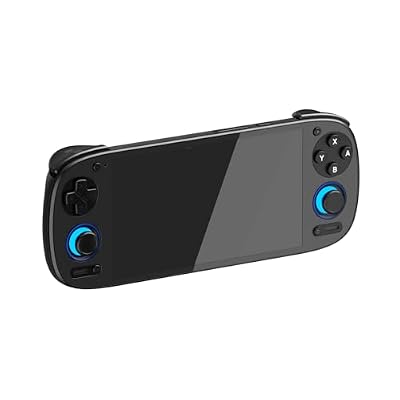
- Top Pick: Specs
- Runner-up: Specs
- Also consider: GL.iNet Slate AX Travel Router
Cloud gaming travels well in theory and badly in practice. The stream itself only needs a modest connection: GeForce Now publishes 15 Mbps for 720p and 25 Mbps for 1080p, Xbox Cloud Gaming publishes 10 Mbps for 720p and 20 Mbps for 1080p, and both work best when latency stays under 80 ms. The problem on the road is rarely the speed of the hotel connection. It is the shared network, the sign-in page each device must clear separately, and the other guests competing for the same access point.
A travel router fixes the structure of that problem rather than the speed of it. It connects to the hotel network once, then builds a small private network that only your devices join, repeating weak Wi-Fi, taking a wired desk feed, or sharing a phone tether.
As an Amazon Associate, we earn from qualifying purchases.
Quick Answer
Buy the Beryl AX if you want the strongest all-round travel router for cloud gaming, with Wi-Fi 6 and a fast wired port. Pick the Slate AX when you need two wired ports and the fastest encrypted throughput. Choose the Opal for a solid budget dual-band option, the Mango for the lightest possible bag, or the TP-Link AC750 for the simplest no-frills setup.
1. GL.iNet Beryl AX
The Beryl AX is the strongest all-round travel router for cloud gaming, and the one most travelers should buy first. Its Wi-Fi 6 radio is rated at a combined 3000 Mbps, with 574 Mbps on the 2.4 GHz band and 2402 Mbps on the 5 GHz band. It also carries a 2.5 gigabit WAN port, so a wired hotel Ethernet feed arrives at full speed, plus a gigabit LAN port. It repeats hotel Wi-Fi into a private network, takes a wired feed, and shares a phone tether over USB, and it runs OpenWrt with OpenVPN and WireGuard rated by the manufacturer at up to 150 Mbps and up to 300 Mbps. At 196 grams with USB-C power, it runs from a power bank.
Specs
| Spec | Detail |
|---|---|
| Wi-Fi | Wi-Fi 6, 574 Mbps at 2.4 GHz plus 2402 Mbps at 5 GHz |
| Wired ports | One 2.5 gigabit WAN and one gigabit LAN |
| Encrypted throughput | Up to 300 Mbps WireGuard, up to 150 Mbps OpenVPN |
| Weight | 196 grams |



2. GL.iNet Slate AX
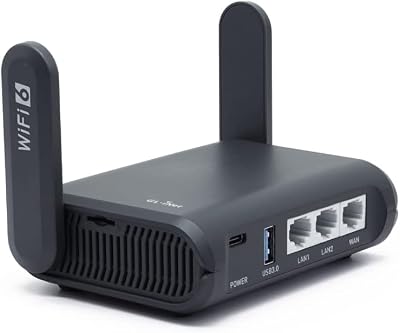
The Slate AX is the pick for travelers who want wired connections for more than one device. It is the only router here with two gigabit LAN ports alongside its gigabit WAN port, so you can plug the hotel Ethernet feed into the WAN port and wire a laptop at the same time. A wired connection removes the interference and contention that shared hotel Wi-Fi adds, and latency under 80 ms is far easier to hold on a cable. Its Wi-Fi 6 radio is rated at a combined 1800 Mbps, with 600 Mbps on 2.4 GHz and 1200 Mbps on 5 GHz, and it posts the fastest encrypted throughput in this group, rated by the manufacturer at up to 550 Mbps for WireGuard and up to 560 Mbps for OpenVPN with DCO support. At 245 grams it is the heaviest router here and needs a 5 volt, 4 amp USB-C supply.
Specs
| Spec | Detail |
|---|---|
| Wi-Fi | Wi-Fi 6, 600 Mbps at 2.4 GHz plus 1200 Mbps at 5 GHz |
| Wired ports | One gigabit WAN and two gigabit LAN |
| Encrypted throughput | Up to 550 Mbps WireGuard, up to 560 Mbps OpenVPN |
| Storage slot | MicroSD slot, cards up to 512 GB |
| Power | USB-C, 5 volts and 4 amps |
| Weight | 245 grams |
3. GL.iNet Opal
The Opal is the budget pick that still covers the full travel-router job. It is a dual-band Wi-Fi 5 router rated at a combined 1200 Mbps, with 300 Mbps on 2.4 GHz and 867 Mbps on 5 GHz, which comfortably carries a 1080p cloud stream. It also carries three gigabit Ethernet ports, one WAN and two LAN. It runs the same OpenWrt firmware as its larger siblings, with OpenVPN and WireGuard support and a captive-portal workflow that signs in once for every device behind it. Encrypted throughput is the honest limit, rated by the manufacturer at up to 65 Mbps for WireGuard and up to 12 Mbps for OpenVPN: enough for a single 1080p stream, but not for several devices running encrypted at once. At 145 grams it runs from USB-C power.
Specs
| Spec | Detail |
|---|---|
| Wi-Fi | Wi-Fi 5, 300 Mbps at 2.4 GHz plus 867 Mbps at 5 GHz |
| Wired ports | One gigabit WAN and two gigabit LAN |
| Encrypted throughput | Up to 65 Mbps WireGuard, up to 12 Mbps OpenVPN |
| Weight | 145 grams |
4. GL.iNet Mango
The Mango is the smallest and lightest router in this group, and it exists for travelers who count every gram. At 40 grams and roughly the size of a matchbox, it still builds the same private network behind hotel Wi-Fi as the larger routers, with support for OpenVPN and WireGuard. For a single player on a single device, that is the whole job. The limits are real and should decide the purchase: its Wi-Fi is single-band 2.4 GHz at up to 300 Mbps, so it cannot use the cleaner 5 GHz band, and its two Ethernet ports run at 100 Mbps rather than gigabit speed. The manufacturer does not state encrypted throughput figures for this model, so treat it as a one-stream router.
Specs
| Spec | Detail |
|---|---|
| Wi-Fi | Wi-Fi 4, single-band 2.4 GHz up to 300 Mbps |
| Wired ports | One 100 Mbps WAN and one 100 Mbps LAN |
| Encrypted throughput | Not stated |
| Power | Micro USB |
| Weight | 40 grams |
5. TP-Link AC750 Travel Router
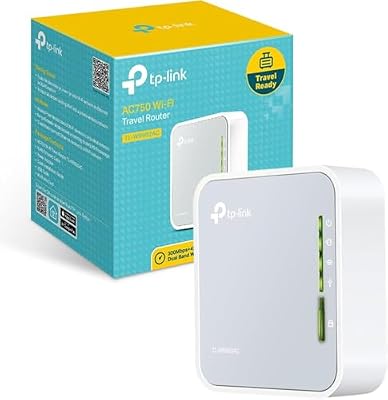
The TP-Link AC750 is the simplest router in this group, and that simplicity is the point. It is a pocket-sized nano router that works in router, hotspot, bridge, range extender, access point, and client modes, so it adapts to whatever the hotel offers. Its dual-band Wi-Fi 5 radio is rated at a combined 733 Mbps, with 300 Mbps on 2.4 GHz and 433 Mbps on 5 GHz, which is ample for a 1080p cloud stream. There are two honest trade-offs: its single Ethernet port runs at 100 Mbps, so a wired connection tops out there, and the manufacturer lists no built-in support for an encrypted tunnel, so it cannot add router-level encryption the way the GL.iNet models can.
Specs
| Spec | Detail |
|---|---|
| Wi-Fi | Wi-Fi 5, 300 Mbps at 2.4 GHz plus 433 Mbps at 5 GHz |
| Wired port | One shared 100 Mbps WAN and LAN port |
| Modes | Router, hotspot, bridge, extender, access point, client |
| Encrypted tunnel support | None built in |
| Power | Micro USB, 5 volts and 2 amps |
| Weight | 56.7 grams |
How to Choose
Start with the connection you will actually use most. If your hotels usually have a wired Ethernet port on the desk, pick a router with gigabit ports and use the cable, since a wired link holds latency steadier than shared Wi-Fi. The Beryl AX is the best wired choice for one device thanks to its 2.5 gigabit WAN port, and the Slate AX is the best wired choice for two devices thanks to its two LAN ports. If you mostly play in lobbies, airports, and cafes, any dual-band router here will do.
Next, match encrypted throughput to your habits. If you run an encrypted tunnel on the router, the Slate AX and Beryl AX leave the most headroom, the Opal covers a single stream, and the Mango and TP-Link AC750 are not the right picks for heavy encrypted use. Then think about size and power: the Mango and TP-Link AC750 run from almost any USB port, while the Slate AX needs a stronger USB-C supply. Finally, count your devices. One player on one handheld needs far less than a traveler who plays while a partner streams video on the same network.
Who Should Skip
Skip a travel router entirely if you only play at home on a network you control. A home router with a strong password and up-to-date firmware already does this job, and a travel router adds nothing to a connection that is already private. Skip it too if your trips are short and you can wait for a trusted network.
Competitive players should skip cloud gaming on hotel Wi-Fi regardless of the router, because no travel router can fix a congested shared network or a hotel connection that is slow to begin with. Skip the Mango and the TP-Link AC750 if you need gigabit wired speeds or router-level encryption, and skip the Slate AX if your power bank cannot deliver the 4 amp USB-C supply it needs.
FAQ
Can I play cloud games at 1080p on hotel Wi-Fi with a travel router?
Yes, when the hotel connection itself is fast and stable enough. GeForce Now publishes 25 Mbps for 1080p and Xbox Cloud Gaming publishes 20 Mbps, so the stream needs far less than the routers here can carry. The travel router gives your devices a private network and, where a wired port exists, a cable connection. It cannot create bandwidth the hotel does not provide.
Is a wired connection better than Wi-Fi for cloud gaming on the road?
Usually yes. A cable removes interference from other guests and nearby networks, and it holds latency steadier during busy hours. If the hotel room has an Ethernet port, use it with a router that has gigabit ports, such as the Beryl AX or the Slate AX. If there is no wired port, connect on the 5 GHz band.
Do I need a travel router, or is a phone hotspot enough?
A phone hotspot is enough for one device on a short session. A travel router earns its place when you have several devices, when the hotel charges per device, or when you want one sign-in to cover everything behind a private network.
Which travel router is best for playing with a partner on the same network?
The Slate AX is the best choice for two players, thanks to its two gigabit LAN ports and the fastest encrypted throughput in this group. The Beryl AX is the next best option, with a faster wireless radio and a 2.5 gigabit WAN port. The Opal can handle two light users.
Final Verdict
A travel router does not make a slow hotel connection fast, but it makes a usable one private, stable, and shared across your devices. For most travelers, the Beryl AX is the right buy: Wi-Fi 6, a 2.5 gigabit wired port, and strong encrypted throughput in a pocket-sized box. The Slate AX is the better pick when two wired devices matter, the Opal is the sensible budget choice, the Mango is the lightest option for a single stream, and the TP-Link AC750 is the simplest router for travelers who want a private network and nothing else.