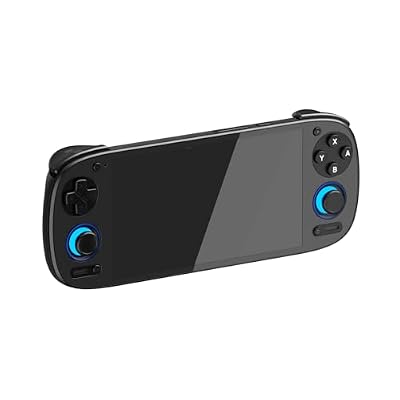
- Top Pick: Retroid Pocket Flip 2: The Clamshell Racer
- Runner-up: Retroid Pocket 5 (Black)
- Also consider: Anbernic RG556 (Blue)
Racing games ask more of a handheld than almost any other retro genre, and they ask for it in a specific place: your index fingers. A platformer forgives a digital shoulder button. A racing game does not, because the throttle and brake live on those triggers, and the difference between a digital on-off switch and an analog trigger with real travel is the difference between feathering the gas out of a wet corner and spinning into the wall. Add in the fact that the classic racing library spans everything from 2D sprite scalers to demanding 3D titles on the Nintendo 64, Dreamcast, and GameCube, and the right handheld becomes a question of triggers, frame pacing, and honest 3D power rather than screen size alone.
As an Amazon Associate, we earn from qualifying purchases.
Quick Answer
For most players, the Retroid Pocket 5 is the racing pick: its analog Hall effect triggers give real throttle and brake control, and the Snapdragon 865 holds a steady frame rate through the PS1, N64, and Dreamcast libraries. The Anbernic RG406H is the 4:3 alternative for the PS1 and N64 era, while the TrimUI Smart Pro covers the 2D and PSP-leaning end on a budget.
Why Racing Punishes the Wrong Handheld
Three things decide whether a retro racer feels right on a handheld. The first is trigger hardware. Analog triggers register how far you press, not just whether you pressed, and that travel is what lets you hold partial throttle through a long sweeper in Gran Turismo or balance the brake in Ridge Racer. Handhelds with digital shoulder buttons can still play these games, but every input becomes a pulse of full gas or full brake, which changes how the cars behave.
The second is frame pacing. Arcade and console racers were built around locked frame rates, and a chipset that almost holds the target speed is worse than one that holds it comfortably, because every dropped frame lands mid-corner as a stutter. This is why the 3D racing eras separate handhelds so sharply. The PS1 library is light work for nearly everything here. The N64 and Dreamcast catalogs, with titles like F-Zero X, Wave Race 64, and Metropolis Street Racer, need a genuinely stronger chip, and GameCube racing pushes further still.
The third is screen shape and refresh. A 4:3 panel matches the PS1 and N64 era exactly, with no wasted space. A 16:9 screen suits PSP racers and the Dreamcast’s widescreen modes. Either way, a clean 60 Hz panel with low processing lag matters more than raw resolution, because steering inputs are constant small corrections that expose display delay quickly.
The Picks
Retroid Pocket 5: Analog Triggers, Flagship Pace
The Pocket 5 is the most complete racing handheld in this roundup. Its Hall effect analog triggers have the travel and resolution that throttle control demands, the sticks are Hall effect as well, and the Snapdragon 865 has enough headroom to hold frame rates steady across the PS1, N64, and Dreamcast libraries, with a good share of GameCube racing on top. The 5.5-inch AMOLED screen renders the 16:9 PSP library and Dreamcast widescreen modes beautifully, and active cooling keeps the chip at full speed during long sessions.
Specs
- Display: 5.5-inch AMOLED, 1920 by 1080
- Chipset: Qualcomm Snapdragon 865
- Memory: 8 GB RAM, 128 GB storage
- Battery: 5,000 mAh
- Extras: Hall effect sticks and analog triggers, active cooling, Android 13
Retroid Pocket Flip 2: The Clamshell Racer

The Flip 2 runs the same Snapdragon 865 and the same analog trigger hardware as the Pocket 5, then folds it into a clamshell that protects the 5.5-inch AMOLED screen in a bag. For racing specifically, the Flip 2’s slightly chunkier grip gives your index fingers a stable perch on the triggers during long races, and the performance story is identical: confident PS1, N64, and Dreamcast emulation with real throttle modulation. Pick it over the Pocket 5 if the device travels with you daily and you want the screen protected without a separate case.
Specs
- Display: 5.5-inch AMOLED, 1920 by 1080
- Chipset: Qualcomm Snapdragon 865
- Memory: 8 GB RAM, 128 GB storage
- Battery: 5,000 mAh
- Extras: Hall effect sticks and analog triggers, clamshell shell, Android 13
Anbernic RG556: OLED Screen, Analog Control
The RG556 pairs a 5.48-inch OLED display with analog triggers and the Unisoc T820 chipset, a combination that covers the racing library from the 16-bit era through Dreamcast and PSP with room to spare. The OLED panel’s contrast flatters night races and neon-soaked arcade titles, and the T820 holds the N64 and Dreamcast catalogs at full speed in the vast majority of games. It sits a step below the Snapdragon 865 machines for the heaviest GameCube racers, but for the PS1, N64, Dreamcast, and PSP eras that define retro racing, it is a complete package.
Specs
- Display: 5.48-inch OLED, 1920 by 1080
- Chipset: Unisoc T820
- Memory: 8 GB RAM, 128 GB storage
- Battery: 5,500 mAh
- Extras: Analog triggers, Hall effect sticks, Android 13
Anbernic RG406H: The 4:3 Era Specialist
The RG406H is the pick when your racing library lives in the PS1 and N64 years. Its 4-inch IPS screen runs at 960 by 720 in a true 4:3 shape, so Gran Turismo, Ridge Racer, Mario Kart 64, and F-Zero X fill the panel exactly as designed, with no side bars and no stretching. Crucially for a compact device, it keeps analog triggers and Hall effect sticks, and the same Unisoc T820 as the RG556 drives the era at full speed. The smaller screen asks you to sit a little closer, but for the 32-bit and 64-bit racing generations it is the most faithful shape and control set in a pocketable body.
Specs
- Display: 4-inch IPS, 960 by 720, 4:3
- Chipset: Unisoc T820
- Memory: 8 GB RAM, 128 GB storage
- Battery: 5,000 mAh
- Extras: Analog triggers, Hall effect sticks, Android 13
TrimUI Smart Pro: The Budget Line
The Smart Pro is the honest budget entry, and its limits define its racing niche. The Allwinner A133 Plus and Linux system handle the entire 2D racing canon, from Out Run and Road Rash through the SNES and GBA Mario Kart titles, plus a large share of PS1 and PSP racing at native speed. What it does not have is analog triggers: the shoulder buttons are digital, so throttle control in sim-leaning games becomes a tapping exercise. For arcade racers and kart games that were designed around digital inputs anyway, that hardly matters, and the 4.96-inch 720p screen and simple Linux front end make it an easy device to live with.
Specs
- Display: 4.96-inch IPS, 1280 by 720
- Chipset: Allwinner A133 Plus
- Memory: 1 GB RAM, 128 GB card storage
- Battery: 5,000 mAh
- Extras: Linux system, Wi-Fi, digital shoulder buttons
How to Choose
Start with your library’s newest era. If your racing shelf ends with the SNES and GBA, the Smart Pro is enough and the simplest to run. If the PS1 and N64 define your collection, the RG406H’s 4:3 screen and analog triggers match that era best. If Dreamcast, PSP, or GameCube racing matters, move to the T820 in the RG556 or the Snapdragon 865 machines, which hold those frame rates without strain.
Then check the triggers, because this is the spec that cannot be fixed later. Analog triggers are close to mandatory for simulation-style games with partial throttle and brake zones, and merely nice for arcade racers built on digital inputs. Every pick above the budget line here has them; the Smart Pro does not, and that single fact should drive the decision more than screen size.
Finally, match the screen to the era. A 4:3 panel serves the PS1 and N64 years perfectly. A 16:9 panel serves PSP and Dreamcast widescreen modes and looks better for the GameCube era. Resolution beyond the source material adds little; steady frame pacing adds everything.
Who Should Skip These
Skip this entire category if your racing is mostly modern. None of these devices replaces a current console or PC for contemporary simulation titles, and players who want licensed modern grids should look at full-size hardware instead. Skip the budget tier if Gran Turismo-style throttle control is the whole point of your library, because digital triggers will frustrate you within one race. And skip the compact 4:3 pick if your eyes prefer a larger screen for long sessions; the RG556 and the Retroid machines exist precisely for that trade.
Frequently Asked Questions
Do I really need analog triggers for retro racing games?
For arcade racers and kart games, no; they were designed for digital inputs and play perfectly on buttons. For simulation-leaning titles from the PS1 era onward, yes. Games like Gran Turismo assume you can hold partial throttle and trail the brake, and analog triggers are the only handheld input that delivers that control.
Which of these handles Dreamcast racing best?
The Snapdragon 865 machines, the Retroid Pocket 5 and Flip 2, hold Dreamcast frame rates most comfortably. The RG556 and RG406H run the Dreamcast library well in the great majority of titles. The Smart Pro is not the right tool for that era.
Is a 4:3 or 16:9 screen better for retro racing?
It depends on the era. The PS1 and N64 libraries are 4:3 native, so the RG406H shows them full-frame. PSP racers and Dreamcast widescreen modes favor 16:9 panels. Neither shape is wrong; matching the screen to your main era removes letterboxing in one direction or the other.
Can these handhelds play GameCube racing games?
The Retroid Pocket 5 and Flip 2 play a good share of the GameCube racing library, and the T820 devices handle lighter titles. Demanding games still push every device here, so treat GameCube as a bonus on the flagship picks rather than the reason to buy the budget or compact models.
Final Verdict
The Retroid Pocket 5 is the racing handheld to buy first: analog Hall triggers, a Snapdragon 865 that refuses to drop frames, and a screen that flatters both the PSP and Dreamcast eras. The Flip 2 matches it and adds a protective clamshell. The RG556 brings OLED and analog control to the same eras, the RG406H is the faithful 4:3 choice for the PS1 and N64 generations, and the TrimUI Smart Pro keeps the 2D and early 3D canon covered on a budget. Choose by era and by triggers, in that order.