Affiliate disclosure: As an Amazon Associate we earn from qualifying purchases. This post contains affiliate links — if you buy through them we may earn a small commission at no extra cost to you. This never affects our recommendations.
📌 Part of our Best PC Gaming Controllers in 2026: Ranked by Game Genre & Budget guide — see the full breakdown, comparisons, and top picks.
PlayStation 5’s DualSense technology redefined what a controller could feel like, but Sony’s lineup has expanded significantly by 2026 — and so has the third-party market. Whether you want elite tournament-grade hardware, a secondary controller for co-op, or the best value on a budget, there is a PS5-compatible option built for your needs.
We evaluated each controller below across build quality, haptic performance, latency, customization options, and long-term durability to give you an honest ranked comparison.
In a hurry? See the top-rated PS5 Controllers deals available right now:
🛒 Check Ps5 Controllers Prices on Amazon →🛒 Best Price Today on Amazon
Prime members get fast, free shipping on everything above, plus member-only deals. New members get a 30-day free trial — cancel anytime.
Start 30-Day Prime Free Trial →See Today’s Amazon DealsTop Picks at a Glance
| Controller | Best For | Connectivity | Back Buttons | Price Range |
|---|---|---|---|---|
| Sony DualSense | Best overall PS5 experience | Bluetooth / USB-C | No | ~$70 |
| Sony DualSense Edge | Competitive customization | Bluetooth / USB-C | Yes (2) | ~$200 |
| Victrix Pro BFG | Modular tournament play | Wired USB-C | Yes (3) | ~$180 |
| Razer Wolverine V2 Pro | Wireless competitive | 2.4G / Bluetooth | Yes (4) | ~$200 |
| NACON Revolution 5 Pro | Precision wired alternative | Wired / BT | Yes (4) | ~$180 |
As an Amazon Associate we earn from qualifying purchases at no extra cost to you.


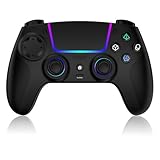
Sony DualSense
- Key Specs: Bluetooth 5.1, USB-C, built-in speaker and microphone, 1,560 mAh battery (~12 hrs), adaptive triggers, haptic feedback via voice-coil actuators, gyroscope, touchpad
- Pros: The benchmark for PS5 haptic immersion; Sony first-party support guarantees the best in-game feature integration; comfortable symmetrical grip; built-in mic eliminates need for a headset in casual play; USB-C charging
- Cons: No back buttons; 12-hour battery is the shortest of any premium controller; sticks can develop drift over time; no swappable components
- Verdict: The default choice for every PS5 player. If you are not competing at a high level, the standard DualSense delivers everything the PS5 platform was designed around.
Sony DualSense Edge
- Key Specs: Same internals as DualSense plus swappable stick modules, swappable back buttons (fn1/fn2), adjustable trigger travel locks, three profile save slots, USB-C braided cable with lock
- Pros: Only PS5 controller with Sony-certified full haptic and adaptive trigger support alongside elite customization; swappable stick modules address the drift concern of the standard DualSense; trigger travel adjustment is genuinely useful for competitive shooters
- Cons: Battery life is slightly shorter than the standard DualSense when wireless; at ~$200 it is one of the most expensive first-party controllers available; only two back buttons vs. four on competing third-party options
- Verdict: The best PS5 controller for players who want official Sony features plus competitive customization and are willing to pay the premium.
Victrix Pro BFG
- Key Specs: Wired USB-C, modular D-pad and face button modules (swap between standard and fighting-game layouts), three back buttons, two trigger locks, 3.5 mm audio jack
- Pros: Most modular PS5 controller available — swap D-pad between cross and disc layout in seconds for fighting games; three programmable back buttons is one more than the DualSense Edge; near-zero latency via wired USB connection; strong build with matte finish
- Cons: Wired only — no wireless option; does not support DualSense adaptive triggers or haptic feedback (uses standard rumble); large and heavy, which suits big-hand users but can fatigue smaller hands
- Verdict: The top choice for fighting game and competitive wired players who prioritize modular hardware over Sony’s haptic ecosystem.
Razer Wolverine V2 Pro
- Key Specs: 2.4G wireless (USB-A dongle) and Bluetooth, four remappable multi-function buttons (two face, two rear), mecha-tactile action buttons, trigger stops, ~28-hour battery (2.4G mode)
- Pros: Best wireless competitive option for PS5; four remappable buttons give a meaningful edge in multiplayer; mecha-tactile face buttons have satisfying tactile click without slowing actuation; strong 2.4G latency performance
- Cons: Does not support DualSense haptics or adaptive triggers; Razer Nexus app required for profile setup; dongle occupies a USB port; ~$200 price matches DualSense Edge without Sony’s ecosystem integration
- Verdict: Best wireless third-party PS5 controller for competitive multiplayer players who prefer Razer’s ergonomic form factor and mecha-tactile buttons.
NACON Revolution 5 Pro
- Key Specs: Wired USB-C and Bluetooth, four rear shortcut buttons, adjustable stick tension and weight system, trigger sensitivity adjustment, NACON Revolution app for PC profile management
- Pros: Adjustable stick tension is a feature found on few controllers at any price — lets you dial in stick resistance to personal preference; four rear buttons; weighted grip panels for ergonomic balance tuning; competitive price vs. DualSense Edge
- Cons: Does not support DualSense adaptive triggers or full haptics; Bluetooth mode increases latency — stick to wired for serious play; app UI is clunky compared to Razer Nexus; build quality feels slightly below Sony first-party
- Verdict: A compelling alternative to the DualSense Edge for players who want four back buttons and stick tension control without paying for Sony’s first-party premium.
Buying Guide
Do You Need DualSense Haptics and Adaptive Triggers?
If you play single-player story games on PS5 — action RPGs, adventure games, first-person titles with weapon feedback — DualSense haptics and adaptive triggers add genuine immersion that no third-party controller replicates. Games like Astro’s Playroom, Returnal, and Demon’s Souls are built around these features. The standard DualSense and DualSense Edge are the only controllers that support the full haptic and adaptive trigger feature set. Every other PS5-compatible controller uses traditional rumble motors and mechanical trigger stops instead.
Competitive vs. Casual: Feature Priority Guide
Competitive multiplayer gamers (Call of Duty, Apex Legends, FIFA) benefit most from back buttons, trigger locks, and low-latency wireless. The DualSense Edge, Razer Wolverine V2 Pro, and NACON Revolution 5 Pro all target this use case. Casual and co-op gamers get more value from the standard DualSense’s battery life, lightweight design, and Sony ecosystem integration. Fighting game players should specifically look at the Victrix Pro BFG’s swappable D-pad modules or consider a dedicated arcade stick if they play competitively.
Wireless vs. Wired on PS5
PS5 natively supports DualSense via Bluetooth with no perceptible lag for standard gameplay. The DualSense Edge also works wirelessly. Third-party options using 2.4G dongles (Razer Wolverine V2 Pro) generally perform better than Bluetooth for latency. For absolutely zero-latency competitive play, a wired USB-C connection is still the gold standard — the Victrix Pro BFG and NACON Revolution 5 Pro both default to wired operation. Note that a USB-C cable from the PS5’s front port delivers the most reliable wired experience; using a USB-A-to-C adapter through the rear ports is also supported.

Controller Longevity and Stick Drift
Stick drift remains a concern across the entire PS5 controller market in 2026. The standard DualSense has a documented history of drift appearing after 6–12 months of heavy use. Sony’s DualSense Edge addresses this with swappable stick modules — a significant long-term value proposition despite the high upfront cost. Third-party controllers with hall-effect sticks (magnetic, contactless) resist drift inherently. If you play more than 20 hours per week, prioritize either the DualSense Edge (swappable modules) or a controller with hall-effect sticks over the standard DualSense to avoid drift-related frustration.
FAQ
- What is the best PS5 controller for competitive gaming?
- For competitive gaming with full Sony ecosystem support, the DualSense Edge is the top pick — it adds back buttons, trigger locks, and swappable modules while keeping full haptic and adaptive trigger functionality. For players who prioritize four back buttons and wireless freedom over haptics, the Razer Wolverine V2 Pro is the strongest third-party alternative. Wired competitive players should look at the Victrix Pro BFG for its modular D-pad and three back buttons.
- Do third-party PS5 controllers support adaptive triggers?
- No current third-party PS5 controller supports Sony’s DualSense adaptive trigger or haptic feedback system. Sony has not licensed these technologies to third-party manufacturers. Third-party controllers use traditional rumble motors and mechanical trigger resistance adjustments. If adaptive triggers are important to your gameplay experience, you must buy a Sony DualSense or DualSense Edge.
- Is the DualSense Edge worth $200?
- For players who spend significant time on competitive titles and want the full DualSense haptic experience alongside elite customization, yes. The DualSense Edge justifies its price through swappable stick modules (addressing drift longevity), official Sony haptic support, trigger travel locks, and three profile presets. For casual players, the standard DualSense at $70 delivers far more per-dollar value. The Edge is a targeted product for a specific type of player — if that description fits you, it is worth it.
- Can I use a PS5 controller on PC?
- Yes. The Sony DualSense connects to PC via USB-C or Bluetooth and is supported natively by Steam with full haptic and adaptive trigger features in compatible titles. DS4Windows provides XInput emulation for non-Steam games. The DualSense Edge works the same way on PC. Third-party PS5 controllers vary in PC compatibility — check manufacturer documentation, as some require specific drivers or companion apps to function correctly on Windows.
- How long does the DualSense battery last?
- Sony rates the DualSense at approximately 12 hours per charge. Real-world battery life depends heavily on haptic intensity — games that use heavy haptic effects drain the battery faster. Expect 8–12 hours depending on title. The DualSense Edge has marginally shorter battery life in wireless mode due to additional hardware. Both charge via USB-C, and charging from 0% to 100% takes approximately 3 hours.
Final Verdict
For the majority of PS5 players, the Sony DualSense remains the best choice in 2026 — it delivers the full PlayStation 5 experience as designed and costs $70. It is the controller to buy first.

Serious competitors should upgrade to the DualSense Edge for official Sony haptic support plus customization, or choose the Razer Wolverine V2 Pro if four back buttons and ultra-reliable wireless matter more than haptics. The Victrix Pro BFG earns its place as the best modular wired option, especially for fighting game players. The NACON Revolution 5 Pro is the strongest value-oriented elite controller for those who want stick tension tuning and four back buttons without paying DualSense Edge prices.
Related Gaming Guides

- Best Gaming Controllers 2026 — PC, Xbox, PS5 & Switch Options Ranked
- Best PC Gaming Controllers 2026 — Wired & Wireless Options Ranked
- PlayStation DualSense Edge wireless controller PS5 PC: Complete Wireless Controller Guide for Gamers (2026)
- Wireless Controller 11: PlayStation DualSense Haptic Gaming Revolution
- Best Hall Effect Controllers 2026: No Drift, Better Precision
Related Articles
Looking for more on this topic? Browse the hand-picked guides below — each one applies the same scoring rubric used in this review.
Frequently Asked Questions
What makes the DualSense different from other controllers?
Two features are unique: haptic feedback using voice-coil actuators that reproduce fine textures rather than simple rumble, and adaptive triggers whose resistance changes to simulate a bowstring or a stiff brake. It also includes a built-in microphone, speaker, gyro and a touchpad. Supported games use these to communicate information you would otherwise miss.
Is the DualSense Edge worth double the price?
The Edge adds swappable stick modules, four back buttons, adjustable trigger stops, on-the-fly profile switching and a carrying case. That matters for competitive shooters and for anyone who has suffered stick drift, since a replacement module costs far less than a whole controller. Casual players get little benefit for the extra outlay.
Do third-party PS5 controllers support haptics and adaptive triggers?
Almost none do, because Sony does not license those technologies broadly. Third-party pads usually offer standard rumble and normal triggers, sometimes with back paddles and Hall effect sticks instead. They are a reasonable choice for fighting games or as a second pad, but you will lose immersion in titles built around DualSense feedback.
How can I prevent or fix stick drift?
Avoid resting heavy objects on the sticks, keep the controller clean, and periodically blow compressed air around the stick base. If drift starts, recalibrate in the console accessibility settings first. Long term, controllers with Hall effect or TMR sticks avoid the problem entirely, and the DualSense Edge lets you swap the module yourself.
Why is DualSense battery life so short?
Haptics, adaptive triggers, the light bar and the speaker all draw meaningful power, which is why the DualSense manages roughly 8 to 12 hours compared with 30 or more on an Xbox pad with AA batteries. Reducing controller vibration intensity and trigger effect strength in system settings extends runtime noticeably, as does dimming the light bar.