The best PC VR headsets with eye tracking for immersive gaming use cameras inside the headset to follow where the eyes are looking, and then use that gaze data to make the game sharper, smoother, and more natural. The most direct benefit is foveated rendering: the game renders the small area being looked at in full detail, while easing the detail elsewhere, which frees graphics power for a higher resolution or a steadier frame rate. Eye tracking can also drive avatar eye movement, guide lens adjustment, and support gaze-based menus in supported software.
The three headsets below all include built-in eye tracking, and all three connect to a gaming PC for PC VR play.
What to Look For
Start with how eye tracking is used. Built-in eye tracking should support foveated rendering in compatible software, automatic IPD adjustment, and gaze input where the game or application supports it. Check whether foveated rendering is dynamic, following the eyes in real time, and whether the games planned for the headset actually use it. A headset with eye tracking that no game supports will not feel different from one without it, so the software library matters as much as the hardware.
Display resolution and refresh rate come next. Eye tracking helps most at high resolution, where foveated rendering can make a real difference to performance. A resolution of 2448 x 2448 pixels per eye or higher suits eye-tracked PC VR well, while 3840 x 3840 pixels per eye gives the sharpest image here.
The PC connection decides how much of that resolution actually reaches the eyes. A direct DisplayPort connection gives an uncompressed video link with low latency, which suits high-resolution headsets best. A USB-C connection or wireless streaming gives more freedom of movement, but the image is compressed, which can soften fine detail.
Best PC VR Headsets With Eye Tracking for Immersive Gaming
1. Pimax Crystal Super VR Headset, Ultrawide, Full Payment Version

The Pimax Crystal Super in its Ultrawide configuration is the most capable eye-tracking headset in this guide for PC VR. It uses Tobii eye tracking at 120 Hz, with Dynamic Foveated Rendering 2.0, automatic IPD adjustment from 58 to 72 mm, and a display at 3840 x 3840 pixels per eye. The Ultrawide optical engine gives a 140-degree horizontal field of view, while swappable engines at 127 degrees and 106 degrees trade width for pixels per degree. QLED panels with mini-LED local dimming keep the image bright and detailed, with a refresh rate of 72 or 90 Hz.
The Crystal Super is a PC VR headset that connects over DisplayPort 1.4 and USB, with inside-out SLAM tracking from four cameras and optional Lighthouse tracking through a separate faceplate. It works with SteamVR and OpenXR software, and Pimax lists a strong PC as a requirement, starting at a high-end graphics card and 32 GB of system memory for the best experience. The listed configuration includes controllers, a DisplayPort cable, and DMAS earphones.
This headset suits a flight or racing simulation gamer who wants the highest resolution here, the widest view, and eye-tracked foveated rendering to help drive that resolution. Confirm the exact optical engine in the listing, because the field of view depends on which engine is fitted.
2. HTC Vive Focus Vision — Mixed Reality and PC VR Headset + Controllers — Consumer Edition

The HTC Vive Focus Vision pairs built-in eye tracking with a sharp display and a flexible PC connection. It uses dual LCD panels at 2448 x 2448 pixels per eye, with a field of view up to 120 degrees and a 90 Hz refresh rate, rising to 120 Hz in DisplayPort mode. Eye tracking supports gaze input, avatar eye control, and foveated rendering in supported software, and automatic IPD adjustment from 57 to 72 mm aligns the lenses to each wearer without manual dials.
A Snapdragon XR2 Gen 1 processor works with 12 GB of memory and 128 GB of storage, expandable with a microSD card up to 2 TB, so the headset can run games on its own as well as stream PC VR titles. Two full-color passthrough cameras and a depth sensor support mixed reality, while four tracking cameras and an infrared floodlight support hand tracking in low light. The headset connects to a PC wirelessly, over USB-C, or over DisplayPort through the optional VIVE Wired Streaming Kit, which gives a direct video link for the clearest PC VR image.
This headset suits a gamer who wants eye tracking, a very sharp display, and the choice between standalone play and a direct DisplayPort PC connection, with a swappable battery for longer sessions.
3. Meta Quest Pro
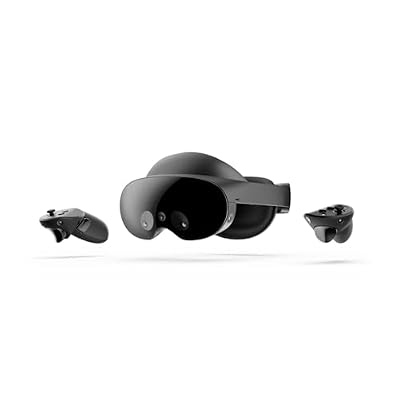
The Meta Quest Pro brings eye tracking and face tracking to a slim standalone headset that also works as a PC VR device. It uses dual LCD panels with a quantum dot layer and mini-LED backlighting, at 1800 x 1920 pixels per eye, with pancake lenses and a 90 Hz refresh rate. The field of view is 106 degrees, and the lenses adjust continuously for interpupillary distance from 55 to 75 mm, with eye tracking to guide the setting.
Inside, a Snapdragon XR2+ Gen 1 processor works with 12 GB of memory and 256 GB of storage. Eye tracking and face tracking are built in, and the Touch Pro controllers track themselves with built-in cameras, so they keep working even when they move out of the headset cameras view. Eye-tracked foveated rendering is supported in compatible software, and full-color passthrough supports mixed reality games. The Quest Pro connects to a PC for PC VR play over a cable or wirelessly, so it can run standalone games on its own and PC VR titles from a gaming PC.
This headset suits a gamer who wants eye and face tracking, self-tracking controllers, and a slim pancake-lens design, with mixed reality and social play as part of the mix. Check the exact listing, the included controllers, and the condition before ordering.
| Headset | Resolution per eye | Refresh rate | Field of view | Eye tracking | PC connection |
|---|---|---|---|---|---|
| Pimax Crystal Super, Ultrawide | 3840 x 3840 | 72 or 90 Hz | 140° horizontal | Tobii, 120 Hz | DisplayPort 1.4 |
| HTC Vive Focus Vision | 2448 x 2448 | 90 Hz, 120 Hz via DisplayPort | Up to 120° | Built in | DisplayPort, USB-C, wireless |
| Meta Quest Pro | 1800 x 1920 | 90 Hz | 106° | Built in, plus face tracking | Cable, wireless |
FAQ
What does eye tracking do in a PC VR game?
Eye tracking follows where the eyes are looking, and games can use that data in several ways. The most common is foveated rendering, which keeps the looked-at area sharp while easing detail elsewhere, freeing graphics power.
Does eye tracking work in every PC VR game?
No. Eye tracking only helps when the game, the runtime, or the headset software supports it. Foveated rendering needs support from the game engine or the VR runtime, and avatar eye movement needs support from the social or multiplayer software.
Is a DisplayPort connection better for eye-tracked PC VR?
Yes, for high-resolution headsets. DisplayPort gives a direct, uncompressed video link from the PC to the headset, which keeps fine detail sharp and latency low. Wireless streaming compresses the image, which can soften the detail that foveated rendering is trying to preserve. A headset that supports both gives the choice between image quality and freedom of movement.
Conclusion
Eye tracking is most valuable in PC VR when it is paired with a high-resolution display and a direct PC connection, because that is where foveated rendering can make the biggest difference. The Pimax Crystal Super leads on resolution, field of view, and eye-tracking speed,
Disclosure: As an Amazon Associate, we earn from qualifying purchases.