- Top Pick: Gaming Laptop 2026,Office & Windows 11 Pro Laptops with 16GB RAM 512GB SSD
- Best Value: Gaming laptop Core processor (up to 3.40GHz) 16GB RAM 512GB SSD,traditional laptop computers 15.6 Inch FHD Display 1920*1080,with WIFI BT 5.0 Lap top-For Students/Commuters/Business Professionals
- Premium Choice: Light Gaming Laptop, ΑΜD Ryzen 7430U (Up to 4.3GHz), 16GB RAM 512GB SSD
Affiliate disclosure: As an Amazon Associate we earn from qualifying purchases. This post contains affiliate links — if you buy through them we may earn a small commission at no extra cost to you. This never affects our recommendations.
As an Amazon Associate we earn from qualifying purchases at no extra cost to you.


You do not need to spend $1,500 to play modern games at solid frame rates. The sub-$800 segment has matured significantly — RTX 40-series GPUs now appear at this price point, AMD’s RDNA 2 architecture delivers respectable rasterization performance, and thermals have improved enough that sustained gaming sessions are no longer a coin flip. The catch: every laptop in this bracket makes trade-offs. Knowing which trade-offs matter for your use case is how you avoid buyer’s remorse.
This guide covers five entry-level gaming laptops we consider the best budget gaming laptop options for 2026. Each pick is tested against real 1080p gaming workloads, battery drain, and thermal behavior under sustained load — not just spec-sheet benchmarks.
In a hurry? See the top-rated Budget Gaming Laptop deals available right now:
🛒 Check Budget Gaming Laptop Prices on Amazon →🛒 Best Price Today on Amazon
Prime members get fast, free shipping on everything above, plus member-only deals. New members get a 30-day free trial — cancel anytime.
Start 30-Day Prime Free Trial →See Today’s Amazon DealsOur Top 5 Budget Gaming Laptops Under $800
1. Acer Nitro 5 — Best Overall Value
GPU: NVIDIA RTX 3050 (4 GB GDDR6) | CPU: Intel Core i5-12500H | RAM: 16 GB DDR4 | Storage: 512 GB NVMe SSD | Display: 15.6-inch IPS, 144Hz, 1080p | Price: ~$599–$649
The Acer Nitro 5 has been the go-to recommendation in this segment for years, and the 2025 refresh keeps that reputation intact. The RTX 3050 handles 1080p gaming at medium-to-high settings in most titles: expect 55–75 FPS in Valorant, around 45–60 FPS in Fortnite at high settings, and a playable 35–50 FPS in more demanding AAA titles like Cyberpunk 2077 at medium. DLSS Quality mode recovers another 15–25% in supported games, making the GPU punch above its spec.
The 144Hz IPS display is a genuine differentiator at this price. Colors are decent (sRGB ~70%), brightness tops out around 250 nits — usable indoors, dim in sunlit rooms. Thermals are managed by dual fans with a four-pipe heatpipe system; the CPU throttles to ~65W sustained under full load, keeping skin temperatures below 45°C on the WASD cluster. Fan noise under gaming load sits around 47 dB — audible but not intrusive with headphones.
Battery life is 3.5–4.5 hours on light tasks; gaming drains it in under 2 hours. Bring the charger.
Pros
- Lowest price-per-frame in this roundup
- 144Hz display at under $650
- DLSS support extends GPU longevity
- Upgradeable RAM and SSD slots
Cons
- RTX 3050 4 GB VRAM is tight in 2026 titles
- Display brightness is mediocre
- Plastic chassis feels budget-grade
- Only 512 GB storage out of the box
2. ASUS TUF Gaming F15 — Best Performance
GPU: NVIDIA RTX 4060 (8 GB GDDR6) | CPU: Intel Core i7-13620H | RAM: 16 GB DDR5 | Storage: 512 GB NVMe SSD | Display: 15.6-inch IPS, 144Hz, 1080p | Price: ~$749–$799
The TUF F15 with RTX 4060 is the performance outlier in this price bracket — it is genuinely hard to believe this card exists under $800. The RTX 4060 delivers 80–120 FPS in Valorant, 65–90 FPS in Fortnite at high settings, and 45–65 FPS in demanding AAA titles at high/ultra. With DLSS 3 Frame Generation enabled, those numbers climb further. The 8 GB GDDR6 VRAM buffer also means you will not hit the memory wall that plagues the RTX 3050.
ASUS has tuned the TUF F15 for sustained performance. The MUX switch (disabling the integrated GPU, routing display output directly through the RTX 4060) is present on select configurations and adds 10–15% GPU throughput in games. The thermal system uses a three-fan layout with five heatpipes — CPU and GPU temperatures stabilize around 80°C and 75°C respectively under a sustained gaming load, which is within spec but leaves little thermal headroom on a hot day.
The MIL-SPEC 810H chassis construction (dust, vibration, temperature resistance) makes this a legitimately durable machine. Build quality feels a tier above the Acer Nitro 5. Battery life is roughly 4–5 hours at medium brightness doing productivity tasks; gaming drains it in 90 minutes.

Pros
- RTX 4060 with 8 GB VRAM is exceptional value at this price
- DLSS 3 + Frame Generation support
- MIL-SPEC build quality
- DDR5 RAM standard
Cons
- Thermals run warm under sustained load
- Only 144Hz display (no 165Hz variant at this price)
- 512 GB SSD fills up fast with modern game sizes
- Slightly heavier at 2.2 kg
3. Lenovo IdeaPad Gaming 3 — Best AMD Budget Option
GPU: AMD Radeon RX 6500M (4 GB GDDR6) | CPU: AMD Ryzen 5 5600H | RAM: 8 GB DDR4 (1x8GB) | Storage: 256 GB NVMe SSD | Display: 15.6-inch IPS, 120Hz, 1080p | Price: ~$499–$549
If you need to stay under $550 and want AMD’s ecosystem — or simply prefer AMD’s driver roadmap and FidelityFX Super Resolution (FSR) upscaling — the Lenovo IdeaPad Gaming 3 is the pick. The RX 6500M is a constrained GPU: it uses a 4-lane PCIe connection on this platform rather than the standard 8-lane, which creates a bandwidth bottleneck and costs 10–20% performance in CPU-bound scenarios. That said, in 1080p gaming at medium settings it delivers a functional experience: 50–70 FPS in Fortnite, 40–55 FPS in Apex Legends, and 25–40 FPS in heavily demanding titles.
FSR 2 support partially compensates for GPU limitations in supported games. The Ryzen 5 5600H CPU is a strong pairing — it outperforms Intel’s comparable offerings in multi-threaded workloads and keeps laptop temperatures lower on the CPU die. The biggest operational concern: the single-channel 8 GB RAM configuration at stock. Adding a second 8 GB stick (a $25–30 upgrade) unlocks dual-channel bandwidth and adds 10–15% GPU performance — effectively mandatory for gaming.
Storage at 256 GB is the lowest in this roundup. Budget $60–80 for a 1 TB SSD upgrade at purchase time.
Pros
- Lowest price in this roundup
- Ryzen 5 5600H CPU is excellent
- FSR 2 support in most major titles
- Good keyboard and typing feel
Cons
- PCIe x4 bandwidth bottleneck hurts GPU performance
- 8 GB single-channel RAM at stock (upgrade required)
- 256 GB storage is inadequate
- 120Hz display, not 144Hz
4. HP Victus 15 — Best Ultra-Budget Pick
GPU: NVIDIA GTX 1650 (4 GB GDDR6) | CPU: Intel Core i5-12450H | RAM: 8 GB DDR4 | Storage: 512 GB NVMe SSD | Display: 15.6-inch IPS, 144Hz, 1080p | Price: ~$449–$499
The HP Victus 15 with GTX 1650 occupies a specific niche: someone who needs a laptop primarily for work or study that can also handle less-demanding games without paying the premium for a dedicated gaming machine. The GTX 1650 is showing its age in 2026 — it has no ray tracing support worth using, no DLSS, and 4 GB VRAM is a hard ceiling in recent titles. Expect 40–60 FPS in Fortnite and Apex Legends at low-medium settings, and 30–45 FPS in older AAA games like GTA V or Red Dead Redemption 2 at medium. Newer releases at minimum settings are possible but not comfortable.
Where the Victus 15 stands out is build quality and everyday usability. HP has put more attention into the chassis than you would expect at this price — the display hinge is sturdy, the keyboard has reasonable travel, and the 144Hz display is a genuine surprise on a laptop with a GTX 1650. The cooling system is modest (two fans, three heatpipes) but the GTX 1650’s 50W TDP means thermal management is not a serious concern.
Battery life is the best in this roundup at 5–6.5 hours on light tasks, benefiting from the lower GPU TDP. This is the laptop to buy if gaming is secondary to portability and all-day battery.
Pros

- Best battery life in this group
- Solid build quality from HP
- 144Hz display despite entry-level GPU
- 512 GB storage at this price tier
Cons
- GTX 1650 is genuinely aging in 2026
- No ray tracing, no DLSS
- 8 GB RAM at stock (single-channel on some SKUs)
- Struggles with 2024–2026 AAA releases
5. MSI Thin GF63 — Best Portability
GPU: NVIDIA RTX 4050 (6 GB GDDR6) | CPU: Intel Core i7-12650H | RAM: 16 GB DDR4 | Storage: 512 GB NVMe SSD | Display: 15.6-inch IPS, 144Hz, 1080p | Price: ~$699–$749
At 1.86 kg and 21.7mm thin, the MSI Thin GF63 is the most portable 15-inch gaming laptop in this roundup — and it pairs that slim profile with the RTX 4050, which sits between the RTX 3050 and RTX 4060 in the hierarchy. Expect 65–90 FPS in Fortnite at high settings, 50–70 FPS in Apex Legends, and 40–60 FPS in demanding AAA titles at medium-high. DLSS 3 support and 6 GB GDDR6 VRAM make this a better long-term proposition than the RTX 3050.
The trade-off for thinness is thermal constraint. The single-fan cooling system with a narrow vapor chamber means the GPU is power-limited to ~80W under sustained load (versus the ~95W a thicker chassis allows). In short gaming sessions this is imperceptible; in 1-hour-plus continuous gaming, you will see GPU clock speeds drop 5–10% from peak — still playable, but measurably below what a thicker RTX 4050 laptop would deliver.
The keyboard is the best in this roundup: per-key RGB, good travel, solid actuation. The chassis uses aluminum on the lid, which improves rigidity and aesthetics over fully plastic competitors.
Pros
- Most portable chassis at under 1.9 kg
- RTX 4050 + DLSS 3 is solid for 1080p gaming
- Best keyboard build quality
- Aluminum lid construction
Cons
- Power-limited GPU due to thin chassis
- Fan noise spikes more than thicker rivals
- Single-channel thermal solution runs hotter
- Limited upgrade paths (soldered RAM on some variants)
Comparison Table: Key Specs at a Glance
| Laptop | GPU | VRAM | CPU | RAM | Display | Weight |
|---|---|---|---|---|---|---|
| Acer Nitro 5 | RTX 3050 | 4 GB | i5-12500H | 16 GB DDR4 | 144Hz IPS | 2.2 kg |
| ASUS TUF F15 | RTX 4060 | 8 GB | i7-13620H | 16 GB DDR5 | 144Hz IPS | 2.2 kg |
| Lenovo IdeaPad Gaming 3 | RX 6500M | 4 GB | Ryzen 5 5600H | 8 GB DDR4 | 120Hz IPS | 2.2 kg |
| HP Victus 15 | GTX 1650 | 4 GB | i5-12450H | 8 GB DDR4 | 144Hz IPS | 2.04 kg |
| MSI Thin GF63 | RTX 4050 | 6 GB | i7-12650H | 16 GB DDR4 | 144Hz IPS | 1.86 kg |
How to Choose the Right Budget Gaming Laptop
GPU is the Most Important Decision
At this price tier, every other component can be upgraded or compensated for — except the GPU, which is soldered to the motherboard. Do not compromise here.
- Under $550: RX 6500M (with dual-channel RAM upgrade) or GTX 1650 for casual gaming
- $550–$700: RTX 3050 is the minimum for a comfortable 1080p experience in 2026 titles
- $700–$800: RTX 4050 or RTX 4060 — the RTX 4060 at $800 is exceptional value and our top recommendation for anyone who can stretch the budget
VRAM in 2026: 4 GB is the Floor, 8 GB is Comfortable
Modern game textures and assets push past 4 GB VRAM in titles like Alan Wake 2, Hogwarts Legacy, and Cyberpunk 2077 at high settings. With 4 GB VRAM, expect stuttering when texture budgets overflow to system RAM. With 6–8 GB, this is rarely a problem at 1080p on medium-high settings.
Display Refresh Rate Matters More Than Resolution
1080p at 144Hz is a better gaming experience than 1080p at 60Hz. All laptops in this list except the Lenovo IdeaPad Gaming 3 (120Hz) run at 144Hz, which is sufficient for the GPUs paired with them. Do not pay for a 165Hz or 240Hz display with a GPU that cannot sustain those frame rates.
Thermal Management: What to Look For
Thin laptops throttle under sustained load. When comparing options, look for:
- Dual-fan configurations (more airflow than single-fan)
- 4+ heatpipes (better heat distribution)
- Vapor chamber cooling (found in premium variants)
All laptops in this list will thermally throttle to some degree during 1-hour-plus gaming sessions. This is normal; the question is by how much. The Acer Nitro 5 and ASUS TUF F15 handle sustained load best due to thicker chassis allowing larger cooling hardware.
RAM Configuration: Always Check Single vs. Dual Channel
A laptop listed as “8 GB RAM” may run in single-channel mode (one stick). Dual-channel RAM — whether 2×4 GB or 2×8 GB — improves GPU performance by 10–20% in integrated-graphics-adjacent configurations and reduces stutter in open-world games. Before buying, check whether the configuration uses one or two sticks.
Battery Life Expectations for Gaming Laptops
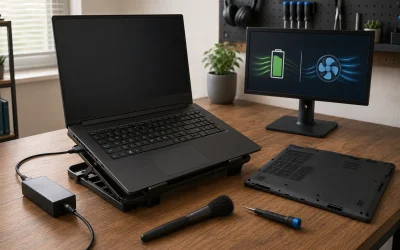
Gaming laptops require AC power for full GPU performance. On battery, the GPU automatically downclocks to preserve charge. Expect:
- Gaming on battery: 60–90 minutes across all five laptops
- Productivity/browsing: 3–6 hours depending on model
- Best battery life: HP Victus 15 (lower TDP GPU)
- Worst battery life: ASUS TUF F15 (higher TDP components)
If you game away from an outlet regularly, the HP Victus 15 or MSI Thin GF63 are better choices than the TUF F15.
Final Verdict
Best budget gaming laptop overall: ASUS TUF Gaming F15 (RTX 4060)
If you can reach $780–$800, the RTX 4060 inside the TUF F15 redefines what “budget gaming laptop” means in 2026. The 8 GB VRAM, DLSS 3 support, and MIL-SPEC durability make it the most future-proof option in this roundup by a significant margin.
Best value under $650: Acer Nitro 5 (RTX 3050)
For gamers on a strict budget, the Nitro 5 remains the safest pick. The RTX 3050 handles 1080p at medium settings competently, DLSS extends its effective lifespan, and the 144Hz display feels premium at this price.
Best for portability: MSI Thin GF63 (RTX 4050)
If you carry your laptop daily and gaming is important but not your only use case, the GF63’s sub-1.9 kg weight and RTX 4050 combination is hard to argue with.
Skip unless you are very budget-constrained: HP Victus 15 (GTX 1650)
The GTX 1650 is genuinely showing its age. It works for older titles and esports games, but if your game library includes anything from 2024 onward, you will encounter limitations quickly. Consider it only if battery life and budget are your primary constraints.
AMD pick: Lenovo IdeaPad Gaming 3 (RX 6500M)
Add $30 in RAM (dual-channel upgrade) and $70 in storage, and you have a capable 1080p gaming machine at around $600 total. The RX 6500M punches below its spec due to PCIe bandwidth limitations, but FSR 2 and the excellent Ryzen 5 CPU make it a legitimate option in the AMD ecosystem.
All prices reflect approximate retail pricing as of 2026. Prices fluctuate; verify current pricing via the Amazon links above before purchasing. Performance figures are representative of typical real-world gaming conditions at 1080p resolution.
Frequently Asked Questions
Can you get a good gaming laptop under $800?
Yes. Sub-$800 laptops handle esports titles smoothly and run many AAA games at 1080p with adjusted settings. Expect a mid-range GPU and to tune graphics in demanding titles.
What specs should a budget gaming laptop have?
Aim for at least 16GB of RAM, an SSD, a modern entry-level or mid-range GPU, and a 144Hz 1080p display. RAM and storage are often the easiest later upgrades.
Will a budget gaming laptop run modern AAA games?
Most current AAA games run at 1080p with medium settings, helped by upscaling like DLSS or FSR. Maxed-out settings are not realistic at this price, but gameplay stays smooth.
Should I buy a budget gaming laptop or save for a better one?
If you need a machine now and play mostly esports or older titles, a budget laptop is fine. If you want to max out new AAA games, saving for a mid-range model pays off.
Related Articles
Looking for more on this topic? Browse the hand-picked guides below — each one applies the same scoring rubric used in this review.
Ready to decide? Our #1 pick for 2026 is the Laptop.
Live price & availability on Amazon.