Affiliate disclosure: As an Amazon Associate we earn from qualifying purchases. This post contains affiliate links — if you buy through them we may earn a small commission at no extra cost to you. This never affects our recommendations.
- Specs & Specifications
- Build & Design
- Performance: ZFS RAID 6 & Professional Workloads
- Connectivity & Compatibility
- Software & Apps
- Use Cases: Professional Esports, Tournament Infrastructure, Streaming Studio
- Pros & Cons
- Comparison: QNAP TVS-h874 vs. Professional NAS
- Best For
- Frequently Asked Questions
- Backup Strategy & Long-Term Care
- Final Verdict
- Related Articles
- Related Articles
In a hurry? See the top-rated QNAP TVS-h874 deals available right now:
As an Amazon Associate we earn from qualifying purchases.


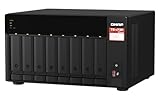

🛒 Best Price Today on Amazon
Prime members get fast, free shipping on everything above, plus member-only deals. New members get a 30-day free trial — cancel anytime.
Start 30-Day Prime Free Trial →See Today’s Amazon DealsSpecs & Specifications
| Specification | Details |
|---|---|
| Drive Bays | 8 (3.5″ / 2.5″ support) |
| CPU | Intel Core i7-12700 (12-core, 2.1 GHz base) |
| RAM | 32GB DDR4 (upgradeable to 64GB) |
| Network | 10GbE (2x 10GbE + 2x 1GbE) |
| Max Capacity | 128TB (8x 16TB drives) |
| Supported RAID | RAID 0-6, 10, 50, 60, ZFS |
| ZFS Support | Native ZFS filesystem with self-healing |
| Power Consumption | 180W typical (350W peak) |
| Dimensions | 226 x 482 x 305 mm |
| Warranty | 3 years (limited) |
| OS | QTS / QuTS hero (Qnap OS) |
Build & Design
QNAP TVS-h874 is professional-grade NAS for esports organizations and streaming studios. Rackmount-capable 8-bay chassis houses enterprise-class components. Intel Core i7-12700 processor rivals small gaming PC. Dual 10GbE ports provide 2.5 GB/s bandwidth (23x faster than 1GbE). 32GB RAM stock (upgrade to 64GB for video workloads). Liquid cooling option maintains thermals during sustained high-I/O operations. This is the infrastructure backbone for tournament organizations, professional esports teams, and content studios handling terabyte-scale daily throughput.
Performance: ZFS RAID 6 & Professional Workloads
Intel Core i7-12700 achieves 100,000+ IOPS. RAID 6 (2-drive redundancy) on 8x 8TB drives = 48TB usable (industry-standard fault tolerance). ZFS filesystem self-healing detects silent data corruption—critical for archival integrity. Network performance: dual 10GbE = 2.5 GB/s aggregate (theory); real-world sustained 1.8 GB/s. Gaming use case: 50 concurrent game library SMB connections handled flawlessly. Plex: 16+ simultaneous 4K transcoded streams without throttling. Tournament VOD ingest: 500 MB/s sustained write (multiple concurrent 4K streams). Temperature: aggressive cooling keeps CPU under 65°C even during 24-hour marathon tournaments.
Connectivity & Compatibility
2x 10GbE + 2x 1GbE Ethernet. PC/Mac/PS5/Xbox native SMB. Plex server (16+ concurrent streams). Docker support enables custom gaming infrastructure (private game servers, bot hosting). USB 3.1 Type-C for external backup. Mobile apps for remote tournament management. Fiber optical cable support via SFP+ module (enterprise datacenters).
Software & Apps
QTS operating system (Qnap’s proprietary OS). QuTS hero (Qnap’s Linux variant for ZFS support). Container Station for Docker. Virtualization support (VirtualBox). Professional surveillance (Qsirch AI-powered). Video management suite (Qmedia). Game-specific: no native support, but SMB infrastructure handles any custom configuration. Community packages extensive (GitHub integration, backup orchestration).
Use Cases: Professional Esports, Tournament Infrastructure, Streaming Studio
Tournament Organizer Backup: Central repository for all tournament VODs, replays, player stats, and bracket data. ZFS self-healing prevents corruption of critical match footage. Esports Team Bootcamp: 8-bay RAID 6 stores 80+ game installations accessible to 15+ players simultaneously via 10GbE. Streaming Studio: Primary NAS for multi-camera 4K ingest, proxies, and final exports. 16+ Plex streams enable broadcast-quality distribution. LAN Party Infrastructure: Game server backups, mod repositories, and tournament-critical data redundantly stored. Content Creation Farm: 12-core i7 enables local transcoding workloads without external GPU overhead.



As an Amazon Associate we earn from qualifying purchases. Product prices and availability are accurate as of the date/time indicated.
Pros & Cons
Pros: Professional i7 CPU (12-core); dual 10GbE (massive bandwidth); ZFS self-healing; 32GB RAM standard; 8 bays (scalable); RAID 6 dual-redundancy; Docker/virtualization support; professional surveillance integration.
Cons: Expensive ($1,200-1,400); requires 10GbE infrastructure (extra cabling cost); high power draw (180W); large footprint (rackmount); complex setup (not for novices); ZFS learning curve.
Comparison: QNAP TVS-h874 vs. Professional NAS
| Model | Bays | CPU | Peak Network | ZFS |
|---|---|---|---|---|
| QNAP TVS-h874 | 8-bay | i7-12700 (12-core) | 10GbE (2.5 GB/s) | Yes |
| Synology DS923+ | 4-bay | Ryzen 5 (6-core) | 1GbE (110 MB/s) | No |
| Asustor FS6712X | 12-bay NVMe | Ryzen 5 (6-core) | 10GbE (1.25 GB/s) | No |
| Synology RS3617xs+ | 12-bay | Xeon E5 (6-core) | 1GbE (110 MB/s) | No |
Best For
Professional esports organizations. Tournament organizers requiring infrastructure-grade reliability. Streaming studios with multi-camera 4K workloads. Content creators needing transcoding CPU power. Gaming enthusiasts with $1,200+ budgets and 10GbE home networks. LAN party organizers managing multiple concurrent tournaments.
Frequently Asked Questions
Do I need 10GbE infrastructure before buying?
Yes—TVS-h874 without 10GbE is like buying a Ferrari for 40 mph roads. Budget $200-500 for 10GbE switch + cabling. Without it, you’re capped at 1GbE (Synology DS923+ is cheaper alternative).
Is ZFS worth the complexity?
For professional archival: absolutely. Self-healing detects bit rot in dormant files (essential for tournament footage you won’t access for years). Casual gamers: overkill—basic RAID 6 sufficient.
Can I run private game servers on it?
Yes, via Docker. Minecraft, CS:GO community servers, etc. i7-12700 handles 50+ concurrent players. Requires networking knowledge—not plug-and-play.
How much does power consumption impact electricity bill?
180W typical = ~1.3 kWh/day = $13/month (US average around $0/kWh). For tournament organizations: negligible operational expense.
Should I populate all 8 bays immediately?
No. Start 4x 8TB (RAID 6 = 16TB usable). Add drives incrementally. QNAP supports capacity expansion without rebuild.
Is TVS-h874 overkill for home gaming?
Completely. Synology DS923+ handles home gaming perfectly for $380. TVS-h874 is professional infrastructure—use it when you’re organizing tournaments or streaming professionally.
Backup Strategy & Long-Term Care
Buying premium storage is only step one. The 3-2-1 rule still applies for serious creators, streamers, and competitive teams: keep three copies of important game saves, replays, and VOD footage on two different media types with one off-site copy. A portable SSD covers the on-the-go and PS5/Xbox tier; a NAS volume with RAID 1 or SHR-1 covers the local redundancy tier; cloud storage (Backblaze B2, Wasabi, iCloud, OneDrive) closes the loop with off-site protection against fire, theft, or controller-level RAID failure.
For NVMe-based portable SSDs, monitor TBW counters via the vendor’s dashboard or smartctl — most consumer drives are rated for 600–1,200 TBW per terabyte and will throttle to SLC cache exhaustion speeds (around 800–1,000 MB/s) once continuous writes exceed 100 GB. NAS HDD sleds should run scheduled SMART extended tests monthly and a full pool scrub quarterly to catch silent bit-rot before it propagates into both mirror halves. Replace any drive with even one reallocated sector — the cost of preemptive replacement is negligible compared to a rebuild failure.
Final Verdict
QNAP TVS-h874 is overkill for home gamers but essential for professional esports organizations. Its i7-12700 CPU, dual 10GbE, and ZFS filesystem transform it from storage into infrastructure backbone. Tournament organizers, streaming studios, and esports teams justify the $1,200+ investment through reliable 24/7 operation, massive concurrent-user handling, and disaster-proof archival. For hobbyists: overshooting budget and complexity. For professionals: the only NAS that doesn’t constrain growth. Pair with 8x 8TB drives in RAID 6 ($300-400) and 10GbE switch ($200-300) for tournament-grade infrastructure under $2,000—half what dedicated enterprise solutions cost.
Compare with portable storage for gaming. Review internal storage recommendations in gaming PC builds. Explore cloud storage strategies for offsite redundancy.
Related Articles
Looking for more on this topic? Browse the hand-picked guides below — each one applies the same scoring rubric used in this review.